By the end you can
- Review the complete Module 02 topic list
- Apply concepts to diagrams and unfamiliar examples
- Practice a full assessment and review missed answers

Module 02: Life's Origins
By the end you can
Open the Life's Origins practice exam: 25 questions per attempt from a 74-question bank. Submit when you finish to see your score and answer explanations. A new attempt gives a different mix.
For a topic-by-topic check, use this review's quiz. Each lesson also has flashcards, a quiz, and a short Explain-it.
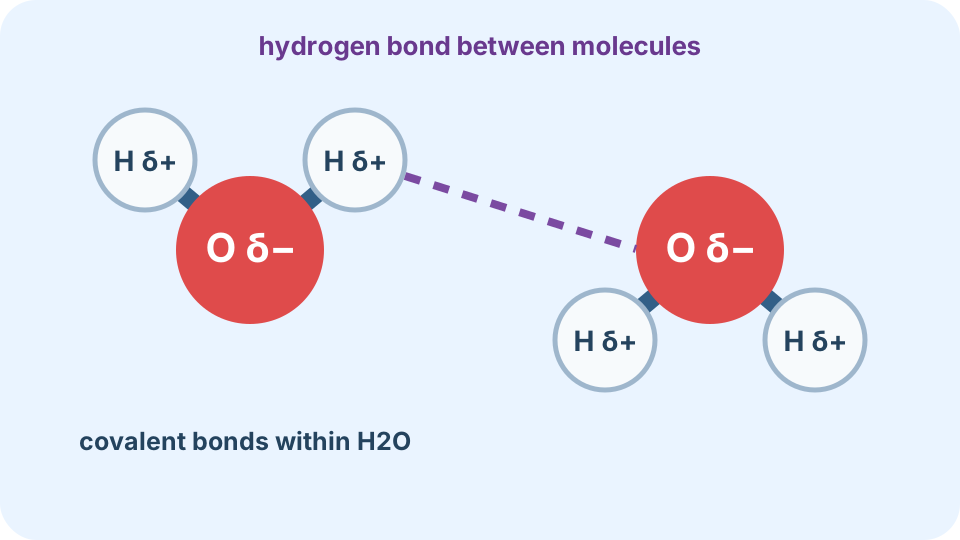
Review 02.01 Properties of Water. Explain ionic, covalent, and hydrogen bonding; polarity; cohesion, adhesion, surface tension and capillary action; dissolving substances; high specific heat and heat of vaporization; ice density; and pH. Connect each property to its cause and a biological example.
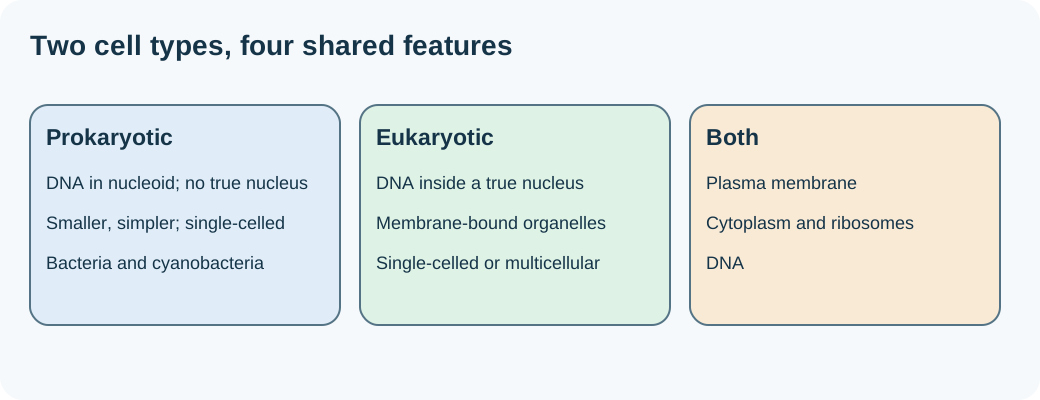
Open the 02.02 review. Cells are the basic units of life. Their structures distinguish cell types, and the microscope you choose determines which details you can see.
Check these topics: What is made of cells?; The three parts of cell theory; Scientists who built the evidence; Prokaryotes and eukaryotes; What both cell types share; The bacterial model; Magnification and resolution; Dissecting and compound light microscopes; TEM and SEM; Practice the virtual microscopy task.
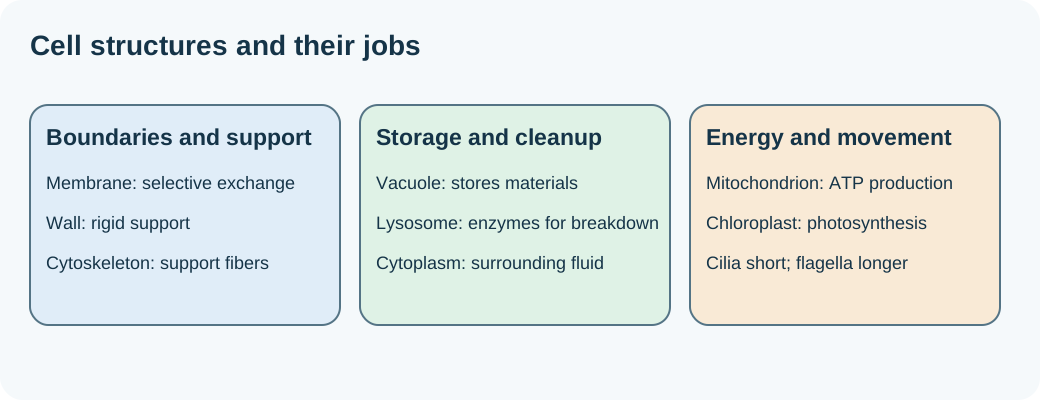
Open the 02.03 review. Every cell structure has a job. Connect what a structure looks like, what it does, and how it works with other structures.
Check these topics: Plant and animal cells; Nucleus, nucleolus, and nuclear envelope; DNA, chromatin, and chromosomes; Ribosomes and rough ER; Smooth ER, Golgi, and vesicles; Mitochondria and chloroplasts; Storage, digestion, and fluid; Boundaries and support; Cilia and flagella; Use the course's farm analogy.
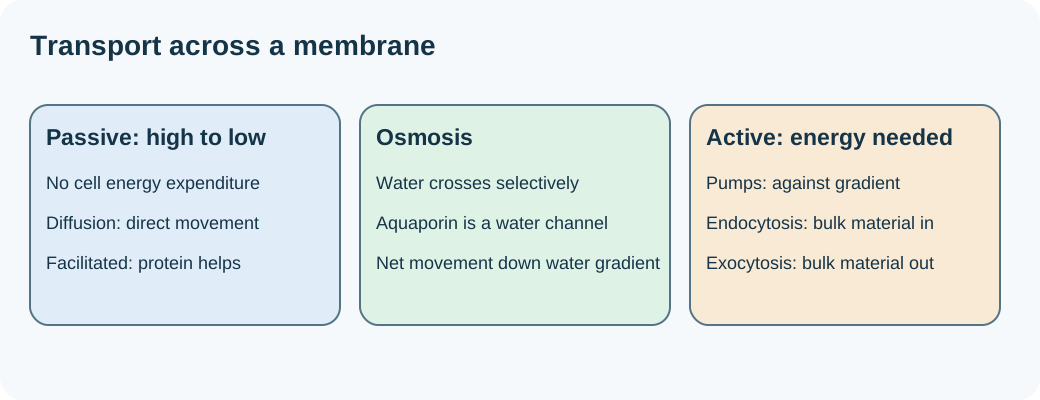
Open the 02.04 review. A selectively permeable membrane regulates exchange. Predict movement by checking what can cross, the concentration difference, and whether cell energy is needed.
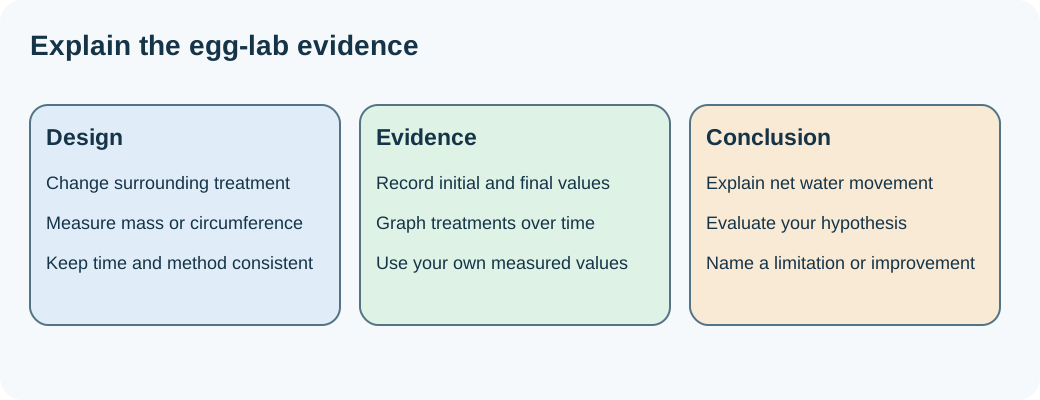
Check these topics: A selectively permeable boundary; The phospholipid bilayer; Diffusion and equilibrium; Facilitated diffusion; Osmosis; Hypotonic, hypertonic, isotonic; Active transport and protein pumps; Endocytosis and exocytosis; Apply the idea to the egg lab; Variables, graphs, and conclusions; Practice a dialysis-bag prediction.
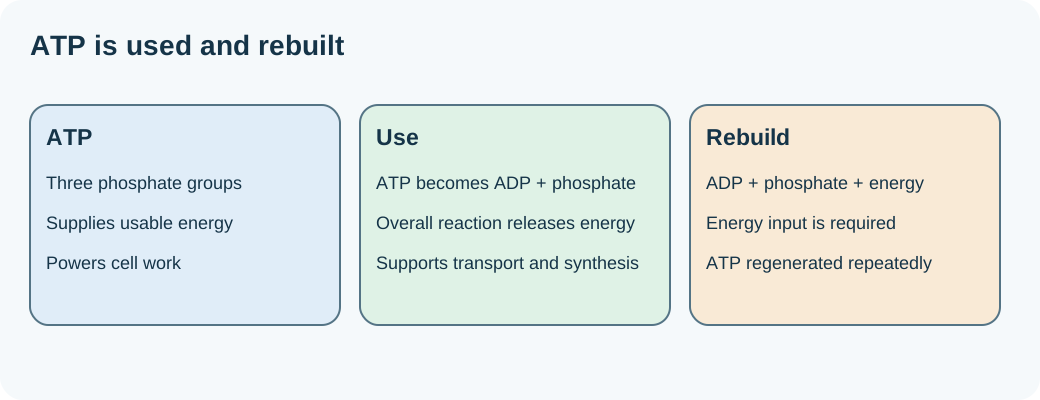
Open the 02.05 review. Food supplies chemical energy. Cells transfer some of it into ATP, use ATP for immediate work, and regenerate ATP from ADP.
Check these topics: Why cells need energy; The structure of ATP; Releasing usable energy; Regenerating ATP; Short-term and long-term storage; The rechargeable-battery analogy.
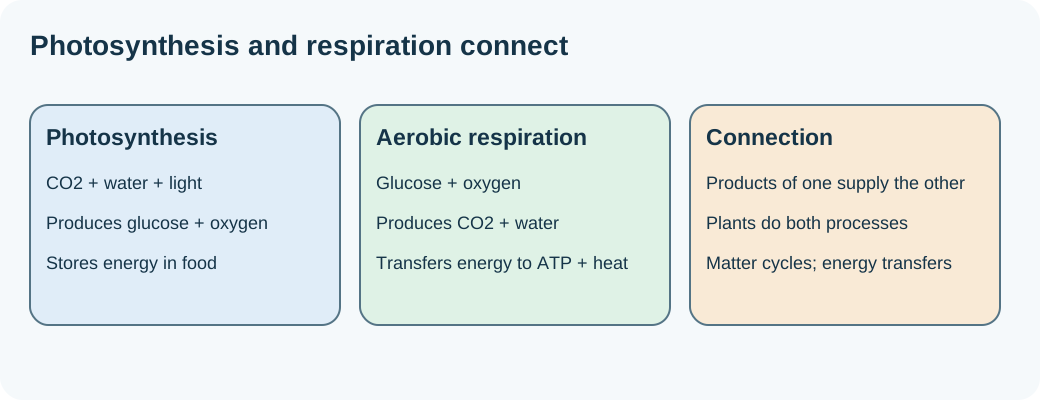
Open the 02.06 review. Photosynthesis captures light energy in glucose. Cellular respiration transfers food energy into ATP. Their overall reactants and products connect.
Check these topics: Photosynthesis: inputs and outputs; The plant structures involved; Matter and energy are conserved; Respiration: inputs and outputs; Where respiration happens; With oxygen and without oxygen; Two kinds of fermentation; How the processes connect; Apply it to a plant, a seed, and an aquarium.
For a cell picture, identify a visible structure and connect it to a function. For an osmosis problem, state the membrane rule, compare solute concentrations, then predict water direction and size change. For an energy question, name inputs, outputs, location, and the energy conversion. For the lab, use your measured data to support your explanation.
Open the DBA rehearsal. Say an explanation in your own words, then try a new example. Your course notebook says the DBA is open note with the lesson closed and that the exam password follows the DBA. Follow your teacherβs current instructions when arranging the assessment.