02.04 Membrane transport and the egg lab

Module 02: Life's Origins

The big idea A selectively permeable membrane regulates exchange. Predict movement by checking what can cross, the concentration difference, and whether cell energy is needed.

By the end you can

  • A selectively permeable boundary
  • The phospholipid bilayer
  • Diffusion and equilibrium
  • Facilitated diffusion
  • Osmosis
  • Hypotonic, hypertonic, isotonic
  • Active transport and protein pumps
  • Endocytosis and exocytosis
  • Apply the idea to the egg lab
  • Variables, graphs, and conclusions
  • Practice a dialysis-bag prediction
Build the idea in small steps

A selectively permeable membrane regulates exchange. Predict movement by checking what can cross, the concentration difference, and whether cell energy is needed.

Not sure about the basics underneath this lesson?

A selectively permeable boundary

The plasma membrane controls which materials enter and leave. This regulation helps maintain homeostasis, a relatively stable internal environment even as outside conditions change. Cells consume nutrients and produce waste continually, so maintaining balance involves ongoing exchange.

Membranes regulate exchange; homeostasis is an ongoing process.

The phospholipid bilayer

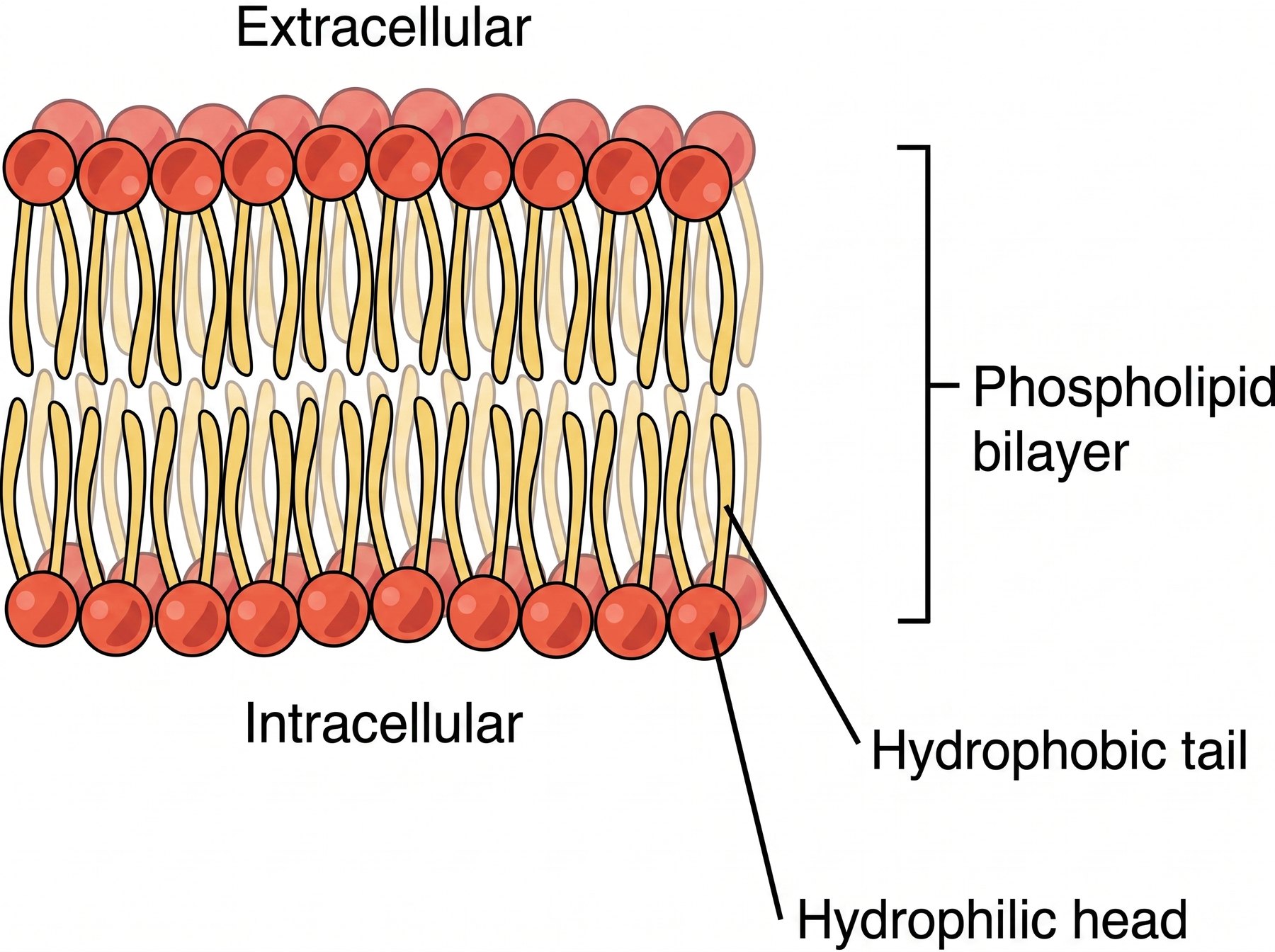
Phospholipids form two layers. Hydrophilic heads face the water inside and outside the cell; hydrophobic tails face each other in the middle. Embedded proteins carry or channel selected substances. Carbohydrates and other molecules add to the membrane's functions. The fluid mosaic description reflects moving components and a mixture of molecules.

Water-facing heads outside; water-avoiding tails in the middle.

Diffusion and equilibrium

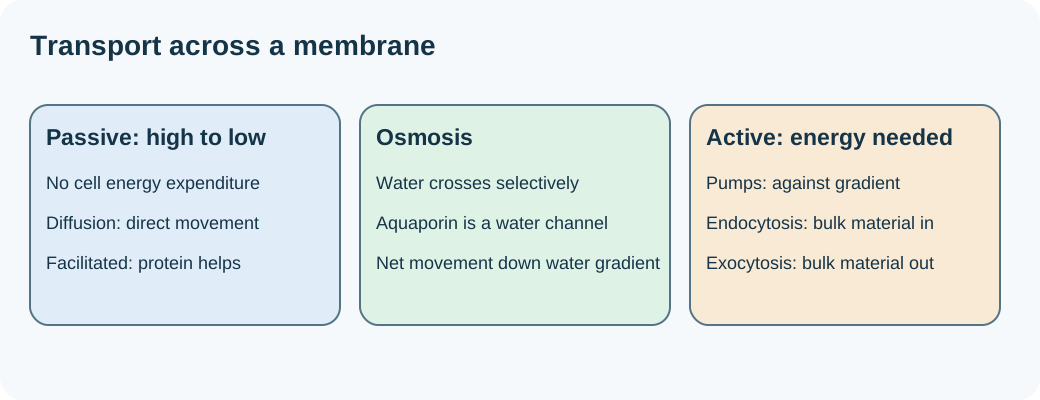
Diffusion is net movement from higher to lower concentration. Small molecules such as oxygen can cross the membrane this way. Passive transport uses no energy from the cell. At equilibrium molecules continue moving in both directions, but equal rates produce no net change.

A concentration gradient describes the difference between regions.

Facilitated diffusion

A channel or carrier protein helps particular substances cross from high to low concentration. This remains passive because no cell energy is spent to push them against the gradient. Aquaporins are water channels. A protein's presence alone does not make a process active.

A transport protein can help passive movement.

Osmosis

Osmosis is the diffusion of water across a selectively permeable membrane. When the solute cannot cross, water moves overall toward the side with the higher solute concentration, which has less free water. Always compare the solution outside with the inside of the cell.

Compare the surrounding solution with the cell to predict net water movement.

Hypotonic, hypertonic, isotonic

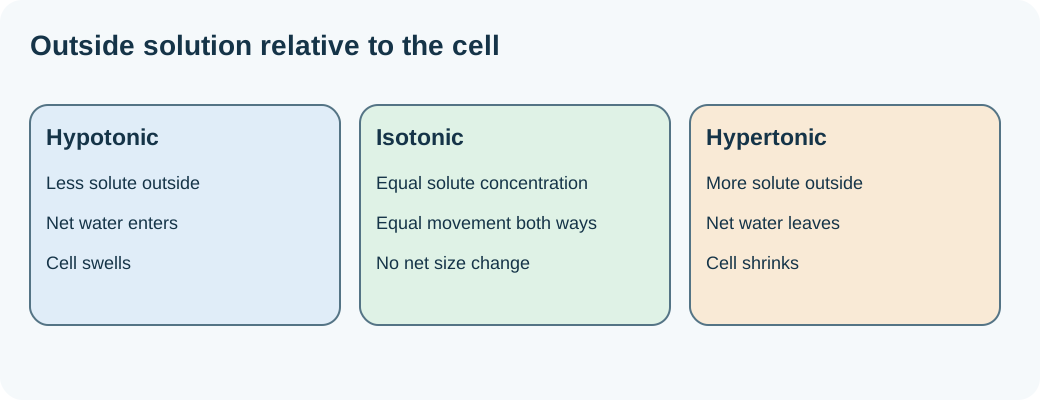
Hypotonic outside solution: lower solute concentration outside, net water enters, cell swells. Hypertonic outside solution: higher solute outside, net water leaves, cell shrinks. Isotonic: equal solute concentration, equal movement both ways, no net size change. Isotonic does not mean water stops moving.

Describe the surrounding solution relative to the cell.

Active transport and protein pumps

Active transport uses cell energy, often ATP. Protein pumps can move small molecules or ions against the concentration gradient, from lower to higher concentration. Maintaining appropriate sodium, potassium, or calcium levels can require this work.

Movement against the gradient needs energy.

Endocytosis and exocytosis

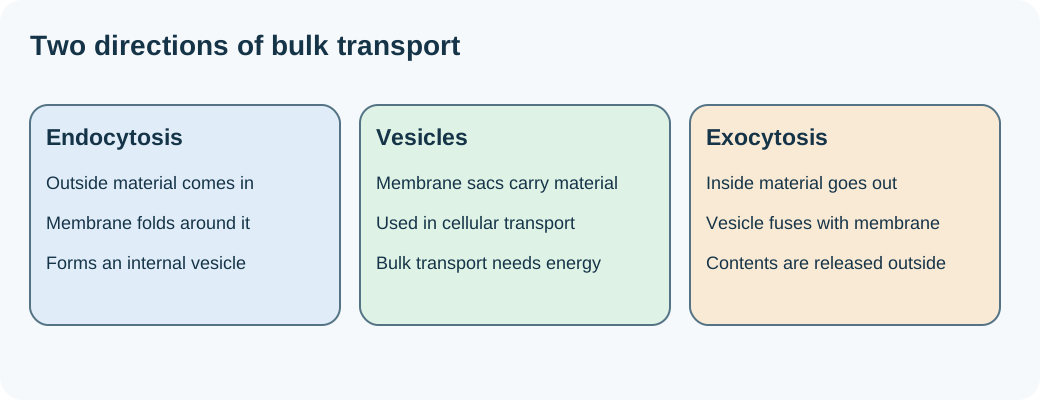
Endocytosis brings material in: the membrane folds around it and forms an internal vesicle. Exocytosis sends material out: an internal vesicle fuses with the membrane and releases its contents. These are energy-requiring forms of bulk transport; size and vesicle movement distinguish them from simple diffusion.

Endo brings in; exo sends out.

Apply the idea to the egg lab

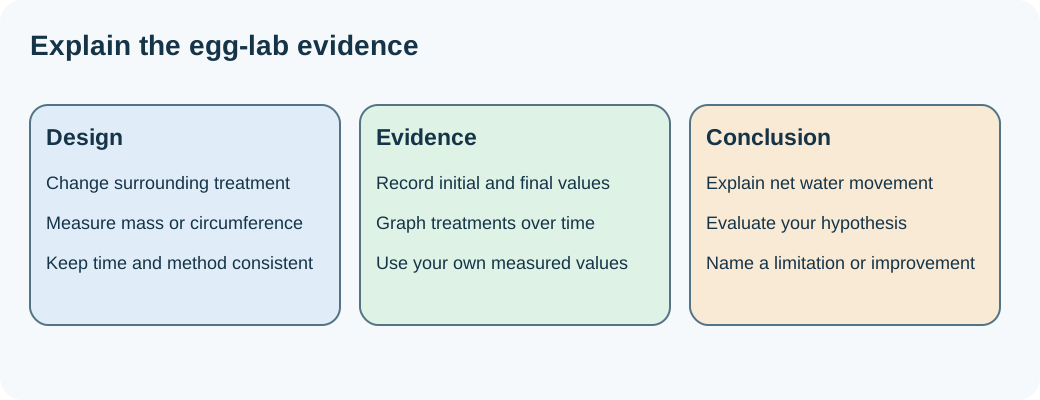
An egg with its shell removed retains a membrane that models selective permeability. Predict changes before measuring, then compare initial and final mass or circumference. In a lower-solute water solution it gains water; in a higher-solute syrup solution it loses water. A control provides a comparison, but an egg in an empty cup is not itself an isotonic solution.

Use measurements to support your explanation of water movement.

Variables, graphs, and conclusions

Independent variable: the surrounding treatment or solution. Dependent variable: the measured change in mass or circumference. Keep time, measurement method, and other conditions consistent. The control group is a comparison treatment; controlled variables are the conditions held constant. The lab requests a line graph showing the treatments over time. State findings, use data, explain osmosis, evaluate your hypothesis, and identify limitations or improvements.

Support the conclusion with your own recorded results.

Practice a dialysis-bag prediction

Suppose a water-permeable, sugar-impermeable bag has 0% sugar and the beaker has 15%. Net water leaves the bag, so its volume decreases. A bag with 20% sugar in a 15% beaker gains water. First identify the membrane rule, then compare concentrations; sugar is not crossing in this setup.

The higher-solute side draws net water across the membrane.