02.05 Cellular energy: ATP and ADP

Module 02: Life's Origins

The big idea Food supplies chemical energy. Cells transfer some of it into ATP, use ATP for immediate work, and regenerate ATP from ADP.

By the end you can

  • Why cells need energy
  • The structure of ATP
  • Releasing usable energy
  • Regenerating ATP
  • Short-term and long-term storage
  • The rechargeable-battery analogy

Build the idea in small steps

Food supplies chemical energy. Cells transfer some of it into ATP, use ATP for immediate work, and regenerate ATP from ADP.

Not sure about the basics underneath this lesson?

Why cells need energy

Cells use energy to grow, move, transport substances, make proteins and other molecules, digest materials, and respond to changes. Glucose and other food molecules contain chemical energy. ATP is the immediate energy source for much of a cell's work.

Food energy is transferred into ATP for cell work.

The structure of ATP

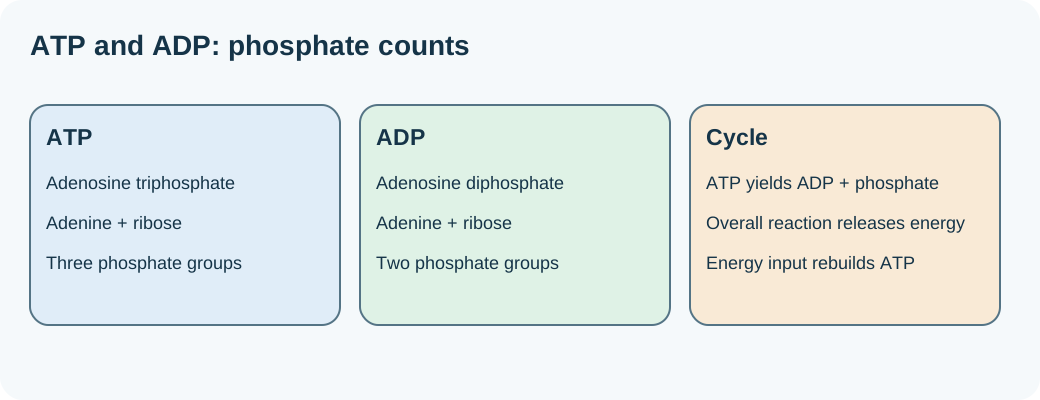
ATP stands for adenosine triphosphate. It contains adenine, a five-carbon sugar called ribose, and three phosphate groups. ADP is adenosine diphosphate and has two phosphate groups. Use the phosphate count to distinguish the two.

Tri = three phosphates; di = two.

Releasing usable energy

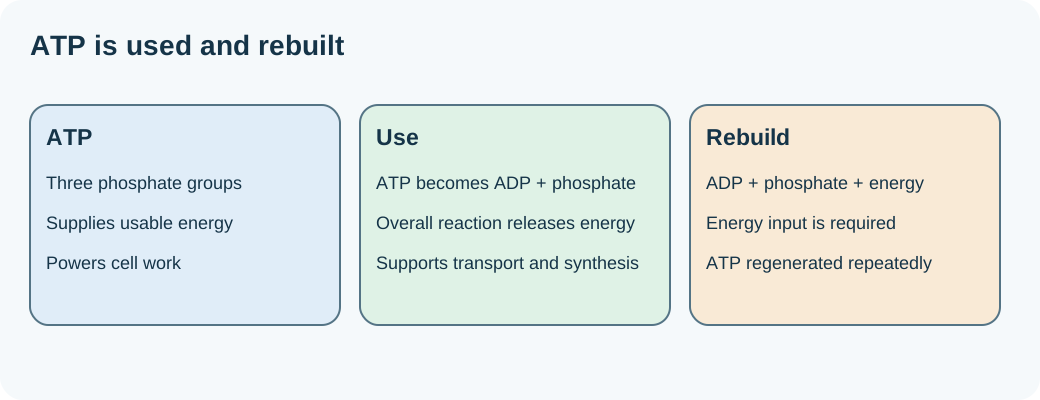
ATP reacts with water and becomes ADP plus a phosphate. The overall reaction releases energy that can be coupled to movement, active transport, or synthesis. The course focuses on the removal of the terminal phosphate. Energy release belongs to the overall chemical reaction.

ATP β†’ ADP + phosphate transfers energy for work.

Regenerating ATP

Adding a phosphate to ADP requires an energy input. Energy harvested from food can drive that rebuilding. The cell repeats this cycle as it does work: ATP supplies usable energy, then ADP is recharged. ATP is a renewable carrier within the cell.

ADP + phosphate + energy input β†’ ATP.

Short-term and long-term storage

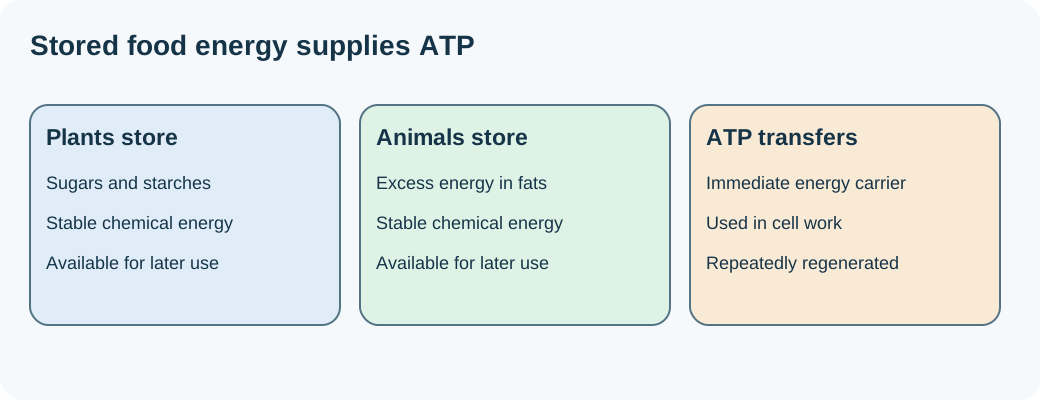
ATP is useful for immediate work and short-term transfer. Stable molecules hold stored energy longer: plants build sugars and starches, while animal cells store excess energy in fats. Breaking down food molecules through metabolic reactions supplies energy to regenerate ATP.

Stored food energy supports repeated ATP regeneration.

The rechargeable-battery analogy

ATP resembles a charged battery ready to power a task; ADP resembles the lower-energy form that can be recharged. Recharging takes energy. The analogy explains cycling, but ATP is a molecule carrying chemical energy, not a tiny electrical battery.

Both cell types need ATP, even though their structures differ.