02.03 Cell structure and function

Module 02: Life's Origins

The big idea Every cell structure has a job. Connect what a structure looks like, what it does, and how it works with other structures.

By the end you can

  • Plant and animal cells
  • Nucleus, nucleolus, and nuclear envelope
  • DNA, chromatin, and chromosomes
  • Ribosomes and rough ER
  • Smooth ER, Golgi, and vesicles
  • Mitochondria and chloroplasts
  • Storage, digestion, and fluid
  • Boundaries and support
  • Cilia and flagella
  • Use the course's farm analogy

Build the idea in small steps

Every cell structure has a job. Connect what a structure looks like, what it does, and how it works with other structures.

Not sure about the basics underneath this lesson?

Plant and animal cells

Both are eukaryotic and typically contain a nucleus, cytoplasm, plasma membrane, ribosomes, mitochondria, ER, and Golgi apparatus. Plant models also show a cell wall, chloroplasts, and a large central vacuole. Animal models show smaller vacuoles. The number and size of organelles vary with a cell's specialized job.

These are general models; specialized cells can differ.

Nucleus, nucleolus, and nuclear envelope

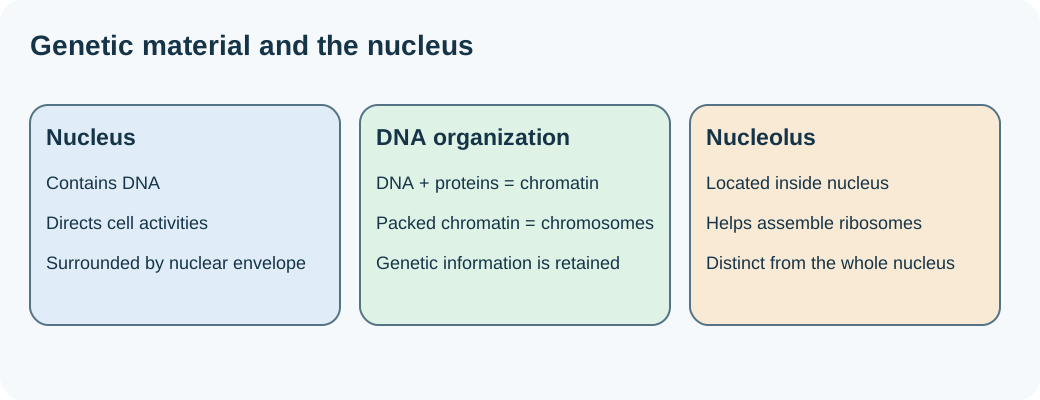
The nucleus contains DNA and directs cell activities through genetic instructions. The nucleolus is inside the nucleus and helps assemble ribosomes. The nuclear envelope surrounds the nucleus with two membranes. These are different structures with different jobs.

Nucleus contains DNA; nucleolus helps make ribosomes.

DNA, chromatin, and chromosomes

DNA is the genetic material. Chromatin is DNA associated with proteins that organize it in the nucleus. Chromosomes are tightly packed forms of chromatin visible during cell division. These names describe the genetic material and its organization, rather than three unrelated substances.

DNA is organized with proteins and can become tightly packed.

Ribosomes and rough ER

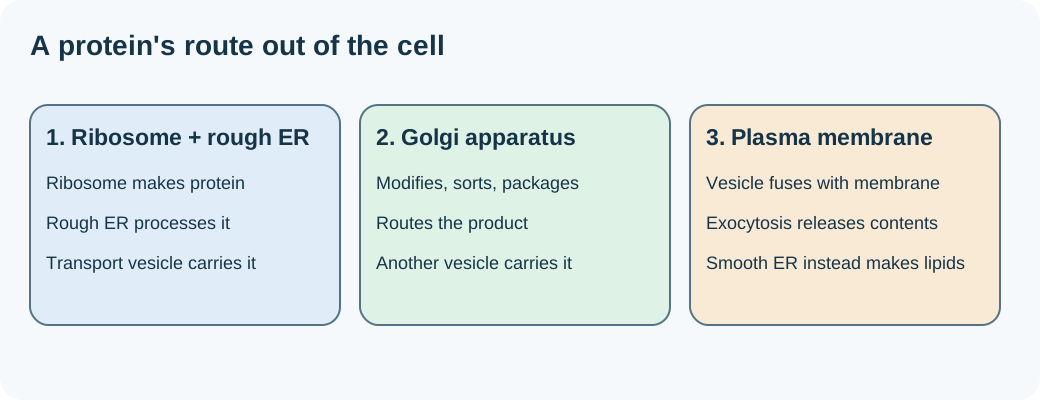
Ribosomes make proteins and are found in both cell types. Some are free in the cytoplasm; others attach to rough endoplasmic reticulum. Rough ER is a membrane network with ribosomes and helps process and transport proteins. A protein destined for export can travel from a ribosome/rough ER in a vesicle to the Golgi.

Follow the protein from production to processing.

Smooth ER, Golgi, and vesicles

Smooth ER has no attached ribosomes; it makes lipids and helps detoxify substances. Golgi membranes modify, sort, and package cell products for storage or transport. Vesicles are membrane sacs that carry products between structures or toward the plasma membrane.

Golgi sorts and packages; smooth ER makes lipids.

Mitochondria and chloroplasts

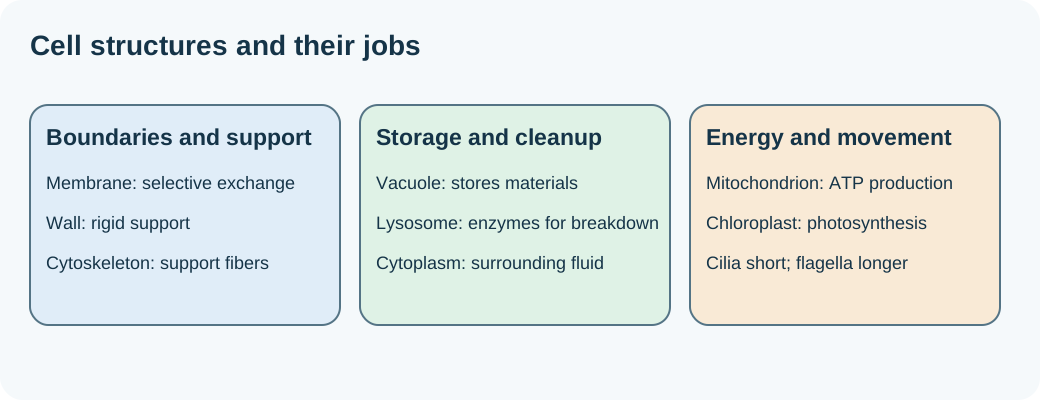
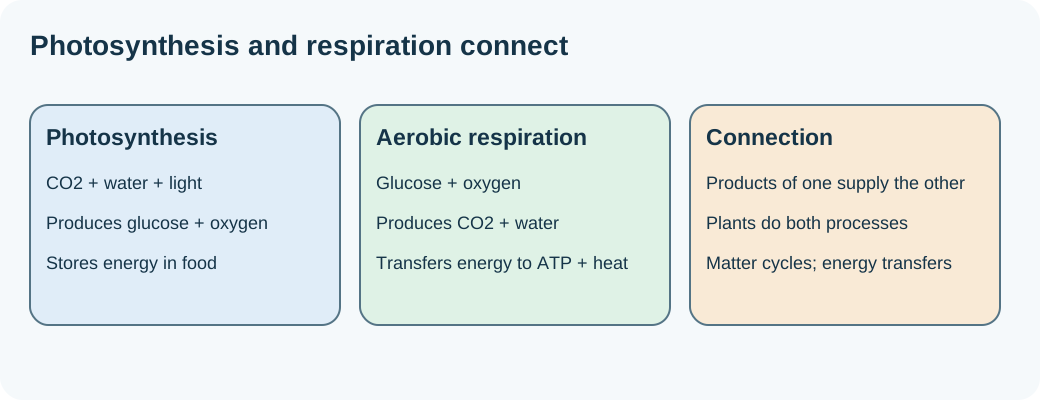
Mitochondria convert chemical energy from food into usable ATP through cellular respiration. Chloroplasts use light energy during photosynthesis to make glucose. Plant cells have mitochondria as well as chloroplasts. Food production and the transfer of food energy to ATP are different tasks.

Plants carry out both photosynthesis and cellular respiration.

Storage, digestion, and fluid

Vacuoles store water, nutrients, and wastes. A plant's large central vacuole also supports the cell when filled. Lysosomes contain enzymes that break down macromolecules and worn-out material. Cytoplasm is the watery, gel-like material surrounding cell structures; many reactions take place there.

Storage, breakdown, and the surrounding fluid have different roles.

Boundaries and support

The plasma membrane regulates what enters and leaves. A plant cell wall is a rigid layer outside the membrane that supports and protects the cell. The cytoskeleton is a network of protein fibers that supports cell shape, anchors structures, and helps movement. Microtubules are hollow protein structures involved in support and cell division; microfilaments are thin fibers forming support networks.

The wall provides support; the membrane controls exchange.

Cilia and flagella

Cilia are many short, hairlike extensions. Flagella are longer extensions. Both help movement in cells that have them; every cell does not have these structures. Use length and arrangement to distinguish them in a cell picture.

Short and numerous versus long extensions.

Use the course's farm analogy

Farmer = nucleus; fence = membrane; land = cytoplasm; seeds = nucleolus; crops = ribosomes; windmill = mitochondrion; tractor = ER; loading truck = Golgi; barn/water tank = vacuoles; greenhouse = chloroplast. The cleanup analogy points to lysosomes. State the actual cellular job when using an analogy.

An analogy helps recall the function; it does not replace the function.