The big ideaNearly every special property of water starts with the same chain: water is polar → neighboring molecules form hydrogen bonds → water behaves in life-supporting ways. Learn that cause, not twelve isolated definitions.
By the end you can
Tell covalent bonds within water from hydrogen bonds between water molecules
Connect polarity and hydrogen bonding to water's major properties
Apply each property to plants, ecosystems, climate, or cells
Before the properties — one chain explains almost everything
The vocabulary list looks long, but most of it grows from one cause: water has partially charged ends.
Not sure about the basics underneath this lesson?
Build the chain once, then attach each property to it.
Partial charges make neighboring water molecules attract.
The molecule has two different partial-charge regions even though its overall charge is zero.
3
3. Hydrogen bonds
The positive end of one water molecule attracts the negative end of another.
4
4. Properties
Those attractions create cohesion, surface tension, high specific heat, high heat of vaporization, and the open structure of ice. Polarity also supports adhesion and dissolving charged materials.
Quick check — answer out loud before you peek
What is the cause chain behind most properties of water?
Uneven electron sharing makes water polar; opposite partial charges form hydrogen bonds; those attractions create the properties.
Got it now? Scroll back up and re-read the section — it should land differently.
Atoms, ions, and chemical bonds
An element cannot be broken into other substances by chemical reactions. An atom has positive protons, neutral neutrons, and negative electrons. Atoms form compounds when they bond. H₂O tells you that one water molecule has two hydrogen atoms and one oxygen atom.
In ionic bonding, atoms gain or lose electrons to become ions; opposite ions attract, as in sodium chloride. In covalent bonding, atoms share electrons. Polar covalent bonding is a type of covalent bonding with unequal sharing. Hydrogen bonding is the weaker attraction between appropriate partially charged regions of molecules.
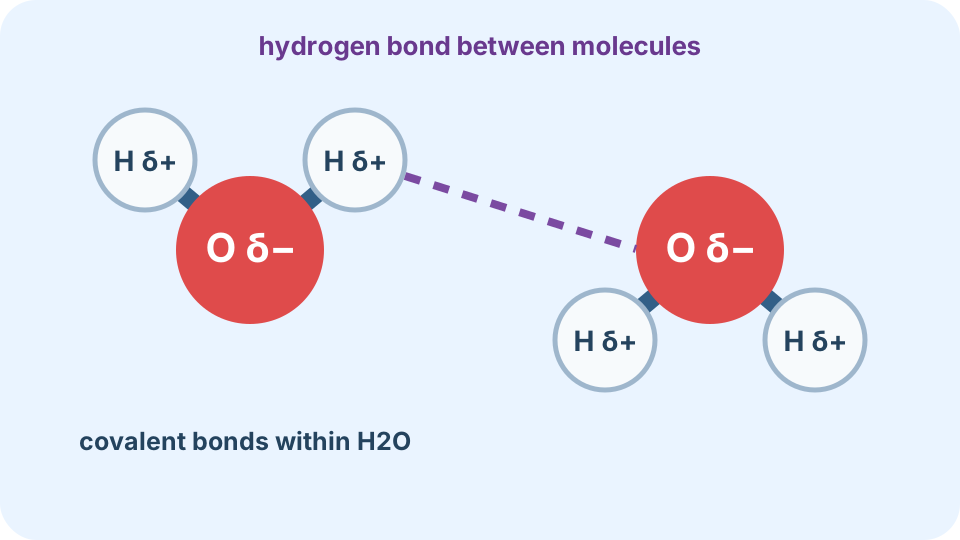
Polar covalent bonds within a water molecule give it the partial charges needed for hydrogen bonding between molecules.
One molecule, two kinds of bond
H₂O has two hydrogen atoms and one oxygen atom. Polar covalent bonds hold H and O together within one molecule because they share electrons unevenly. Oxygen pulls the shared electrons closer, making its end partially negative (δ−) and the hydrogen ends partially positive (δ+).
Opposite partial charges on neighboring water molecules attract. That weaker attraction between molecules is a hydrogen bond.
Covalent within; hydrogen bond between. The partial charges make both possible.
Likely on the quizIf a stem asks what holds H to O inside one H₂O molecule, choose covalent. If it asks what attracts separate water molecules, choose hydrogen bonding.
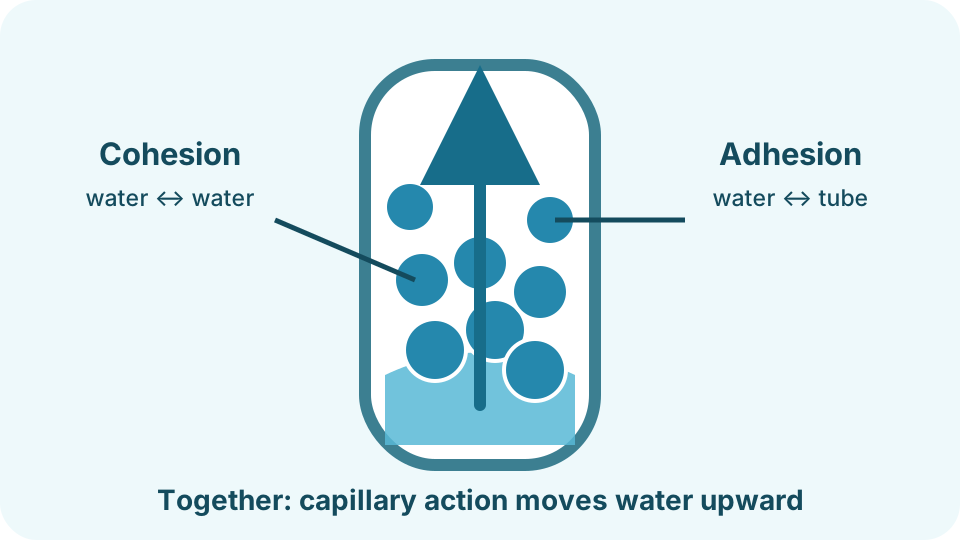
Cohesion is water attracting water. It makes droplets bead and strengthens the surface into surface tension. Adhesion is water attracting a different material, such as a plant vessel or paper towel. In a narrow space, adhesion pulls water along the surface while cohesion pulls more water behind it. Together they produce capillary action.
Water sticks to the tube and to other water, so the column can rise.
Likely on the quizWater rising in a plant or paper towel = capillary action. A water bug supported at the surface = surface tension.
Not sure about this bit?
Sort the words by what is attracted.
1
Water to water
Cohesion. At the surface, that produces surface tension.
2
Water to something else
Adhesion. Think glass, a leaf, or paper towel fibers.
3
Both in a narrow space
Capillary action. Adhesion leads along the wall; cohesion brings the water column with it.
Quick check — answer out loud before you peek
A paper towel pulls colored water upward. Name the two attractions.
Adhesion to the towel and cohesion between water molecules.
Got it now? Scroll back up and re-read the section — it should land differently.
Universal solvent — polarity carries materials
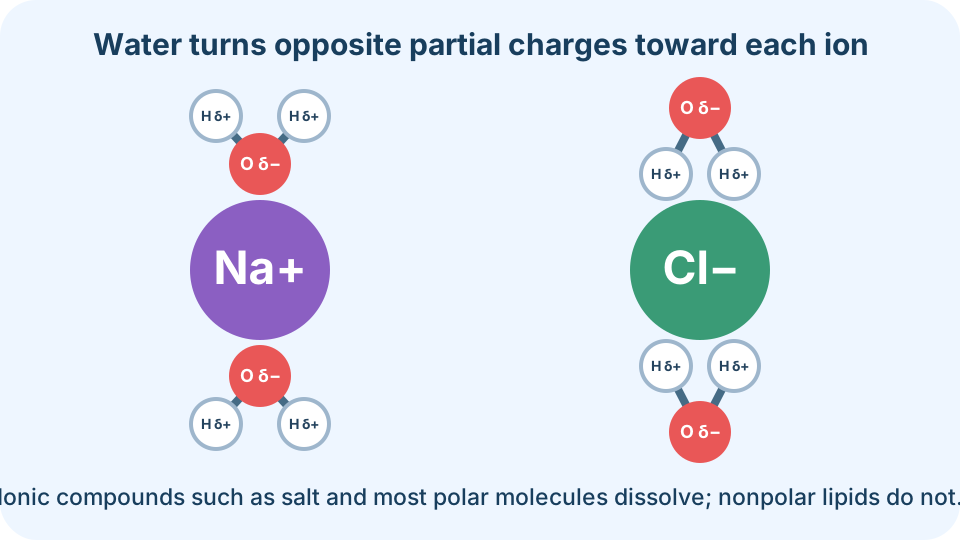
Water dissolves more substances than any other liquid because its partially charged ends attract ions and other polar molecules. That lets water carry minerals, nutrients, and chemicals through soil and living things. Nonpolar substances such as lipids do not dissolve well in water because they do not have charged regions for water to attract.
Likely on the quizSugar (polar) and salt (ionic) dissolve. Lipids are nonpolar and do not.
Temperature control — specific heat and vaporization
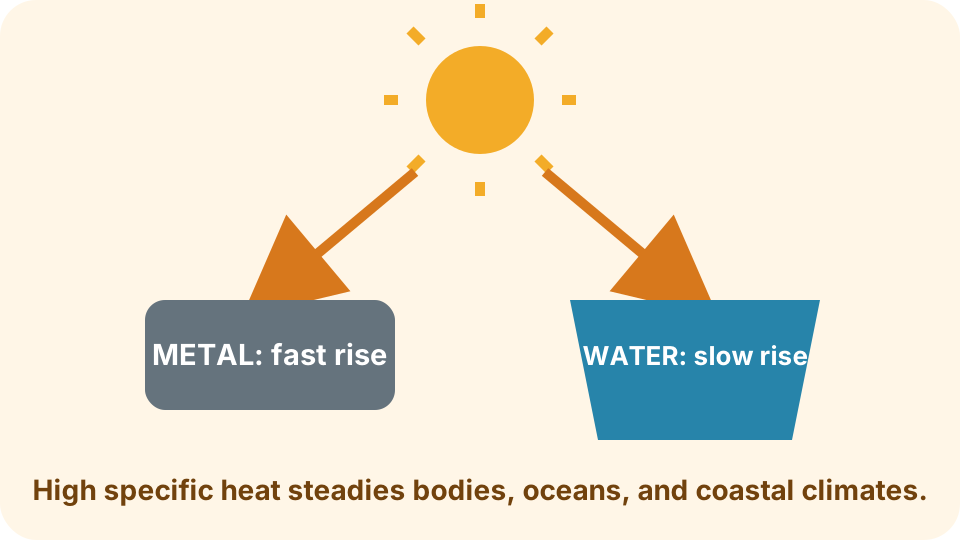
Specific heat is the energy needed to change 1 gram of a substance by 1 °C. Water's high specific heat means it absorbs or releases a lot of energy with only a small temperature change. That steadies body temperature, ocean ecosystems, and coastal climates.
Heat of vaporization is the energy needed to turn 1 gram of liquid into gas. Water's hydrogen bonds take energy to overcome, giving water a high boiling point and making evaporation an effective way to carry heat away.
With the same heating, water changes temperature more slowly than metal.
Likely on the quizThe liquid that takes the longest to heat has the highest specific heat.
Why ice floats
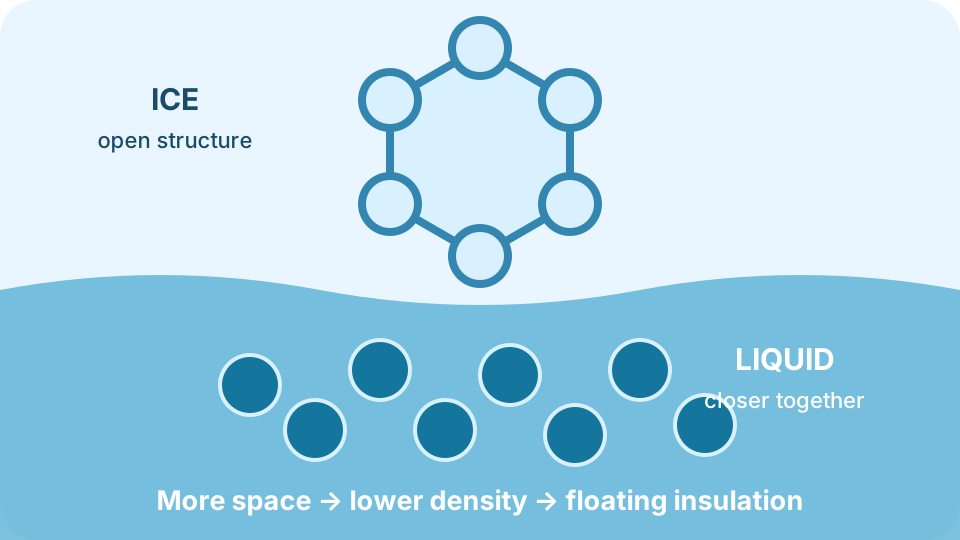
When water freezes, hydrogen bonds lock the molecules into an open, six-sided arrangement. The molecules spread farther apart than in liquid water, so the same mass takes more volume. Ice is therefore less dense and floats.
Floating ice forms an insulating layer. If ice sank, lakes and ponds could freeze from the bottom up and destroy the habitat below.
The open ice structure uses more space than liquid water.
Likely on the quizDo not choose “ice molecules are closer together.” Frozen water expands because its molecules are farther apart.
Not sure about this bit?
The frozen arrangement is the weird part.
1
Freeze
Hydrogen bonds hold molecules in an open six-sided structure.
2
Expand
The molecules sit farther apart, so the same mass takes more volume.
3
Float
More volume for the same mass means lower density. The floating layer insulates liquid water below.
Got it now? Scroll back up and re-read the section — it should land differently.
pH — acid, neutral, or base
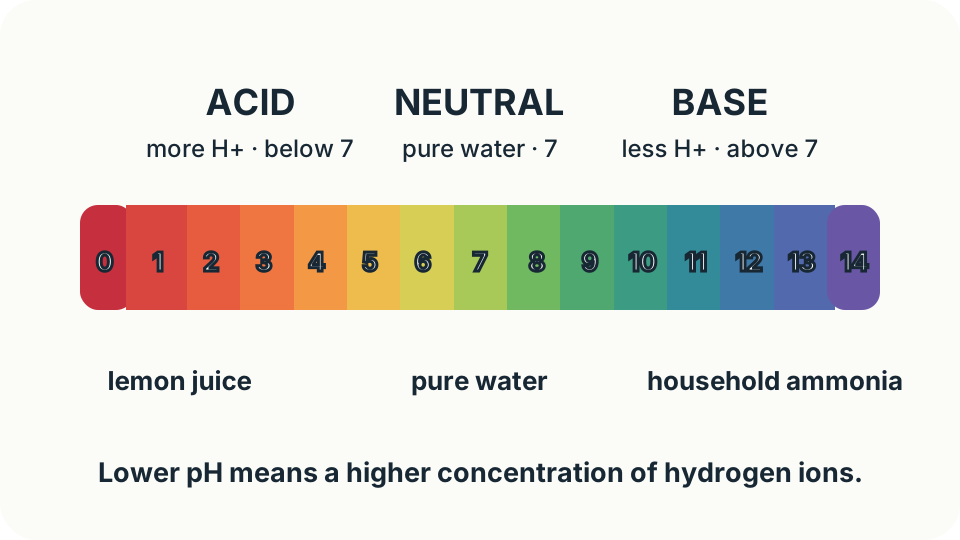
pH measures hydrogen-ion (H⁺) concentration on a 0–14 scale. Pure water is neutral at 7. Values below 7 are acids; lower pH means more H⁺. Values above 7 are bases; higher pH means less H⁺.
Course examples: battery acid and gastric fluid are strongly acidic; vinegar and lemon juice are acidic; pure water is neutral; seawater and baking soda solution are basic; household ammonia is more strongly basic.
Below 7 = acid; 7 = neutral; above 7 = base.
Likely on the quizA low pH has a high H⁺ concentration. A high pH has a low H⁺ concentration.
Properties of Water practice
The course review is a vocabulary match. These questions use those same definitions, plus the Biology Notebook's application questions. Explain the property before reading the feedback.
Look for the relationship: water-to-water, water-to-other, temperature, density, or H⁺.