02.06 Photosynthesis and cellular respiration

Module 02: Life's Origins

The big idea Photosynthesis captures light energy in glucose. Cellular respiration transfers food energy into ATP. Their overall reactants and products connect.

By the end you can

  • Photosynthesis: inputs and outputs
  • The plant structures involved
  • Matter and energy are conserved
  • Respiration: inputs and outputs
  • Where respiration happens
  • With oxygen and without oxygen
  • Two kinds of fermentation
  • How the processes connect
  • Apply it to a plant, a seed, and an aquarium
Build the idea in small steps

Photosynthesis captures light energy in glucose. Cellular respiration transfers food energy into ATP. Their overall reactants and products connect.

Not sure about the basics underneath this lesson?

Photosynthesis: inputs and outputs

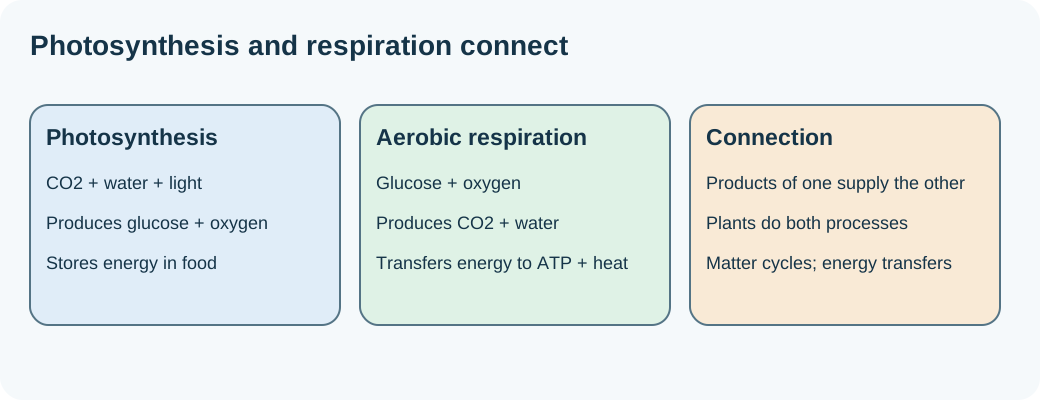
Plants, algae, and some bacteria carry out photosynthesis. Carbon dioxide and water are the reactants; light supplies energy. Glucose and oxygen are products. Light energy becomes chemical energy stored in glucose. The overall equation is 6COβ‚‚ + 6Hβ‚‚O + light energy β†’ C₆H₁₂O₆ + 6Oβ‚‚.

Photosynthesis builds glucose using light energy.

The plant structures involved

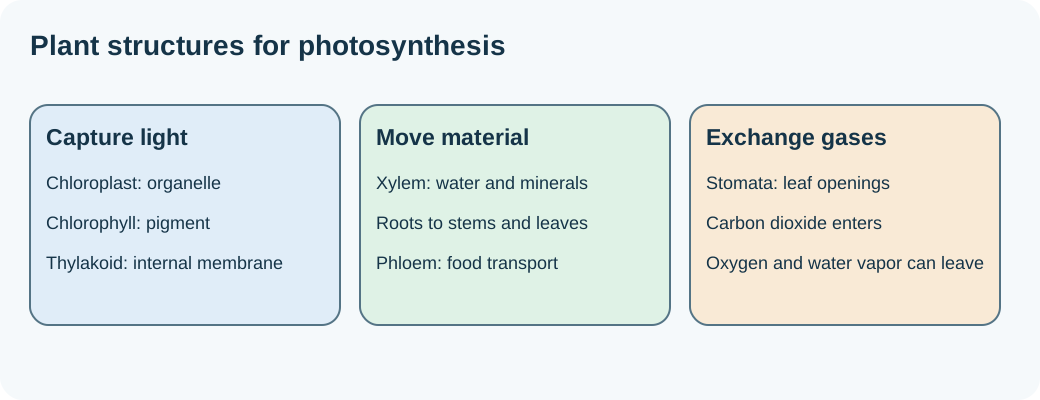
Chloroplasts are the photosynthetic organelles in plant cells. Chlorophyll is the green pigment that captures light. Thylakoids are membrane structures inside chloroplasts. Stomata are leaf openings for gas exchange. Xylem transports water and minerals from roots; phloem transports food through the plant.

Keep organelle, pigment, and transport tissue distinct.

Matter and energy are conserved

Chemical reactions rearrange atoms. The carbon, hydrogen, and oxygen present in the reactants remain in the products. Sunlight's energy is transformed into stored chemical energy. A reaction changes the arrangement and energy transfers, rather than making matter or energy disappear.

Count the elements on both sides of the overall equation.

Respiration: inputs and outputs

Aerobic cellular respiration uses glucose and oxygen, producing carbon dioxide, water, and energy transferred to ATP with heat released. The overall equation is C₆H₁₂O₆ + 6Oβ‚‚ β†’ 6COβ‚‚ + 6Hβ‚‚O + energy. Both plants and animals carry out respiration; plants need ATP even though they also make glucose.

Respiration transfers food energy into ATP.

Where respiration happens

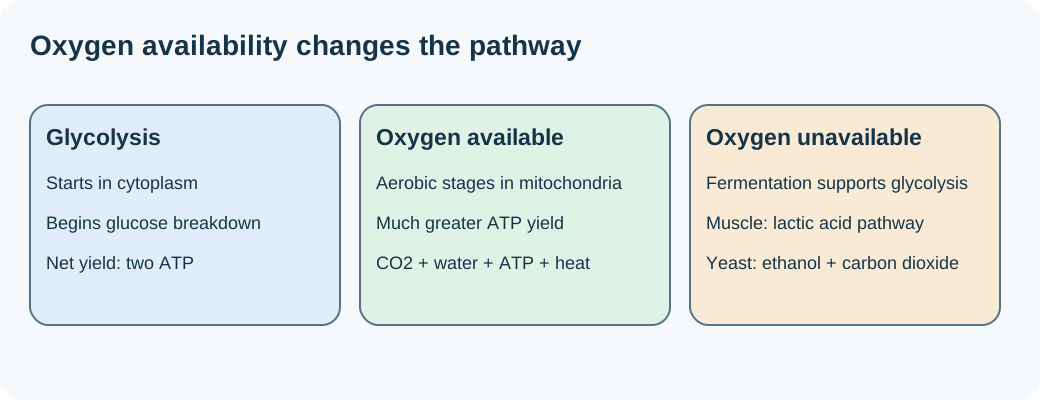
Glycolysis begins the breakdown of glucose in the cytoplasm. In eukaryotic cells, later aerobic stages occur in mitochondria. The course names the Krebs cycle and shows later energy-transfer steps. The central goal is ATP production. Breathing moves air; cellular respiration is a set of chemical reactions.

Cytoplasm first, then mitochondria for aerobic stages.

With oxygen and without oxygen

Aerobic respiration requires oxygen and produces much more ATP per glucose than the fermentation pathway. When oxygen is unavailable, glycolysis can continue with fermentation supporting it. The course uses 'anaerobic' for this oxygen-free pathway. Its net yield is two ATP per glucose from glycolysis, compared with more than 30 for aerobic respiration in the course.

Know the yield comparison rather than treating fermentation as equally efficient.

Two kinds of fermentation

Lactic acid fermentation is associated with animal muscle cells when oxygen supply is limited and also occurs in some microbes. Alcoholic fermentation in yeast produces ethanol and carbon dioxide; the carbon dioxide makes dough rise. Both allow glycolysis to continue without oxygen.

Lactic acid pathway versus ethanol + carbon dioxide pathway.

How the processes connect

Photosynthesis supplies glucose and oxygen used in respiration. Respiration supplies carbon dioxide and water used in photosynthesis. The overall equations have opposite arrangements of these substances, though their detailed reaction steps are different. Matter cycles while energy passes from sunlight to food to ATP and is eventually dispersed as heat.

Plants do both processes; animals depend on food made by producers.

Apply it to a plant, a seed, and an aquarium
A seed can use stored food in respiration before it grows leaves. In light, an aquatic plant photosynthesizes while also respiring. A snail uses oxygen and releases carbon dioxide through respiration. Explain an exchange by naming the process and its reactants/products; a plant still respires when it cannot photosynthesize.

Use the equations to predict the exchange of matter.