Explain it

02.10-part-two-review — 4 short write-ups

Question 1 of 4

A checkpoint, not a test
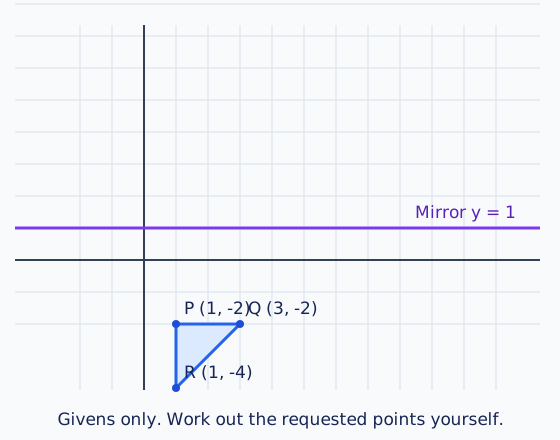
Write the two-stage transformation

Given triangle P (1, −2), Q (3, −2), R (1, −4), and line y = 1. Intermediate and final images are not drawn.
Triangle PQR has P(1,−2), Q(3,−2), R(1,−4). Translate it left 2 and up 1, then reflect it across y=1. Give the three intermediate and three final coordinates. Explain one reflected point using equal distances, and explain why the final triangle is congruent to the original.

Work P → P₁ → P₂, and repeat for Q and R.

Question 2 of 4

A checkpoint, not a test
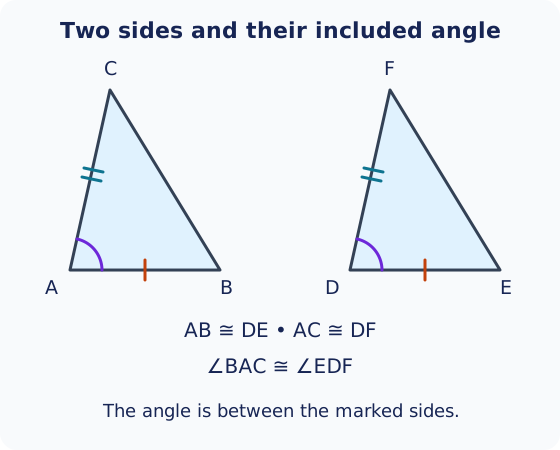
Write the congruence argument

Triangles ABC and DEF with AB congruent DE, AC congruent DF, and included angle BAC congruent EDF.
Given AB≅DE, AC≅DF, and ∠BAC≅∠EDF, prove BC≅EF. State the matching triangles, explain why the angle is included, name the congruence test, and justify the requested side pair.

Name which sides meet at A and D. Prove congruence before using corresponding parts.

Question 3 of 4

A checkpoint, not a test
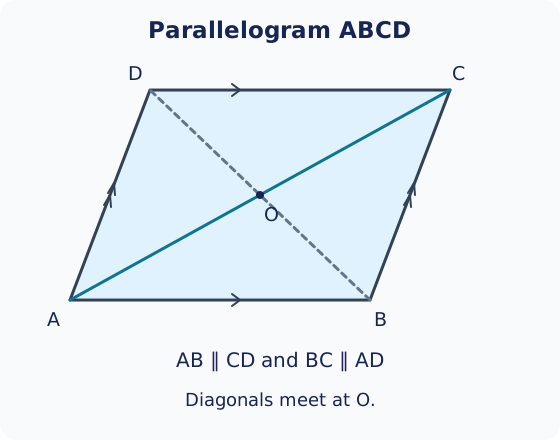
Use the parallelogram’s evidence

Parallelogram ABCD, with A bottom left, B bottom right, C top right, D top left. Diagonals AC and BD meet at O.
ABCD is a parallelogram whose diagonals AC and BD intersect at O. Using diagonal AC, explain how alternate interior angles and the shared side prove opposite sides congruent. Then find AC and BD if AO=7 and BO=5, explaining which diagonal property you used.

Compare ΔABC with ΔCDA. Keep the two full diagonal lengths separate.

Question 4 of 4

A checkpoint, not a test
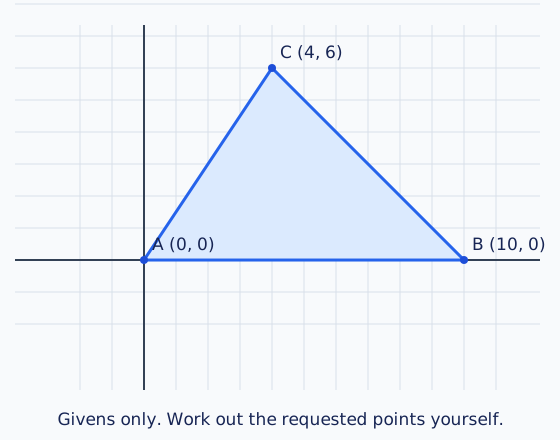
Show the midpoint calculations

Given triangle A (0, 0), B (10, 0), C (4, 6). Midpoints are not plotted.
A(0,0), B(10,0), C(4,6). M is the midpoint of AC and N is the midpoint of BC. Calculate M and N. Use their coordinates to show MN is parallel to AB and half its length. Give reasons for direction and length separately.

Average x-values together, then y-values together. Equal y-values mean horizontal.