Transformations and congruence exam: Part Two review

Module 02 — Transformations and Congruence

The big idea Show what you did and why it works. Part Two is short response.
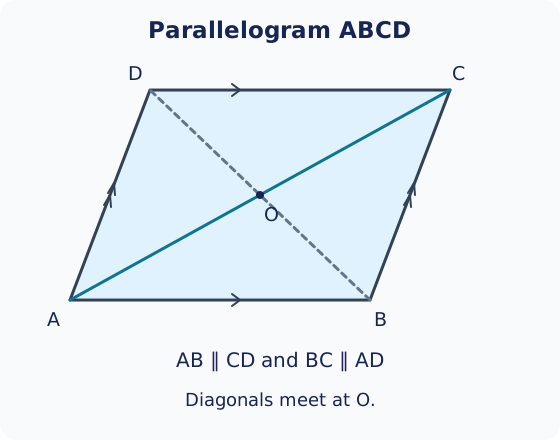
Parallelogram ABCD, with A bottom left, B bottom right, C top right, D top left. Diagonals AC and BD meet at O.

By the end you can

  • Write coordinate work in the order of the transformations.
  • Pair proof statements with valid reasons.
  • Support a triangle or quadrilateral conclusion with calculations and diagram facts.
A short response can be short

A few justified lines are enough when each line does a job.

Not sure about the basics underneath this lesson?

What a complete short response includes

Write the rule or theorem, show how it applies, and state the conclusion. For a coordinate problem, show the starting, intermediate, and final coordinates. For a proof, name the evidence before the conclusion.

This review uses new rehearsal problems across the same module as Part One. It does not reproduce the real Part Two exam. Use the Explain-it page for feedback on your own words.

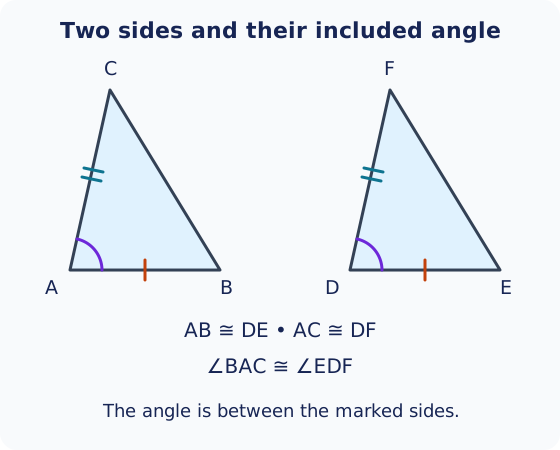
A pair of triangles with corresponding side and included angle marks to support a written justification.

Rehearsal 1: a sequence with all the coordinates

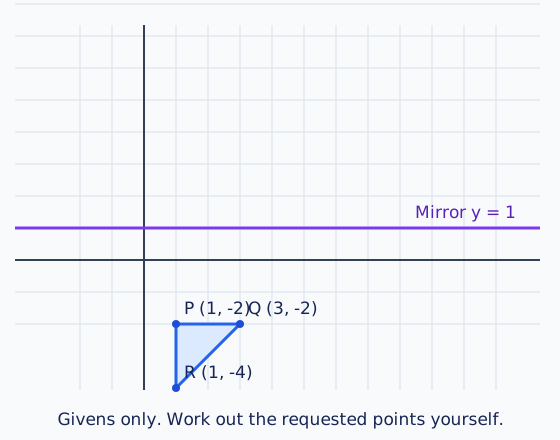
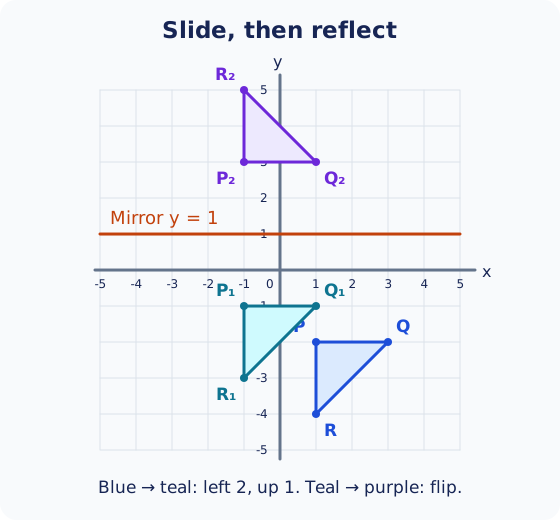
Triangle PQR has P(1, −2), Q(3, −2), R(1, −4). Move it left 2 and up 1, then reflect across y = 1.

Before revealing the model, write each intermediate and final coordinate. Explain why the final triangle is congruent to the original. Use the line labeled y=1 as the mirror, not the y-axis.

Given triangle P (1, −2), Q (3, −2), R (1, −4), and line y = 1. Intermediate and final images are not drawn.

Model 1: keep the two moves separate

Compare your work one line at a time. Your wording can differ if the coordinates and reasons agree.

Triangle P(1,-2), Q(3,-2), R(1,-4) slides left 2 and up 1 to P₁(-1,-1), Q₁(1,-1), R₁(-1,-3), then reflects across y=1 to P₂(-1,3), Q₂(1,3), R₂(-1,5).

Rehearsal 2: prove, then use corresponding parts

Given: AB ≅ DE, AC ≅ DF, and ∠BAC ≅ ∠EDF. Prove: BC ≅ EF.

Use the marked diagram. State which triangles match, name the congruence test, then justify the final side pair. Do not use CPCTC before proving the triangles congruent.

Triangles ABC and DEF with AB congruent DE, AC congruent DF, and included angle BAC congruent EDF.

Model 2: SAS before CPCTC

Match vertices A ↔ D, B ↔ E, C ↔ F.

Triangles ABC and DEF with AB congruent DE, AC congruent DF, and included angle BAC congruent EDF.

Rehearsal 3: make a parallelogram argument

ABCD is a parallelogram. Diagonal AC divides it into ΔABC and ΔCDA. Prove that opposite sides are congruent using the parallel sides, alternate interior angles, and the shared diagonal.

Then suppose AO = 7 and BO = 5. State AC and BD, and explain why they need not be equal.

Parallelogram ABCD, with A bottom left, B bottom right, C top right, D top left. Diagonals AC and BD meet at O.

Model 3: use the shared diagonal

Keep triangle names in corresponding order. The shared side is the included side for ASA.

Parallelogram ABCD, with A bottom left, B bottom right, C top right, D top left. Diagonals AC and BD meet at O.

Rehearsal 4: use numbers before letters

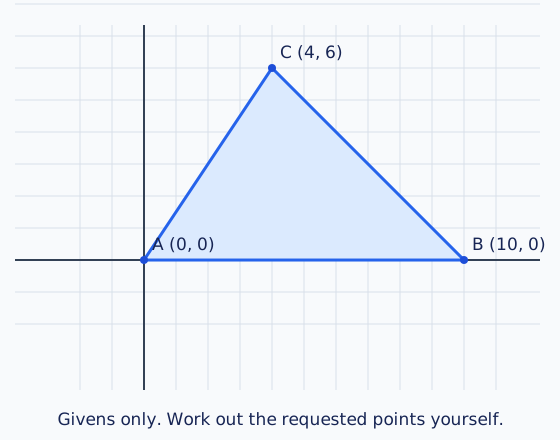
Let A(0, 0), B(10, 0), C(4, 6). M is the midpoint of AC and N is the midpoint of BC. Find M and N, then show MN is parallel to AB and half as long.

The Midpoint Formula means average each coordinate: add the two x-values and divide by 2; do the same with y. No guessed positions are needed.

Given triangle A (0, 0), B (10, 0), C (4, 6). Midpoints are not plotted.
Not sure about this bit?

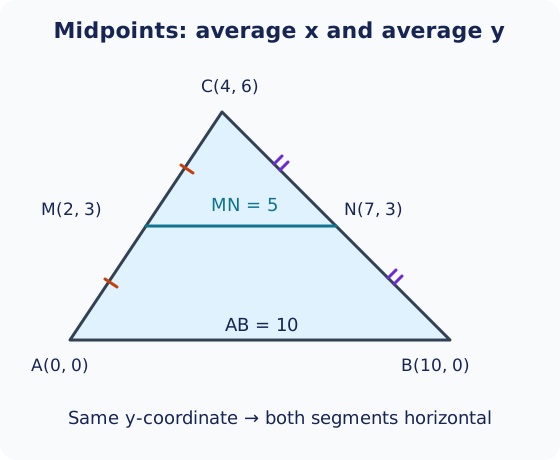
Model 4: midpoint, direction, length

This checks the Midsegment Theorem for the stated numeric triangle. One numeric example is not a proof for every possible triangle.

A(0,0), B(10,0), C(4,6); M(2,3) is the midpoint of AC and N(7,3) is the midpoint of BC. MN is parallel to AB and half as long.

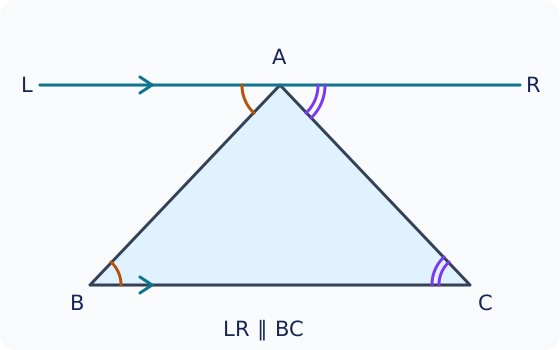
Triangle Sum: explain the picture

For a general triangle ABC, construct LR through A parallel to BC. The angles at B and C match the two outer angles at A by alternate interior angles. Those outer angles and ∠BAC fill the straight angle LAR.

Angle Addition adds the neighboring pieces. A straight angle measures 180°. Substitute the matching angle measures to prove the triangle’s total is 180°. Do not cite Triangle Sum as its own proof.

LR passes through A parallel to BC. The angle LAB matches angle ABC, and CAR matches BCA; together with BAC they fill the straight angle LAR.

If you see letters as coordinates

A letter represents a number that can vary. In a general coordinate proof, we avoid picking one fixed triangle. For example, A(0,0), B(b,0), C(u,v), with b>0 and v>0, puts the base on the x-axis and C above it.

The side midpoints are (u/2,v/2) and ((b+u)/2,v/2). Their y-values match, so the midsegment is horizontal. Its length is b/2, while the base length is b. This is the same reasoning as the numeric example, now for every such triangle.

A(0,0), B(10,0), C(4,6); M(2,3) is the midpoint of AC and N(7,3) is the midpoint of BC. MN is parallel to AB and half as long.
The drawing shows the numeric example. Letters let the proof apply beyond that one drawing.
Not sure about this bit?

Before you submit a written response

Check the requested endpoint: coordinates, a length, an angle, triangle congruence, or a particular side pair. State that endpoint in your last sentence.

Check each reason. “Given” must have been given. “Midpoint” requires equal halves on the segment. CPCTC comes after congruence. A diagram’s appearance alone does not establish a property.

A pair of triangles with corresponding side and included angle marks to support a written justification.

Check the reasoning

These short choices check the reasons behind your written work. The Explain-it page is where you rehearse writing the responses yourself.

1 / 6 0 correct

Final checklist

Tick these off as you go. Saved in this browser.