By the end you can
- Recognize gene and chromosome mutations.
- Explain substitutions and frameshifts.
- Distinguish inherited changes from somatic changes and gene regulation.
- Connect mutagens and cell-cycle controls to mutation effects.
Module 03: Cell Reproduction

By the end you can
A mutation changes genetic material. Copying errors or environmental damage can change one gene, a chromosome’s structure, or chromosome number. Effects may be harmful, helpful, or neutral. A small change does not guarantee a small effect.

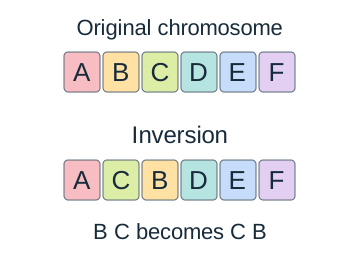
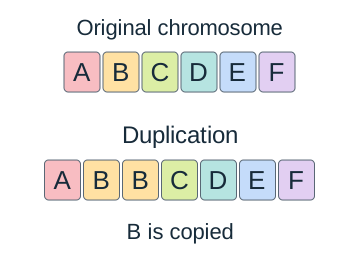
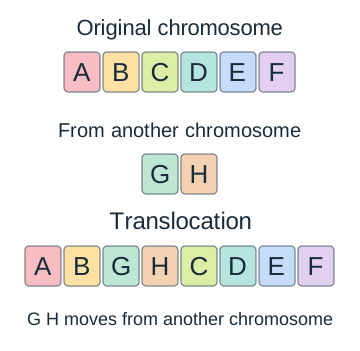
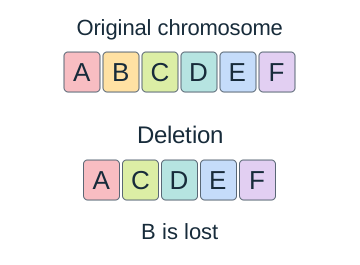
Compare the order before and after. Deletion loses a segment; duplication repeats one. Inversion reverses a segment’s order. Translocation moves a segment to another chromosome. These changes affect chromosome structure, rather than simply replacing one DNA base.
Deletion removes material. Duplication adds a copy. Inversion keeps the material but reverses its order. Compare the original and changed chromosome before naming the mutation.
Got it now? Scroll back up and re-read the section — it should land differently.
In this course figure, one segment appears twice after the change. That extra copy is a duplication. Ask what changed: the number of copies, the order, or the chromosome carrying the segment?
An inversion reverses part of the original sequence. A translocation moves material between chromosomes. In the translocation figure, G and H arrive from another chromosome; the key clue is where the material came from.
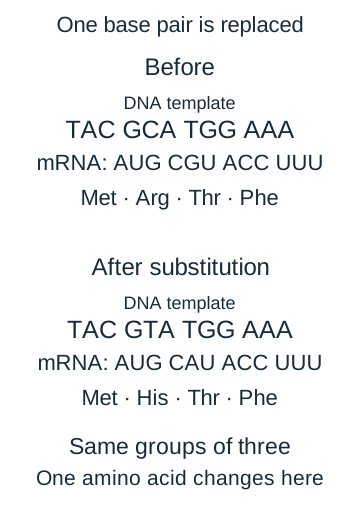
A substitution replaces a base pair. It can leave the amino acid unchanged, change one amino acid, or create an early stop. The result depends on the mRNA codon. Use the mRNA chart in Protein Synthesis when you need that bridge.
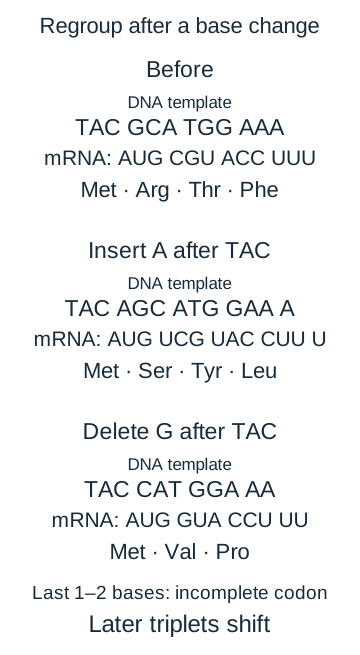
Ribosomes read mRNA in groups of three. Adding or removing one or two bases can shift how later bases are grouped, changing later codons and the protein. This is a frameshift. Compare the reading groups after the change, not just the first altered base.
First group the original message into threes. Now regroup after a one-base insertion or deletion. The changed grouping is why a small DNA change can affect many later amino acids. A substitution usually leaves the grouping in place.
Got it now? Scroll back up and re-read the section — it should land differently.
A mutation in a somatic body cell, such as a skin cell, is not passed to offspring through reproduction. A mutation in a sperm or egg can be inherited. An inherited recessive allele may be present without its trait appearing.

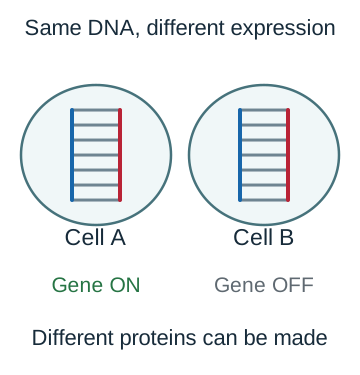
Cells can turn different genes on or off. That changes which messages are transcribed and which proteins are made. Skin and liver cells can therefore do different jobs while carrying the same DNA. Gene regulation changes expression; it does not require a new DNA sequence.
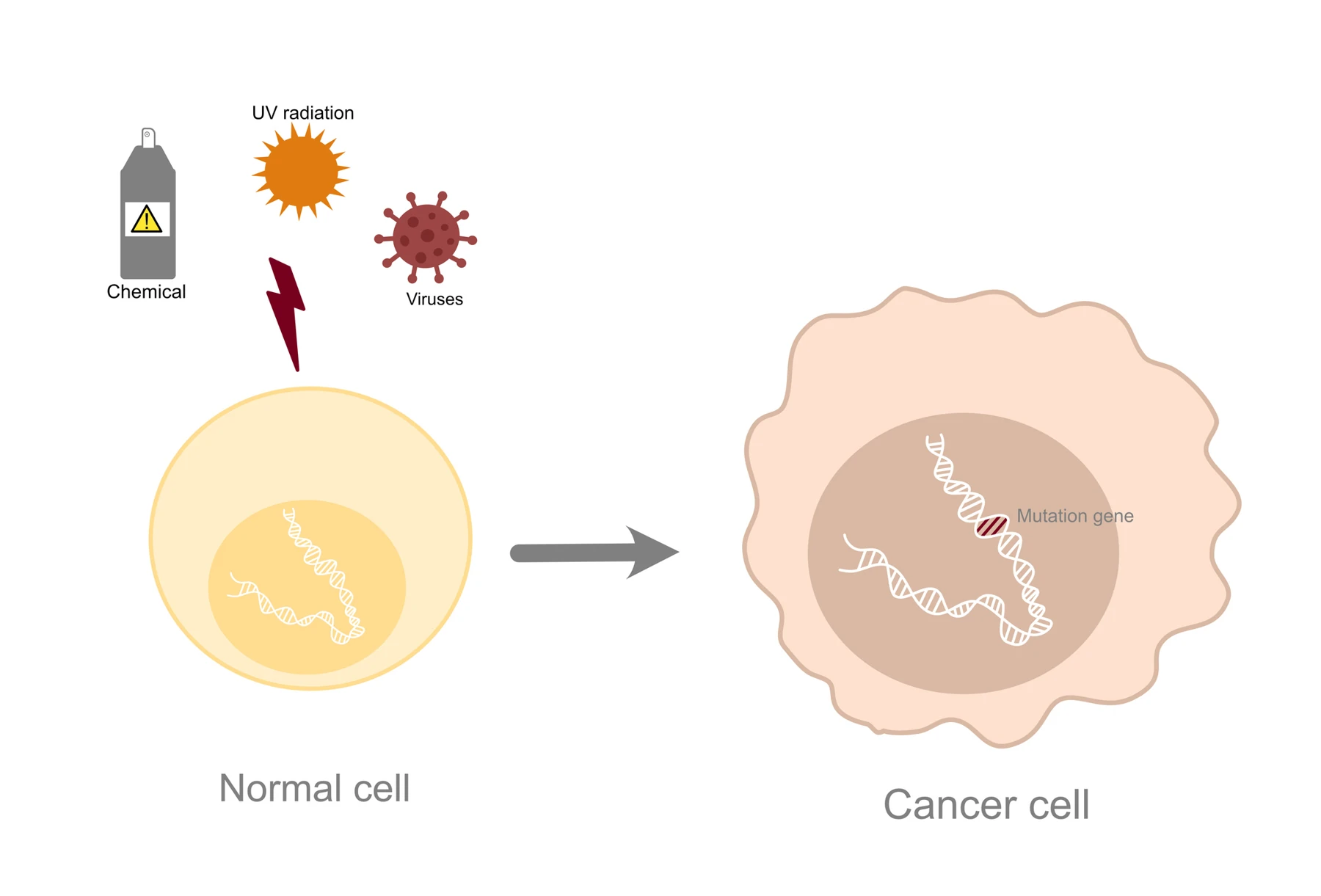
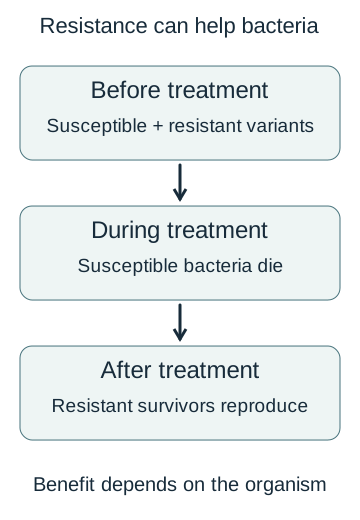
Mutations supply inherited variation. Resistance to a drug can benefit a bacterium while making an infection harder to treat. Other mutations damage protein function, and some have no noticeable effect. A mutagen, such as UV radiation or a DNA-damaging chemical, raises the rate of mutations.
The lesson also discusses sickle-cell disease, cystic fibrosis, chromosome-number changes from nondisjunction, resistance traits, and polyploid crops. Sickle-cell and cystic fibrosis examples connect altered genes with protein function. Nondisjunction is a failure of chromosomes or chromatids to separate; it can leave a gamete with an extra or missing chromosome. Polyploidy involves extra complete chromosome sets.
Got it now? Scroll back up and re-read the section — it should land differently.
Cancer involves uncontrolled cell growth and division. Mutations in genes that regulate the cell cycle can disrupt its controls; p53 is one example in the lesson. A benign tumor stays localized. A malignant tumor invades nearby tissue and can spread.

The course describes radiation and chemotherapy as cancer treatments and explains that rapid cell division can make cancer cells vulnerable to DNA damage. Use this as a biology connection between the cell cycle and treatment. For the quiz, distinguish uncontrolled growth, benign tumors, and malignant invasion. p53 helps control cell-cycle responses when DNA is damaged.
Got it now? Scroll back up and re-read the section — it should land differently.
Choose an answer, then use the explanation to check your reasoning.