

The big idea Copy the DNA message, then read mRNA codons to build a protein.
By the end you can
- Distinguish the three RNA jobs.
- Transcribe a labeled DNA template.
- Match codons and anticodons.
- Use an mRNA codon chart to translate a sequence.
Module 03: Cell Reproduction
By the end you can
Keep the message, delivery, and building jobs separate.
Transcription makes mRNA from the DNA template. Pair A with U, T with A, and C with G.
Split mRNA into groups of three. Look those mRNA codons up on the chart.
tRNA brings amino acids to the ribosome. The chain grows until a stop codon.
Do you look up a DNA template directly on the codon chart?
No. Make its complementary mRNA first.
Got it now? Scroll back up and re-read the section — it should land differently.
DNA stores the instructions. Transcription copies a gene into mRNA. Translation reads that message to assemble amino acids into a protein. This flow of information is the central dogma.
In a eukaryotic cell, DNA stays in the nucleus. mRNA can leave and carry its message to a ribosome.
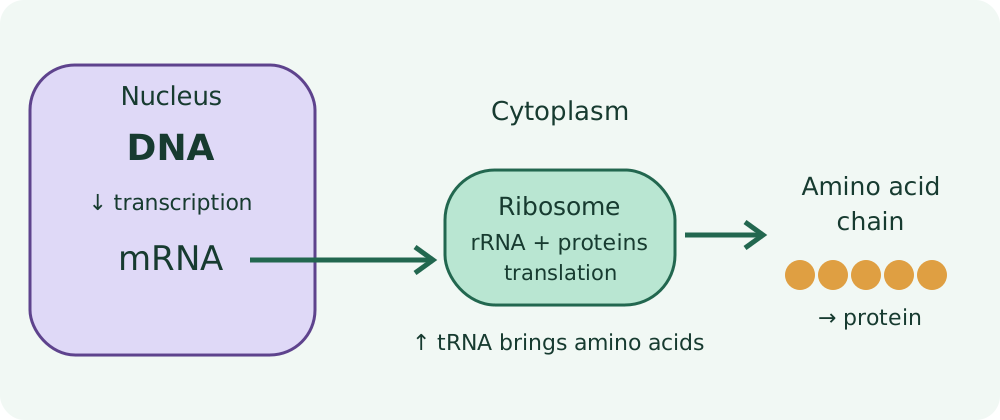
Messenger RNA (mRNA) carries the copied instructions. Transfer RNA (tRNA) delivers amino acids. Ribosomal RNA (rRNA), together with proteins, forms ribosomes and helps join amino acids.
RNA is usually single-stranded, has ribose sugar, and uses uracil (U). DNA is double-stranded, has deoxyribose, and uses thymine (T).
RNA polymerase separates a section of DNA and builds complementary mRNA from one template strand. Promoters mark where transcription begins.
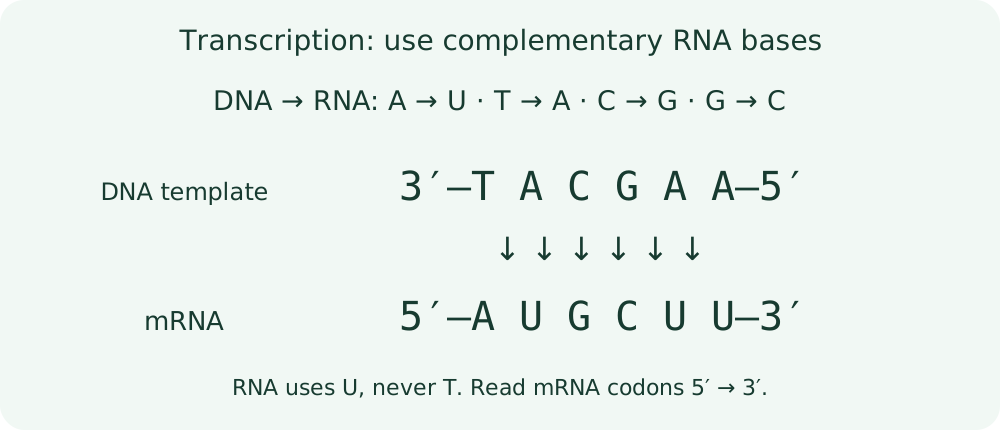
Pair DNA → RNA as A → U, T → A, C → G, and G → C. For example, DNA template 3′-TAC GAA-5′ gives mRNA 5′-AUG CUU-3′.
Check whether a question gives a template strand or a coding strand. This practice always labels template strands explicitly.
A codon is three bases on mRNA. A complementary anticodon is on tRNA. For mRNA codon 5′-AUG-3′, the paired anticodon is 3′-UAC-5′.
The ribosome reads mRNA codons. Matching tRNAs bring amino acids, which are linked into a chain. AUG starts translation and codes for methionine. UAA, UAG, and UGA signal stop; a stop codon does not add an amino acid.
Read mRNA 5′ to 3′ in groups of three. Find the first base at the left, the second across the top, then the third base within the cell. Use mRNA, not the DNA template or tRNA anticodon.
Example: AUG CAU UGA gives methionine, histidine, then stop. Some amino acids have several codons. That is why a base change does not always change the protein. Four bases in three positions give 64 codons for 20 amino acids plus stop signals.
The genetic code is shared by nearly all organisms. Amino acid order helps determine protein shape and properties.
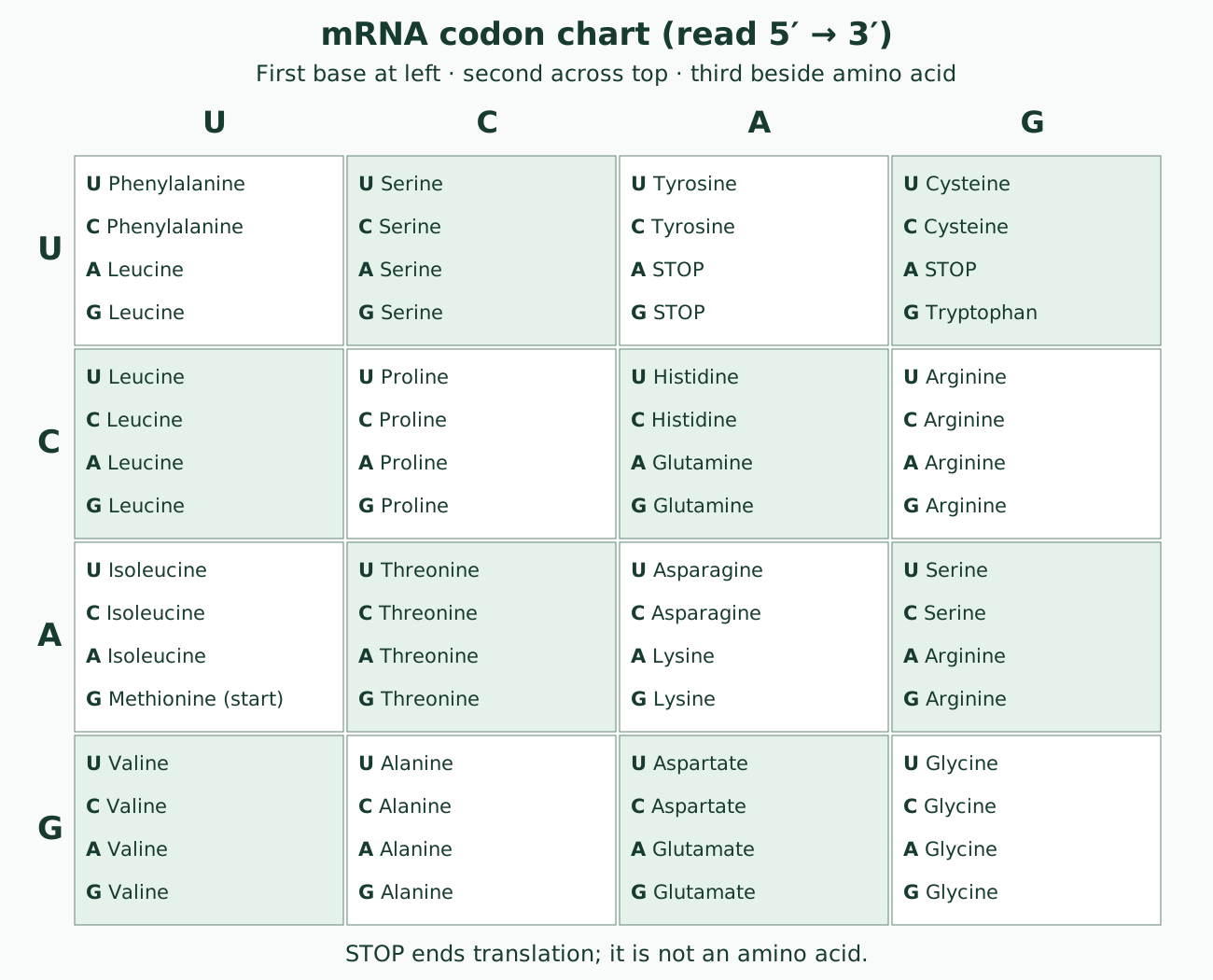
For ACG: find row A, column C, then the line beginning G. The answer is threonine.
Does a stop codon add an amino acid?
No. It signals the end of translation.
Got it now? Scroll back up and re-read the section — it should land differently.