The big ideaThe DBA is a short conversation about 01.01, 01.02, and 01.03. For each question: name the idea, explain why it works, and give one course example. Eight short Explain-it rehearsals let you practice that move without answer choices. After the call, submit the date and time of the conversation in the Reflection assignment.
By the end you can
Explain one idea from each of the three module lessons out loud
Support an answer with a course example instead of stopping at a definition
Complete short-answer rehearsal without relying on multiple-choice options
Complete the DBA call and submit its date and time
Before the DBA β what the call is actually checking
The instructor will ask a few questions from Lessons 01.01β01.03 to make sure you are ready for the module exam. You do not need a speech or a perfect script.
Not sure about the basics underneath this lesson?
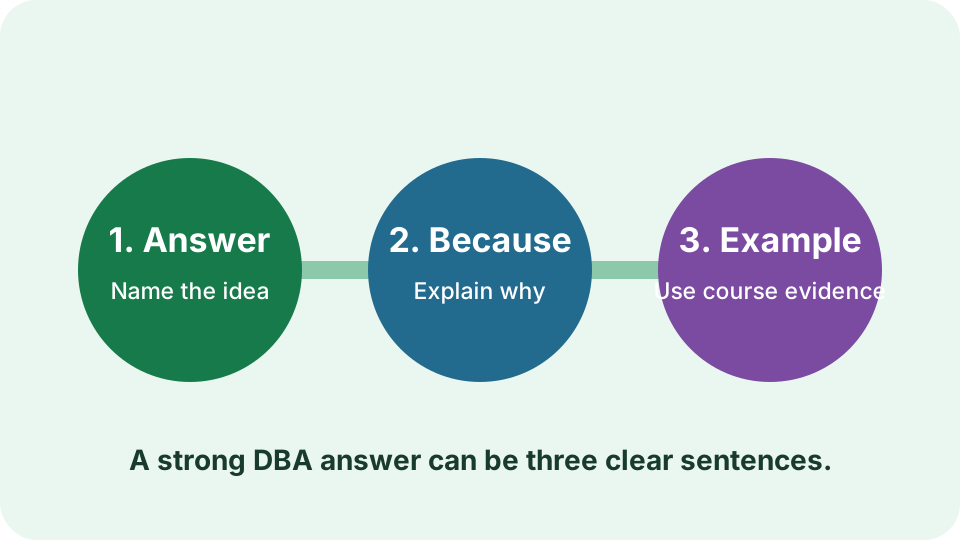
A complete answer has three small parts.
Answer β because β example
1
1. Answer
Name the idea directly. Example: βAn enzyme lowers activation energy.β
2
2. Because
Explain what that changes. Example: βThat lets the reaction start more easily and happen faster.β
3
3. Example
Use course evidence. Example: βLactase speeds the breakdown of lactose.β
4
If you blank
Ask the instructor to repeat the question, name which lesson it comes from, and start with the part you know. That is better than guessing.
Quick check β answer out loud before you peek
What are the three jobs in a strong DBA answer?
Answer the question, explain why, and give a course example.
Got it now? Scroll back up and re-read the section β it should land differently.
01.01 β Exploring Life prompt bank
Try these aloud:
What makes a question scientific instead of an opinion?
How can you tell science from pseudoscience?
In an experiment, how do you identify the independent variable, dependent variable, control group, and controlled variables?
How are a scientific theory and law different?
Talking points: Science uses observable evidence and testable questions. Its evidence can be measured, repeated, and checked by others. Pseudoscience may sound scientific but does not follow a reliable experimental method. The IV is changed; the DV is measured; the control group stays under the same conditions except for the tested independent-variable change; controlled variables stay the same. A theory explains how or why; a law describes what happens. A theory does not become a law.
Say the answer, explain why, then give a course example.
Likely on the quizCourse example: in the salt-and-water table, more salt delayed freezing, supporting the inference that salt lowers water's freezing point.
01.02 β Chemistry of Life prompt bank
Try these aloud:
Compare the structure and job of carbohydrates, lipids, proteins, and nucleic acids.
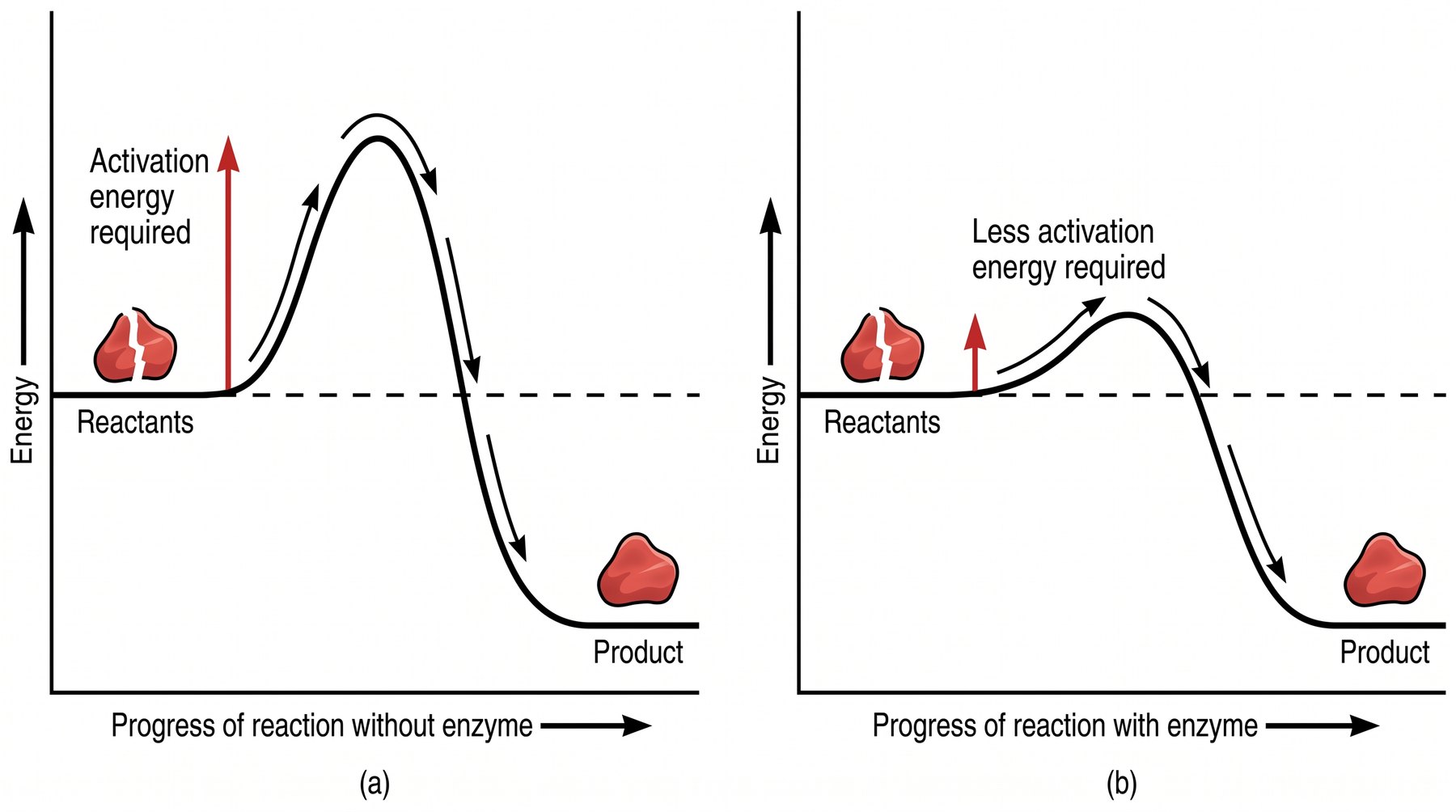
How do enzymes regulate chemical reactions?
Why does a molecule's structure matter to its function?
What happens when atoms in sugar molecules are rearranged during a chemical reaction?
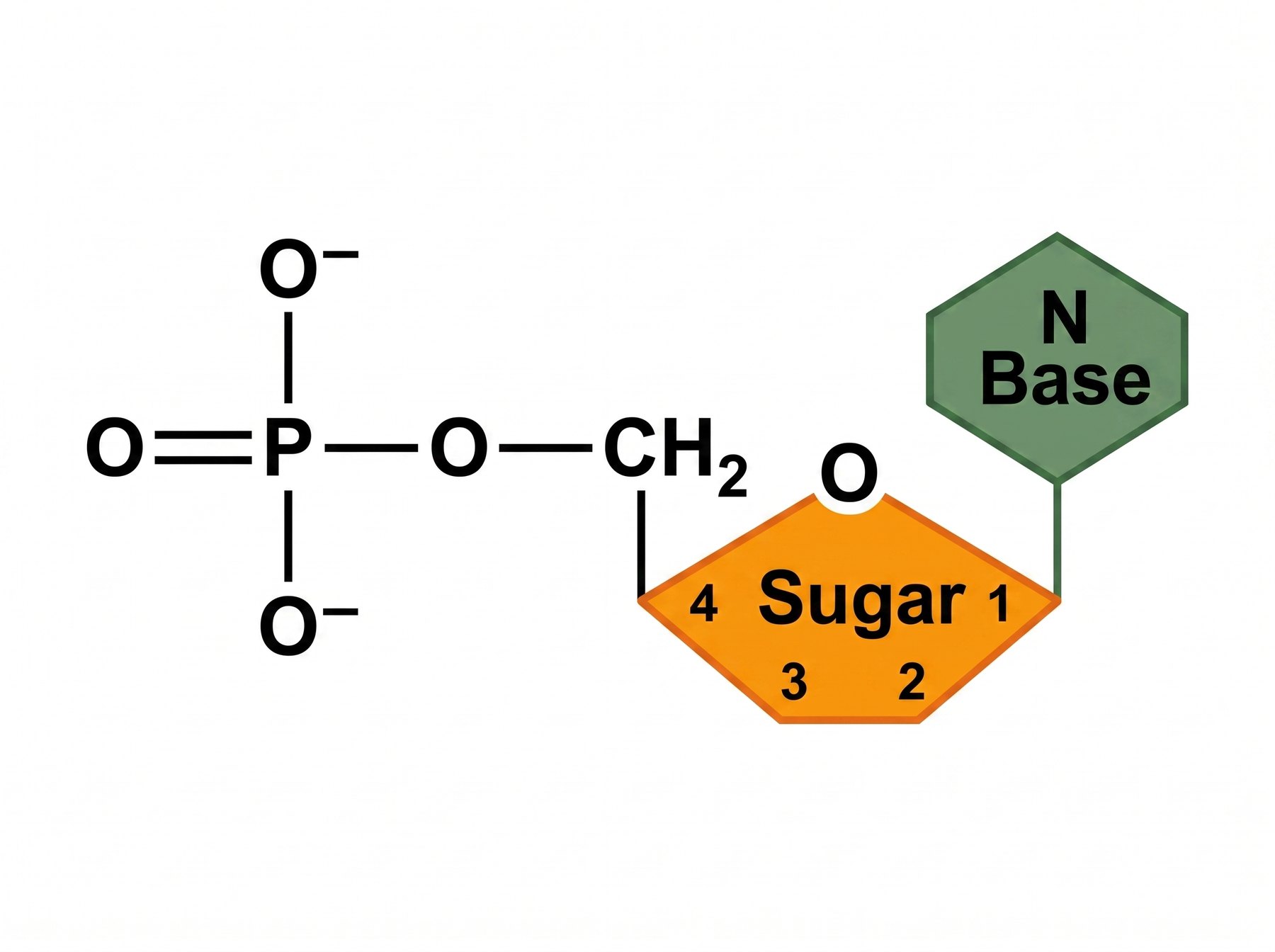
Talking points: Carbohydrates are sugar units used mainly for energy. Lipids have several structures: fats have glycerol plus three fatty acids; phospholipids have glycerol, two fatty acids, and a phosphate group; steroids have four linked carbon rings. Lipids store energy, form membranes, or act as chemical signals. Proteins are amino-acid chains whose folded shapes do many jobs; nucleic acids are nucleotide chains that store genetic information. Enzymes lower activation energy and speed reactions without being used up. If an enzyme denatures, its active-site shape no longer fits. Sugar reactions recombine carbon, hydrogen, and oxygen atoms into different products, and those rearrangements help provide energy for cell processes.
A nucleotide: sugar + nitrogen base + phosphateThe enzyme pathway has the lower activation-energy peak.
Likely on the quizThe recovered 01.04 review asks about carbohydrate as a photosynthesis product, lactase speeding lactose breakdown, and the three-part nucleotide structure.
01.03 β Earth's Early Atmosphere prompt bank
Try these aloud:
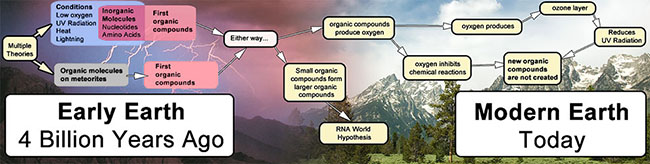
What were conditions like on early Earth?
What evidence supports ideas about how organic molecules formed?
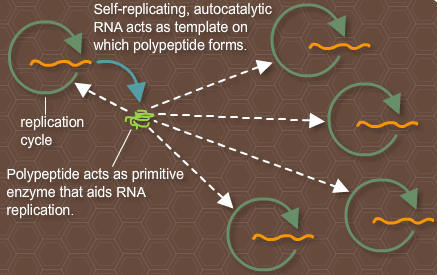
How does RNA World connect early life to the universal genetic code?
What were the first cells, and how did oxygen change life later?
Why did anaerobic respiration fit the first cells, and why did aerobic respiration become useful later?
Talking points: Early air had little oxygen and included inorganic gases, with strong UV and volcanic energy. Organic molecules could form from inorganic materials or arrive on meteorites; Miller and Urey showed amino acids could form under simulated conditions, though their setup did not prove exactly how life began. Self-replicating RNA could carry information and act as a catalyst. The first organisms were anaerobic prokaryotes. Photosynthetic cyanobacteria added oxygen later, allowing oxygen-using aerobic organisms to become common.
Early Earth had little oxygen; oxygen and ozone came later.RNA World connects self-copying information with catalytic activity.
Likely on the quizDo not blend the names: Oparin and Haldane proposed organic-from-inorganic chemistry; Miller and Urey ran the flask experiment; RNA World is the self-copying/catalyst idea.
Oral rehearsal β build a complete answer
Pick any prompt above. Give yourself about 30 seconds to answer without reading the talking points.
Answer: Name the idea directly.
Because: Explain the mechanism or reason.
Example: Use a molecule, experiment, graph, or early-Earth example from the course.
If you get stuck, say, βI know this connects toβ¦β and name the lesson bucket. That gives you a clean restart instead of guessing.
Three sentences are enough when each sentence has a job.
Likely on the quizThe course rubric rewards understanding supported with explanations and methods. A bare vocabulary definition is weaker than a definition plus why and an example.
Short-answer rehearsal β no answer choices
The DBA Explain-it practice gives you eight short questions across all three lessons. Answer from memory first. The feedback checks the biology and gives you another try when an important idea is missing.
You do not need to finish all eight in one sitting. Before the call, clear at least one from 01.01, two from 01.02, and two from 01.03 so every lesson bucket has been tested without multiple choice.
Practice explaining the evidence, not recognizing an answer choice.
Likely on the quizUse the same three-part frame each time: answer, because, course example.
Course self-check β mixed module practice
These nine questions preserve the concepts and wording patterns from the course's recovered 01.04 Test Your Knowledge activity. Answer first; use the explanation only after you choose.