04.05 Circuit designs

Module 04 โ€” Circuits and Current ยท quiz worth 30 pts

The big idea Series means one path. Parallel means more than one path. Adding resistance in series raises total resistance. Adding parallel branches lowers it and raises total current at the same voltage.

Count the paths

Series and parallel look similar in a schematic until you trace from one battery terminal around and back.

Not sure about the basics underneath this lesson?

What every complete circuit still needs

Current needs a voltage source and an unbroken path. The path is usually wire. Devices on that path use the current and add resistance. How those resistances are arranged changes the overall resistance, and therefore the current. The two simple layouts are series and parallel. Many building circuits mix both; that mix is a series/parallel circuit.
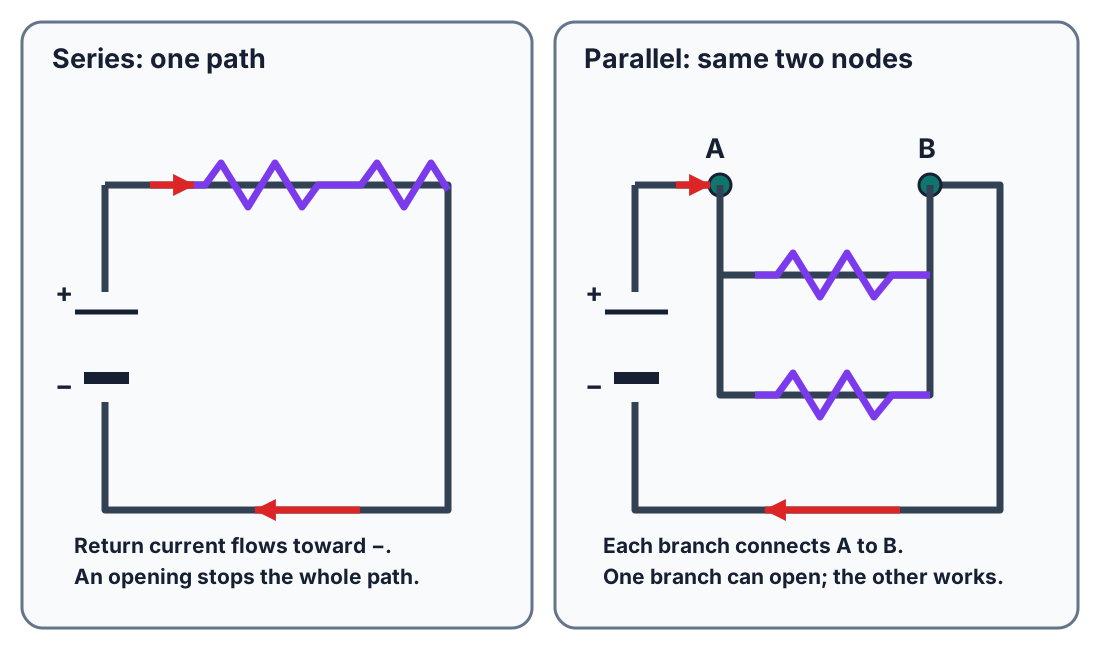
Series: one path

In series, resistors sit one after another on a single path. Charge has only that path. If it opens, current stops everywhere. Holiday lights wired in series go all dark when one bulb burns out. Adding resistors in series increases total resistance and decreases the flow rate of charge. Compass deflection around a simple series loop is the same at different points: there is one current on that one path.

A series circuit has one current path through two resistors, while a parallel circuit has two resistor branches connected between the same nodes A and B; each cell labels the long thin bar positive and the short thick bar negative, and conventional-current arrows return toward the negative terminal.
Series components share one path. Parallel branches share the same two nodes. Conventional current leaves + and returns toward โˆ’.
Not sure about this bit?

Parallel: more than one path

In parallel, two or more resistances connect between the same two points. Charge can take any complete branch. If one bulb burns out, the other complete branches can stay lit. With the same components and the same voltage, more electrons flow through the parallel arrangement than through the series arrangement, so total current is higher. Adding resistors in parallel decreases total resistance and increases the flow rate of charge.

Not sure about this bit?

Compare with Ohm's law

1. Keep voltage in view

The lesson's comparison uses the same source voltage and the same parts, rearranged.

2. Ask how many complete paths exist

One path is series. Shared endpoints for two or more resistors is parallel.

3. Translate to R and I

I = V/R. If the layout raises total R, current falls. If it lowers total R, current rises. That is why the parallel compass deflection is larger in the course activity.

4. Record the worksheet the way Canvas asks

The 04.05 Circuit Construction Kit work is a data table, not a multiple-choice quiz. In series, the current through each bulb is the same. Compute each V = IR, check that those voltages add to the source, then P = IV for each bulb. In parallel, the voltage across each bulb is the same. Compute each I = V/R, check that those currents add to the source current, then P = IV for each bulb. Do not replace that table with a single equivalent-resistance formula. This lesson never writes one.

Worksheet rehearsal: three resistors

Series: same current, voltages add

  • Resistances. R1=2.0โ€‰ฮฉ,ย R2=4.0โ€‰ฮฉ,ย R3=8.0โ€‰ฮฉR_1=2.0\,\Omega,\ R_2=4.0\,\Omega,\ R_3=8.0\,\Omega
  • Series current (same through each). I=1.0โ€‰AI=1.0\,\text{A}

Find each bulb voltage, check the source voltage, and find each power.

  1. Each voltage is V = IR. The current is 1.0 A in every resistor.
    V1=(1.0)(2.0)=2.0โ€‰V,ย V2=4.0โ€‰V,ย V3=8.0โ€‰VV_1=(1.0)(2.0)=2.0\,\text{V},\ V_2=4.0\,\text{V},\ V_3=8.0\,\text{V}
  2. Series voltages add to the source.
    Vsource=2.0+4.0+8.0=14.0โ€‰VV_{\text{source}}=2.0+4.0+8.0=14.0\,\text{V}
  3. Each power is P = IV.
    P1=2.0โ€‰W,ย P2=4.0โ€‰W,ย P3=8.0โ€‰WP_1=2.0\,\text{W},\ P_2=4.0\,\text{W},\ P_3=8.0\,\text{W}

V = 2.0 V, 4.0 V, 8.0 V. Source 14.0 V. P = 2.0 W, 4.0 W, 8.0 W. One open resistor stops this whole loop.

Parallel: same voltage, currents add

  • Resistances. R1=2.0โ€‰ฮฉ,ย R2=4.0โ€‰ฮฉ,ย R3=8.0โ€‰ฮฉR_1=2.0\,\Omega,\ R_2=4.0\,\Omega,\ R_3=8.0\,\Omega
  • Source voltage (same across each branch). V=8.0โ€‰VV=8.0\,\text{V}

Find each branch current, check the source current, and find each power.

  1. Each current is I = V/R. The voltage is 8.0 V on every branch.
    I1=8.0/2.0=4.0โ€‰A,ย I2=2.0โ€‰A,ย I3=1.0โ€‰AI_1=8.0/2.0=4.0\,\text{A},\ I_2=2.0\,\text{A},\ I_3=1.0\,\text{A}
  2. Parallel currents add to the source current.
    Isource=4.0+2.0+1.0=7.0โ€‰AI_{\text{source}}=4.0+2.0+1.0=7.0\,\text{A}
  3. Each power is P = IV.
    P1=(4.0)(8.0)=32โ€‰W,ย P2=16โ€‰W,ย P3=8.0โ€‰WP_1=(4.0)(8.0)=32\,\text{W},\ P_2=16\,\text{W},\ P_3=8.0\,\text{W}

I = 4.0 A, 2.0 A, 1.0 A. Source 7.0 A. P = 32 W, 16 W, 8.0 W. One open branch leaves the other complete branches working.

Not sure about this bit?

Traps on this lesson

Series is not 'stronger current'

Adding series resistors lowers flow rate. The holiday-light failure mode is total blackout, not extra current.

Parallel is not 'one path with extra bulbs'

Parallel means shared endpoints and extra paths. Extra series bulbs on the same line are still series.

Mixed circuits exist

A building circuit can be series/parallel. Name the part that is one-path and the part that branches.

Layout practice

For each item, count complete paths before choosing.

Final checklist

Tick these off as you go. Saved in this browser.