04.03 Capacitance

Module 04 โ€” Circuits and Current ยท quiz worth 15 pts

The big idea A capacitor is two conducting plates separated by an insulator. It stores charge. Charge does not travel through the dielectric.

Store, don't conduct through

People treat a capacitor like a short piece of wire. It is a dead end with a second plate nearby.

Not sure about the basics underneath this lesson?

Two plates and a dielectric

A capacitor is two layers of conducting material separated by an insulator. The conductors are the plates. The insulator is the dielectric. It stops charge from moving from one plate to the other inside the device. You can make a simple capacitor with wax paper between two sheets of aluminum foil. Manufactured capacitors roll that stack into a cylinder and put it in a can. The schematic symbol is two equal parallel lines. Capacitance is the charge-holding ability of that stack. It is measured in farads (F), named after Michael Faraday.
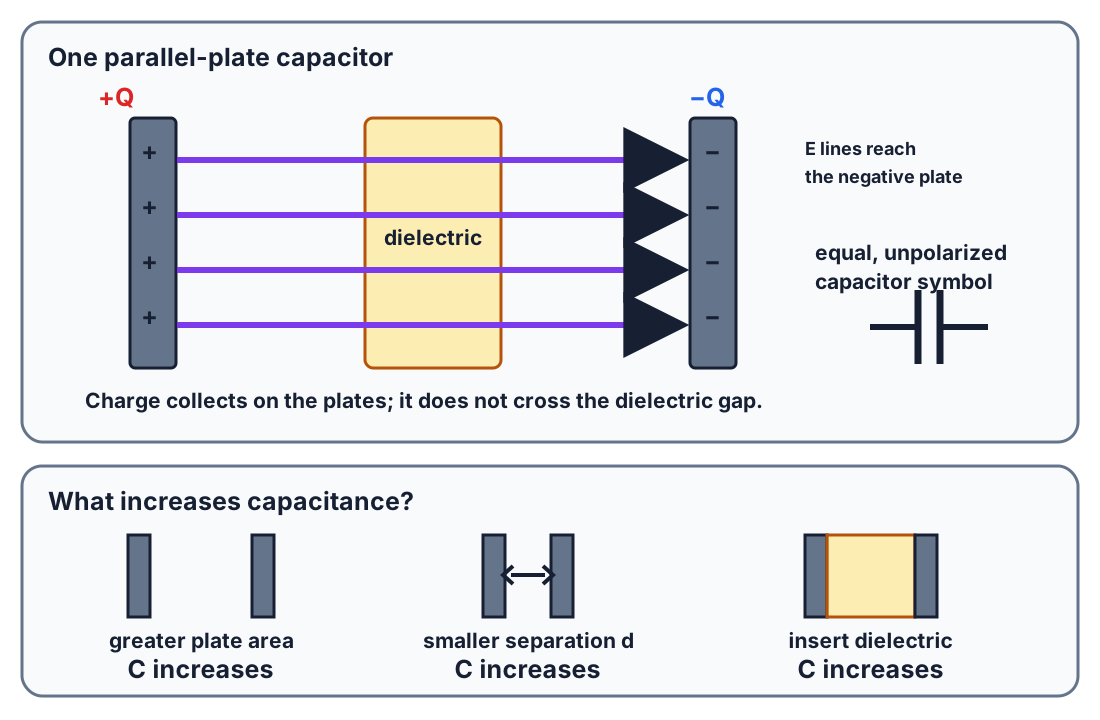
A positive plate and negative plate face each other with electric-field arrows reaching across a dielectric from positive to negative; comparisons show that greater plate area, smaller separation, and inserting a dielectric increase capacitance.
Charge collects on equal plates without crossing the dielectric gap. Greater plate area, smaller separation, and a dielectric each increase capacitance.

What changes capacitance

Parallel-plate capacitance depends on plate area, how far apart the plates are, and the material between them. A computer key is a capacitor: pressing it moves the plates closer and increases capacitance, which the computer reads as a keystroke. A defibrillator stores a burst of charge on capacitors. Nerve cells have biological capacitors that discharge as impulses. The course animation of how a capacitor works has no accessible text version. Open that widget in Canvas if you need the motion.

The air-jar analogy

The lesson uses two plastic jars with a balloon between them as a model. Real capacitors do not contain air or balloons. The balloon stands for the dielectric: air cannot pass through it, just as charge cannot pass through the insulator between plates. Blow into one tube and the balloon expands into the other chamber. Air that comes out the far tube came from that far chamber, not through the balloon. Cover one tube and the balloon stays distended. That is the analog of stored charge remaining on the plates.

Charging and discharging

Charge

Put the capacitor in a battery circuit and close the switch. The bulbs light briefly, then dim and go out. The compass deflects, then returns to rest. Rest means the capacitor is fully charged. This lesson locates that stored charge on the plate attached to the battery's positive terminal. The other plate is still there: it is a conductor on the negative terminal. The dielectric between them blocked a through path.

Discharge

Open the switch, remove the battery, close the gap with a wire, and close the switch again. The bulbs light briefly and go out. The compass deflects the other way, then returns. There is no battery in the loop, so the moving charge had to come from storage on the plate.

What that proves

Charge did not travel through the capacitor and back to the battery during charging. It was stored on the + plate, with the other plate connected to the negative terminal. Discharging still lights the bulbs after the battery is gone.

Not sure about this bit?

Traps on this lesson

The dielectric is not a wire

Charge does not flow through the insulator between the plates. That is the point of the balloon in the air-jar model.

Brief light is not a broken bulb

On charge and on discharge, the bulbs flash and then go out because current is temporary. A steady glow would mean a through conductor, not a capacitor.

Closer plates, larger capacitance

The keyboard key works because pressing reduces separation. Do not reverse that: moving plates apart lowers capacitance in this lesson's account.

Capacitor practice

For each item, say where the charge is and whether anything can pass through the insulator.

Final checklist

Tick these off as you go. Saved in this browser.