3.3.2 Is It Fair? β€” discussion prep

Unit 3 Β· Culture Β· Lesson 3.3 Economics

The big idea Global trade has grown more than 20 times over since 1950, and world wealth has more than quintupled β€” but not evenly. This discussion asks you to pick one question about that unevenness and defend a position with real evidence. This page reviews the setup data and the reasoning tools; the position is yours to choose.

By the end you can

  • Describe how global wealth and trade have grown since 1950.
  • Explain that this growth has been distributed unevenly.
  • Choose one discussion question, take a position, and support it with two pieces of evidence.
Before you start: what "unevenly distributed growth" actually means

The discussion questions all assume you already get this idea. Here it is in plain terms.

Not sure about the basics underneath this lesson?

The numbers behind the question

The activity opens with real figures: the volume of international trade grew more than 20 times in the 50 years before this course was written β€” from around $300 billion in 1950 to around $7,000 billion ($7 trillion) in 2004. Over the same period, global wealth (GDP) more than quintupled, and the global per-person average nearly tripled.

The numbers behind the question (2)

But the activity is explicit that these gains are not evenly distributed β€” advanced, industrialized economies have captured far more of the growth, widening the gap between wealthy and poorer nations. That gap is the entire premise behind the three discussion questions.

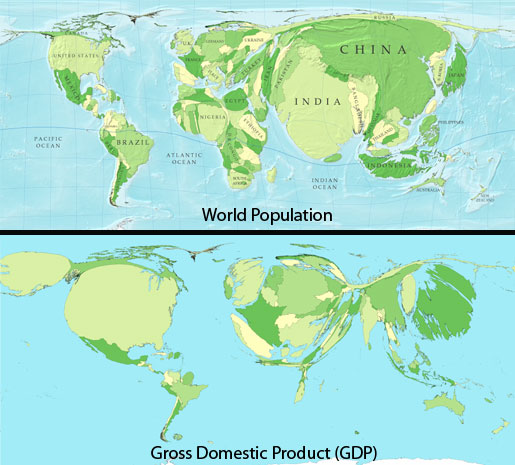
Two world cartograms with country shapes resized by population (top) and by gross domestic product (bottom)
The activity's own cartograms: world population (top) vs. gross domestic product (bottom). Compare how differently the two maps balloon β€” wealth is far more concentrated than population.
Likely on the quiz If you want a concrete data point for your post, the trade and GDP figures above are straight from the activity itself β€” you don't have to invent numbers.

Pick one question and build two pieces of evidence

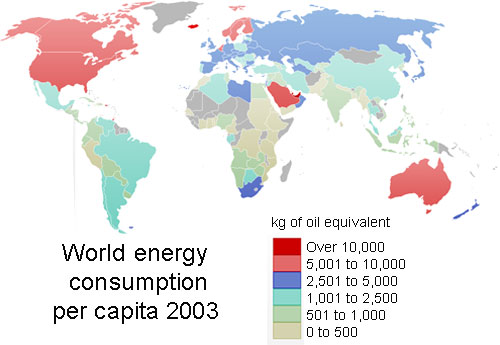
You choose one of three questions: (1) Is economic growth more important than economic equality? (2) Should economic growth be sacrificed, if necessary, to reduce poverty? (3) Should world energy consumption be more evenly distributed β€” and what could be done to make it that way?

Pick one question and build two pieces of evidence (2)

For whichever you pick, the activity's own planner asks you to take a yes/no stance and then write two separate pieces of supporting evidence β€” not just restate your opinion twice. Evidence can come from the maps and data on this page, something from earlier in this unit (development, GDP, HDI), or outside knowledge you can explain clearly. If you pick question 3, your post should also address the "what could be done" part, not just whether distribution should change.

Pick one question and build two pieces of evidence (3)

Your actual post needs to be a real paragraph: complete sentences, proper spelling and punctuation, logic and evidence doing the work β€” not just a stated opinion.

World map color-coded by per-capita energy consumption, from dark red (highest) to tan (lowest)
World energy consumption per capita β€” directly relevant if you pick question 3.
Likely on the quiz "Supporting evidence" means something a skeptical reader could check or recognize as a real pattern β€” not just a stronger restatement of your opinion.
Not sure about this bit?

How this discussion is actually scored

The activity's own scoring note: this discussion is worth a maximum of 10 points. You get up to 7 points for your original post (the paragraph answering your chosen question). You get up to 3 more points if you add a real, substantive follow-up β€” responding to a classmate's post with specific agreement, disagreement, or a question that pushes the discussion further. A one-line "I agree!" reply will not earn those 3 points.

How this discussion is actually scored (2)

One more thing straight from the activity: if you're working ahead in the course, or you're the only one in the discussion, check with your teacher for grading guidelines so you can still receive full credit β€” the normal peer-reply structure assumes classmates are there to respond to.

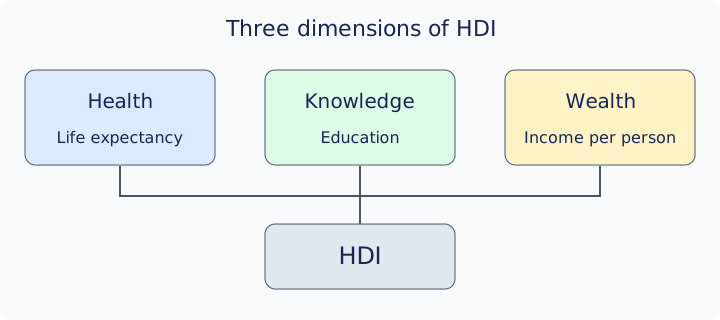
HDI combines health, knowledge, and income per person.
A reference for separating development outcomes from total economic output.
Likely on the quiz Budget your effort to match the points: the 7-point original post is the bulk of the grade, but don't skip the 3-point follow-up if classmates have posted β€” a real response to someone else's reasoning, not just a compliment.
Not sure about this bit?

Final checklist

Tick these off as you go. Saved in this browser.