The big ideaEvery government answers the same question differently: who holds power, and how much of it? One person (autocracy), a small group (oligarchy), everyone (democracy), or no one (anarchy). Once you can sort a government into one of those buckets, you can explain Socialism vs. Communism, spot a theocracy, and read a political map for what it really shows: not land, but sovereignty.
By the end you can
Read political maps.
Describe the different forms of government around the world.
Evaluate the strengths and weaknesses of different systems of government.
Analyze the tension between ethnicities and national governments.
Before you start: sort every government by two questions
This unit throws a lot of government types at you fast. Almost all of them answer just two questions, and once you ask those two questions automatically, the vocabulary stops feeling random.
Not sure about the basics underneath this lesson?
Every time you meet a new government word, ask: (1) who holds the power — one person, a few, or everyone? (2) how much power do they hold — total control, a lot but not total, or limited?
One ruler = autocracy. A small group = oligarchy. Everyone, through voting = democracy. Theocracy is really a flavor of either autocracy or oligarchy, where the power is justified by religion instead of force or heredity.
Total control over actions AND beliefs = totalitarian. A lot of power but not that total = authoritarian. Specific limits written into law = limited government. No real power at all = anarchy.
3
The two questions are independent
A government can be an autocracy (question 1) that's also authoritarian rather than totalitarian (question 2) — the two sortings don't have to match up the same way every time.
Quick check — answer out loud before you peek
A king rules alone, but a written constitution limits what he's allowed to do. How would you answer both sorting questions?
Who holds power: one person, so autocracy. How much power: limited, since the constitution restricts it — this would be a limited monarchy, not a totalitarian one.
Got it now? Scroll back up and re-read the section — it should land differently.
What a political map actually shows
A political map shows political units and their boundaries — but what it's really mapping is power: control over the actions of others.
What a political map actually shows (2)
The course draws a sharp line between power and authority. A mugger with a gun has power — he can control what you do — but not authority, because his power comes from fear, not from being recognized as legitimate. A respected leader has both. Legitimate means recognized as having the right to rule, even by people who complain about that government.
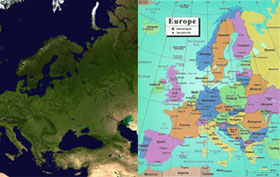
The course's own contrast: a satellite photo shows nature; a political map shows something invisible from space — who governs what.
Likely on the quizCaligula's motto — "let them hate me, as long as they fear me" — is the course's own example of power without legitimacy. If a question describes control through fear alone, that's power, not authority.
Sovereignty and the four traits of a state
Sovereignty goes further than authority: it's the exclusive, supreme authority within a territory — the one kind of power only a government can hold, never a parent or a mugger. Every nation-state (a people within a territory, ruled by a sovereign government) shares four characteristics: population, territory, government, and sovereignty.
Historical classifications from the course; use the lesson’s definitions rather than treating this as current news.
Likely on the quizIf a question lists the four traits every state shares, they're exactly these four words: population, territory, government, sovereignty.
Political art and protest: Dylan, Rivera, Neruda
This unscored activity asks you to read three works created out of political dissatisfaction, each in a different medium:
Political art and protest: Dylan, Rivera, Neruda (2)
Bob Dylan's "The Times They Are A-Changin'" (1964 song) — widely read as a statement about the generation gap and the hope younger people brought to political movements of the era, though Dylan himself downplayed any deliberate statement, saying he was mainly capturing a feeling.
Political art and protest: Dylan, Rivera, Neruda (3)
Diego Rivera's murals — the original New York mural, Man at the Crossroads (1933), included Lenin. Rockefeller asked Rivera to remove Lenin's face; Rivera refused, and the mural was covered and later destroyed. Rivera reworked it in Mexico City as Man, Controller of the Universe (1934). Distinguish the destroyed New York work from the surviving Mexican version. The course's political point is the conflict over the imagery and its message. Museum chronology.
Political art and protest: Dylan, Rivera, Neruda (4)
Pablo Neruda's "The Dictators" (1950 poem, Canto General) — a Chilean poet and political activist (and Nobel laureate), his poem uses images of death, silence, and decay to convey the horror of life under dictatorship.
Political art and protest: Dylan, Rivera, Neruda (5)
The point tying all three together: art can carry a political message as powerfully as — sometimes more powerfully than — a direct argument, because it reaches people's emotions as well as their reasoning.
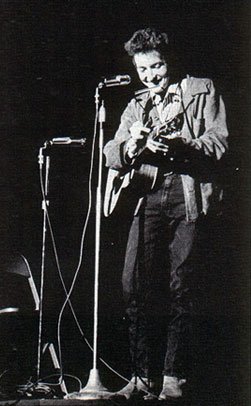
Bob Dylan performing in 1963, a year before "The Times They Are A-Changin'" — the course's own photo for this activity.
Likely on the quizMatch each artist to a medium and message, then explain the political conflict or concern expressed by the work.
Not sure about this bit?
Three different art forms, three different political moments. The trick is keeping straight which one goes with which.
1
Anchor each to one detail
Dylan = a song about generational change. Rivera = a mural so controversial it got destroyed. Neruda = a poem about the horror of dictatorship.
2
Rivera's story has a clear cause and effect
He painted Lenin into a mural the Rockefellers commissioned → they asked him to change it → he refused → they destroyed it. That chain of events is the part worth remembering, not just "there was a mural."
3
Why the course groups all three together
It's making one point three ways: art can carry a political message as powerfully as — sometimes more powerfully than — a direct argument, because it reaches emotion, not just reasoning.
Got it now? Scroll back up and re-read the section — it should land differently.
Oligarchy: a small group holds all the power together. Two named subtypes: an aristocracy (power held by hereditary nobility) and single-party rule (only one official party may hold office).
Theocracy: a nation ruled by the laws of a religion, as interpreted by people believed to be divinely guided. Vatican City (Catholic doctrine, guided by the pope) and several Islamic states — Saudi Arabia, Iran, Afghanistan — are the course's named examples, though it notes their laws vary widely even though all are built on Shariah.
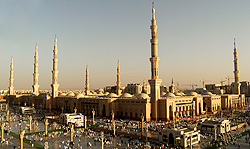
Saudi Arabia — the course's own example of a theocracy, where Islamic law is the basis for national law.
Likely on the quizAristocracy and single-party rule are both kinds of oligarchy — a small group, not one ruler and not the whole population.
Putting strengths and weaknesses into words
Both the Governments study sheet and the separate Perfect Government checkup ask you to fill out the same table: the strengths and weaknesses of autocracy, oligarchy, and democracy. The checkup's own answer key is an in-course interactive this library couldn't capture as text, so use this card to build your own answer from what the lesson already taught you about each system — not to memorize a hidden list.
Putting strengths and weaknesses into words (2)
Work it out from traits you already know: autocracy — one ruler, no consultation required, so decisions can happen fast; but there's no check on that power, and a bad or self-interested ruler has nothing stopping them. Oligarchy — a small group's combined judgment can be broader than one person's, but power still stays concentrated among the few, so most of the population still has no voice. Democracy — citizens have a voice in choosing their leaders, which is the course's own basis for legitimacy and accountability; but building consensus among many people or elected representatives is slower than one person deciding alone, and representative democracy (535 members of Congress for 300 million Americans) still concentrates day-to-day power in relatively few hands.
Historical classifications from the course; use the lesson’s definitions rather than treating this as current news.
Likely on the quizBefore your quiz or checkup, write your own one-line strength and one-line weakness for each of the three systems, using the speed-vs-accountability tradeoff above. Then check it against your actual Perfect Government checkup answer key.
Not sure about this bit?
You don't need a memorized list here — you need a reasoning habit you can apply to any government type.
1
Ask "how fast can they decide?"
Fewer people involved in a decision = faster. That's autocracy's real strength and democracy's real tradeoff.
2
Ask "what stops abuse of power?"
More people with a voice = more accountability. That's democracy's real strength and autocracy's real tradeoff.
3
Apply it to oligarchy in between
A small group is faster than a whole democracy but slower than one autocrat; it has a bit more accountability than one ruler, but still excludes almost everyone from the decision.
Quick check — answer out loud before you peek
Using just the speed-vs-accountability idea, give one sentence each for a strength and a weakness of oligarchy.
Strength: a few decision-makers can combine different perspectives faster than a whole population voting. Weakness: most of the population still has no voice or accountability over those few.
Got it now? Scroll back up and re-read the section — it should land differently.
Democracy: direct vs. representative
Democracy comes from Greek demos (people) + kratos (rule) — "rule of the people." The original Athenian form was direct democracy: every citizen assembles to make decisions directly. It only works at small scale — the New England town meeting is the course's modern survivor.
Democracy: direct vs. representative (2)
Modern nations use representative democracy: sovereignty is exercised by a subset of the people the citizens elect. The U.S. has only 535 members of Congress, 9 Supreme Court justices, and one president representing 300 million people — the course notes this could sound like an oligarchy, but the difference is that everyone has a voice in choosing those few.
Historical classifications from the course; use the lesson’s definitions rather than treating this as current news.
Likely on the quizDirect democracy = everyone decides. Representative democracy = everyone picks who decides. The headcount difference (300 million vs. 535) is the course's own illustration of why representative democracy still isn't an oligarchy.
Parliamentary vs. presidential republic
Two main organizing patterns for representative democracies: in a parliamentary system, the legislature chooses a prime minister (head of government) from among its own members, with a separate, more limited head of state. In a presidential republic, the people elect a president directly and separately from the legislature, and the president serves as both head of government and head of state.
Historical classifications from the course; use the lesson’s definitions rather than treating this as current news.
Likely on the quizHead of state = official face of the country to the world. Head of government = runs the executive branch day to day. In a presidential republic, one person is both.
Voting systems
First-past-the-post (FPP, "winner take all"): the candidate with the most votes wins, even without a majority. Clinton won the 1992 U.S. presidential election with just 43% of the popular vote because a strong third-party candidate (Perot) split the rest. The runner-up gets zero representation, which tends to push politics toward two dominant parties.
Voting systems (2)
Proportional representation: citizens vote for a party, and seats are divided by each party's share of the vote — a party with 25% of the vote gets about a quarter of the seats, even behind a party with 45%. This gives smaller parties real seats and usually produces multi-party legislatures where coalitions are needed to govern.
Voting systems (3)
Germany combines both ideas, but not by giving each house the same voting method: the elected lower house, the Bundestag, is chosen through a mix of FPP and proportional voting. The upper house, the Bundesrat, isn't elected by citizens at all — its members are delegates chosen indirectly by Germany's state governments.
Historical classifications from the course; use the lesson’s definitions rather than treating this as current news.
Likely on the quizFPP tends toward two dominant parties; proportional representation tends toward several parties and coalitions. For Germany specifically: Bundestag = citizens vote (mixed FPP/proportional). Bundesrat = state governments delegate, no direct citizen vote at all.
Not sure about this bit?
Germany's two houses are easy to mix up because both involve "indirect" representation in some sense — but they're indirect in very different ways.
1
Bundestag: citizens vote, just in a mixed way
Regular German citizens cast votes for the Bundestag. The "mixed" part is just that the system combines first-past-the-post and proportional methods — it's still a direct citizen election.
2
Bundesrat: no citizen vote at all
The Bundesrat's members are sent there by Germany's state governments, the way an employer might send a representative to a meeting. No German citizen casts a ballot for a Bundesrat seat.
3
The one-sentence test
If a question asks "do citizens vote for this body," Bundestag = yes, Bundesrat = no.
Got it now? Scroll back up and re-read the section — it should land differently.
The spread of democracy
The course states that in 1950, about 20 of the world's 80 countries were democracies, and that by the time the course was written, roughly 120 of 193 countries were. Two forces the course names: decolonization in the 1950s–60s (though many former colonies became autocracies, not democracies, so decolonization only partly drove democratization), and the collapse of the Soviet Union, after which most surrounding Communist governments also fell and mostly became democracies.
Historical classifications from the course; use the lesson’s definitions rather than treating this as current news.
Likely on the quizDecolonization alone did not guarantee democracy — the course is explicit that many newly independent states became autocracies instead. These are the course's own stated counts from when it was written, not necessarily today's.
Socialism and Communism
Socialism is a political doctrine promoting social and economic equality and cooperation. Communism is a subset of Socialism, defined by state ownership of the means of production. Communist states use single-party rule because, in the Communist view, competing parties just let the wealthy dominate every party — so the Communist Party alone is trusted to end that exploitation through state control of the economy.
Historical classifications from the course; use the lesson’s definitions rather than treating this as current news.
Likely on the quizKeep the family tree straight: Socialism is the broad goal (equality, cooperation). Communism is one specific path to it (state ownership, often single-party).
Not sure about this bit?
These two words get used almost interchangeably in everyday conversation. The course draws a precise line between them.
1
Socialism is the goal
Social and economic equality and cooperation — that's it. Nothing here says HOW to achieve it.
2
Communism is one specific method
State ownership of the means of production, usually enforced through one party. It's Socialism's goal pursued through government control of the economy.
3
There's more than one method
The next card shows social democracy — the same Socialist goal, pursued through voting and reform instead of state ownership. Communism isn't the only road to Socialism's goal.
Got it now? Scroll back up and re-read the section — it should land differently.
Marx: bourgeoisie, proletariat, and the Manifesto
Karl Marx argued the bourgeoisie (rich property owners, the capitalist class) exploited the proletariat (the working class) by controlling the means of production. His 1847 Communist Manifesto, with Friedrich Engels, called for the proletariat to overthrow capitalism and for the state to take control of production on behalf of the people.
Historical classifications from the course; use the lesson’s definitions rather than treating this as current news.
Likely on the quizBourgeoisie own the means of production. Proletariat sell their labor. Marx's whole argument is about the relationship between those two groups.
Two paths from Marx: social democracy vs. revolution
Not every Socialist agreed with Marx's call for violent revolution. Social Democrats used voting power instead, reforming capitalism (minimum wage, public health care) rather than replacing it — a path the course describes as still popular in Western Europe.
Two paths from Marx: social democracy vs. revolution (2)
Revolutionary Marxists, led by Lenin's Bolsheviks, seized Russia in 1917 and renamed their party Communist in 1918 — the point where Communism split permanently from social democracy as a distinct path.
Historical classifications from the course; use the lesson’s definitions rather than treating this as current news.
Likely on the quizBoth groups shared Marx's goals. Social Democrats chose ballots; revolutionary Marxists like Lenin chose force. That choice is the whole difference.
Communism's spread and decline
The course states that by the early 1980s, nearly a third of the world's population lived under Communist governments, naming China (1949) and Cuba (1959) among its examples. Communism has since declined sharply, per the course: the Soviet collapse in 1989–91, China mixing a command economy with market reforms, and Cuba moving toward private enterprise (from 8% of workers in private companies in 1981 to nearly 23% by 2000, as the course states it).
Historical classifications from the course; use the lesson’s definitions rather than treating this as current news.
Likely on the quizThese spread/decline figures are the course's own stated history up to when it was written — treat them as the course's timeline, not a claim about Communism's status today.
How much power: totalitarian, authoritarian, limited, anarchy
Governments can also be sorted by how much power they hold over daily life, separate from who holds it. Totalitarian government: total control over actions and beliefs — rare, because it's so hard to maintain. Nazi Germany and the Soviet Union are the course's historical examples. Authoritarian government: a lot of power, but not total control — historically the most common form of government. Limited government: specific limits on government power, as in the U.S. and most of Europe.
How much power: totalitarian, authoritarian, limited, anarchy (2)
Authoritarian rulers justify their power in different ways: fear, divine right (a ruler claims God-given authority), or ideology (a belief system that justifies the social order) — and the most extreme version pushes all the way to totalitarianism.
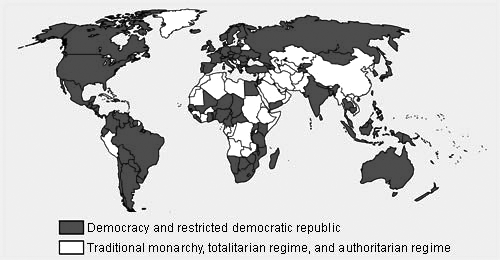
The course's own world map of government types, from the Perfect Government checkup — the same two-color grouping used for strengths/weaknesses reasoning.
Likely on the quizPattern the course points out directly: governments with a lot of power tend to be run by one person or a small group, while democracies tend to limit government power.
Anarchy and failed states
Anarchy — no rules, laws, or government power — is usually short-lived, but it persists in some failed states: countries where the central government doesn't actually control its own territory, often because violent factions (warlords, militias, terrorist groups) compete for control instead. Somalia, fractured since its 1960 independence, is the course's named example.
Historical classifications from the course; use the lesson’s definitions rather than treating this as current news.
Tribes, nations, and the difficulty of unifying them
Nationalism is the belief that a group sharing territory, language, culture, and ethnicity should have its own sovereign state. Building a nation out of diverse tribes and ethnic groups is genuinely difficult — unification is often bloody (even the U.S. needed a civil war 80 years after independence to cement its union).
Tribes, nations, and the difficulty of unifying them (2)
Why unification is hard, per the course: tribal and clan leaders are used to exercising power without opposition, and nation-states force them to share it. Power often comes with economic advantage gained through corruption, which leaders resist giving up. Without a tradition of peaceful political debate, groups often default to violence.
Tribes, nations, and the difficulty of unifying them (3)
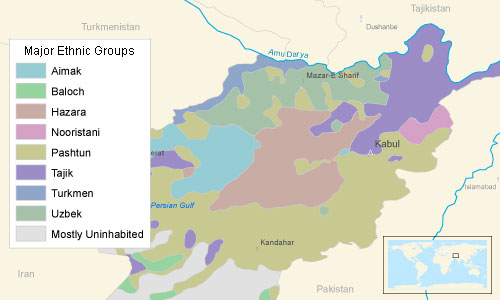
The course's running example is Afghanistan: it describes a new democratic government forming in 2002, after the Taliban's overthrow, and frames the country's four major ethnic groups as an ongoing nation-building challenge at the time the course was written. That's the course's own stated history, not a claim about Afghanistan's government today — treat it as the worked example the lesson is teaching from, not current news.
Afghanistan's major ethnic groups — the course's own illustration of why unifying a nation-state can be so difficult.
Likely on the quizIf a question asks why a diverse country struggles to unify, the course's own two reasons are sharing power (leaders aren't used to it) and sharing economic advantage (often tied to corruption) — not simply "the groups dislike each other."
Partition: a messy possible solution
Iraq, divided among Sunni, Shiite, and Kurdish populations living intermixed rather than in separate regions, is the course's example of how hard partition (dividing a country into separate political entities) would be to pull off cleanly — new borders couldn't cleanly separate populations that already live among each other.
Historical classifications from the course; use the lesson’s definitions rather than treating this as current news.
Likely on the quizPartition sounds like a clean fix on paper. The course's own point is that it usually isn't, when ethnic groups are mixed together rather than geographically separated.
Citizens and public policy
A citizen has the full protections and rights of a nation's laws, plus the responsibility to contribute to its welfare — in the U.S., everyone born in the country is a citizen, and others can become citizens through naturalization. Citizens shape public policy: government actions that make and carry out laws, or solve problems affecting citizens, like building a park to fix a lack of green space or funding freeways to fix aging transportation.
Historical classifications from the course; use the lesson’s definitions rather than treating this as current news.
Power beyond governments: NGOs
Governments aren't the only power-holders. Nongovernmental organizations (NGOs) are private institutions doing work similar to governments — education, health care, emergency services, environmental protection — without being part of one. The course states the world has only about 200 national governments, but over 40,000 international NGOs, plus many more operating domestically.
Historical classifications from the course; use the lesson’s definitions rather than treating this as current news.