1.4.8 Five Themes Assessment Pack

Unit 1 · Introduction to Geography · Lesson 1.4 Five Themes

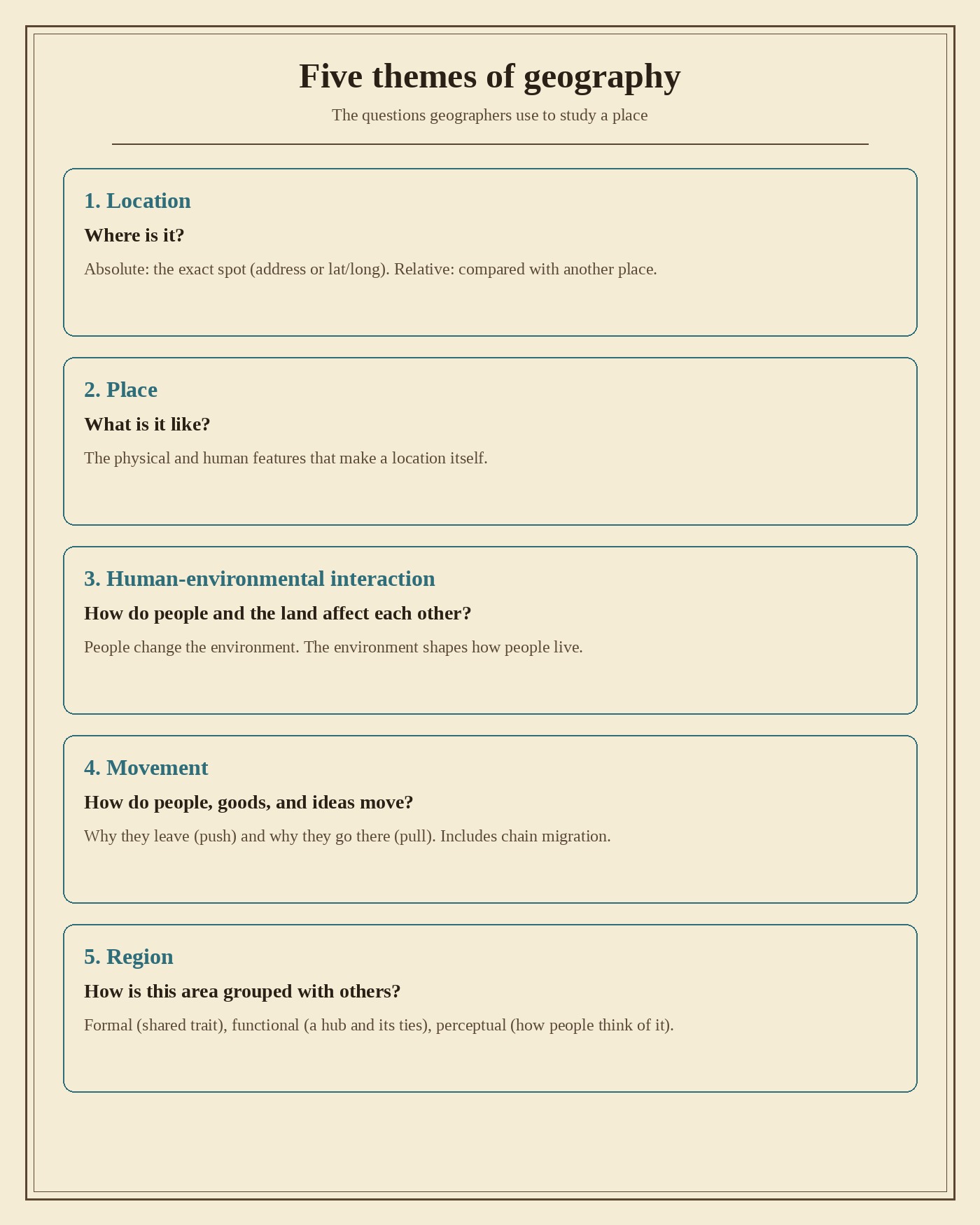
The big idea The five themes are five different questions about one place: where it is, what it is like, how it belongs with other areas, what moves, and how people and the environment affect each other.
Five themes of geography arranged around a globe

By the end you can

  • Match a geographic question or example to the correct theme.
  • Tell apart absolute and relative location and formal, functional, and perceptual regions.
  • Plan complete-sentence answers for every part of the 1.4.8 country assignment.
Five themes, five verbs

The assessment changes the geographic question while keeping the country or event fixed.

Not sure about the basics underneath this lesson?

Five questions, one country

Location: Where is it? Place: What is it like there? Region: What larger area is it part of, and what unifies that area? Movement: How do people, goods, resources, and ideas move? Human-environmental interaction: How do people modify, adapt to, and depend on the environment?

Five themes of geography arranged around a globe
Apex uses the five themes to break a large amount of information into manageable questions.
Likely on the quiz The quiz may describe an example without naming the theme. Ask which of the five questions the example answers.

Location and place are not twins

Absolute location pinpoints an exact spot, such as a street address or latitude and longitude. Relative location describes one place from another using a landmark, time, direction, or distance. Place adds physical and human characteristics. Switzerland is mountainous (physical), and people visit to ski (human).

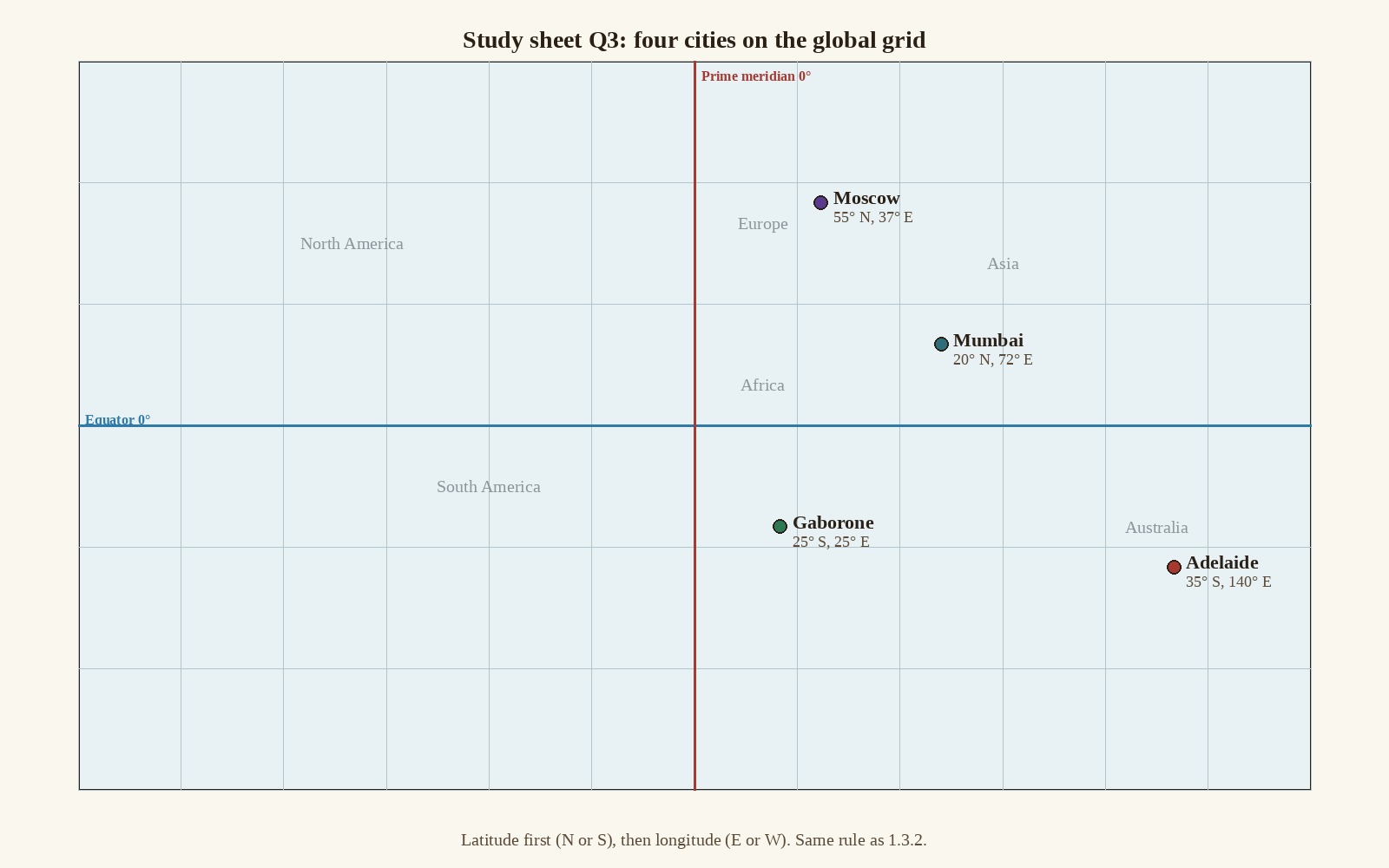
Four cities plotted by latitude and longitude
Exact coordinates answer location. A description of the land and people answers place.
Likely on the quiz Where is it? is location. What is it like there? is place.

Three ways to build a region

A formal region shares a measurable property, such as government, language, climate, or political boundaries. A functional region is tied to a focal point by trade, communication, or transportation. A perceptual region comes from people's attitudes and can be subjective or misleading.

A globe on a desk beside geography notes
There is more than one reasonable way to divide the world into regions.
Likely on the quiz Common property = formal. Connections to a center = functional. Attitude or opinion = perceptual.
Not sure about this bit?

Movement has causes and paths

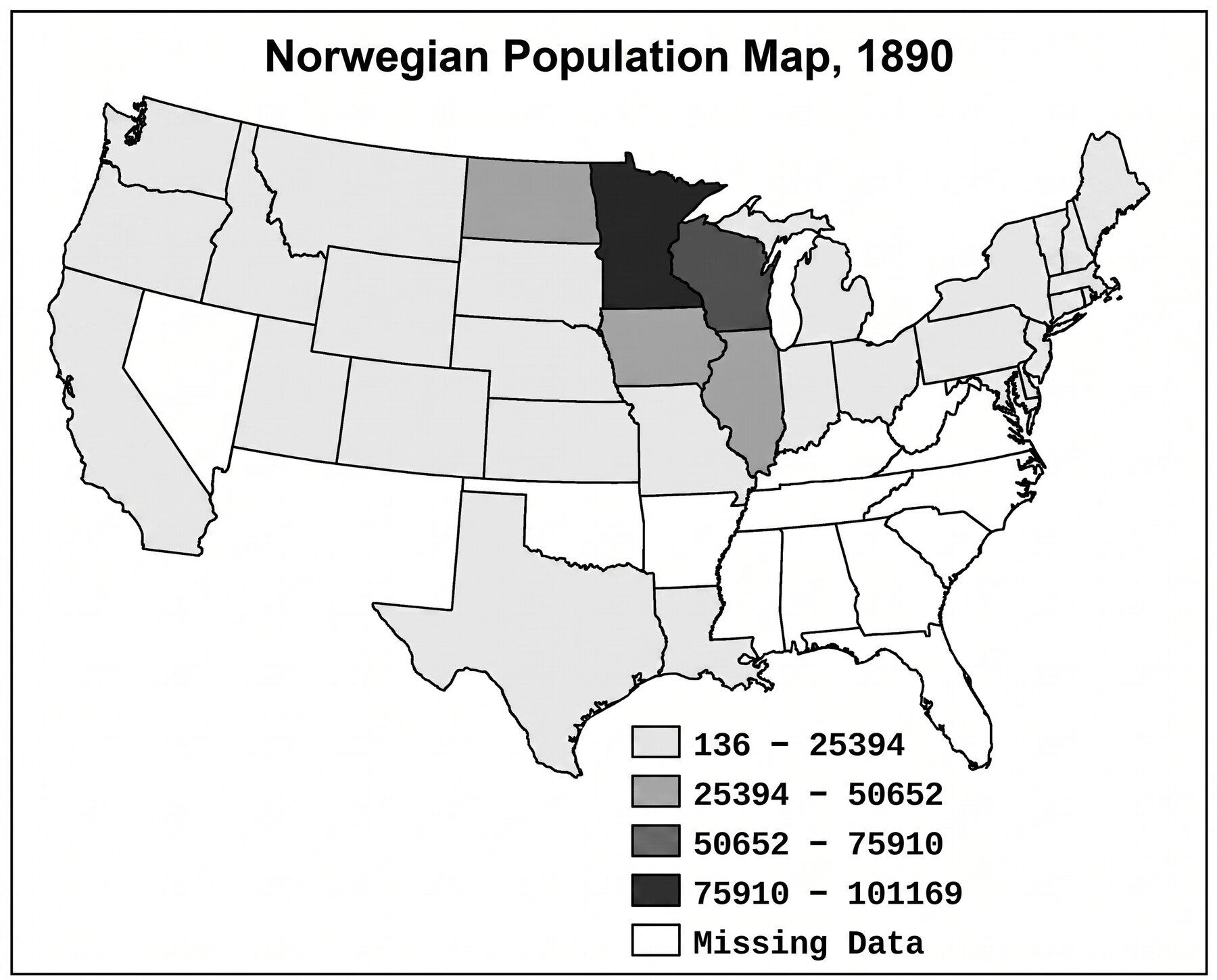
Push factors are reasons to leave. Pull factors are reasons to go somewhere. Chain migration happens when early arrivals encourage family, friends, and neighbors to follow. Physical geography affects which routes are possible, and population data reveals a migration's scale and scope.

Movement also includes goods, resources, and ideas. The three migration songs show that movement can carry hope, persecution, homesickness, and culture.

Apex map of Norwegian-born residents by state in 1890
The same migration can be studied through location, place, region, movement, and human-environmental interaction.
Likely on the quiz Push means away from the starting place. Pull means toward the destination.

Modify, adapt, depend

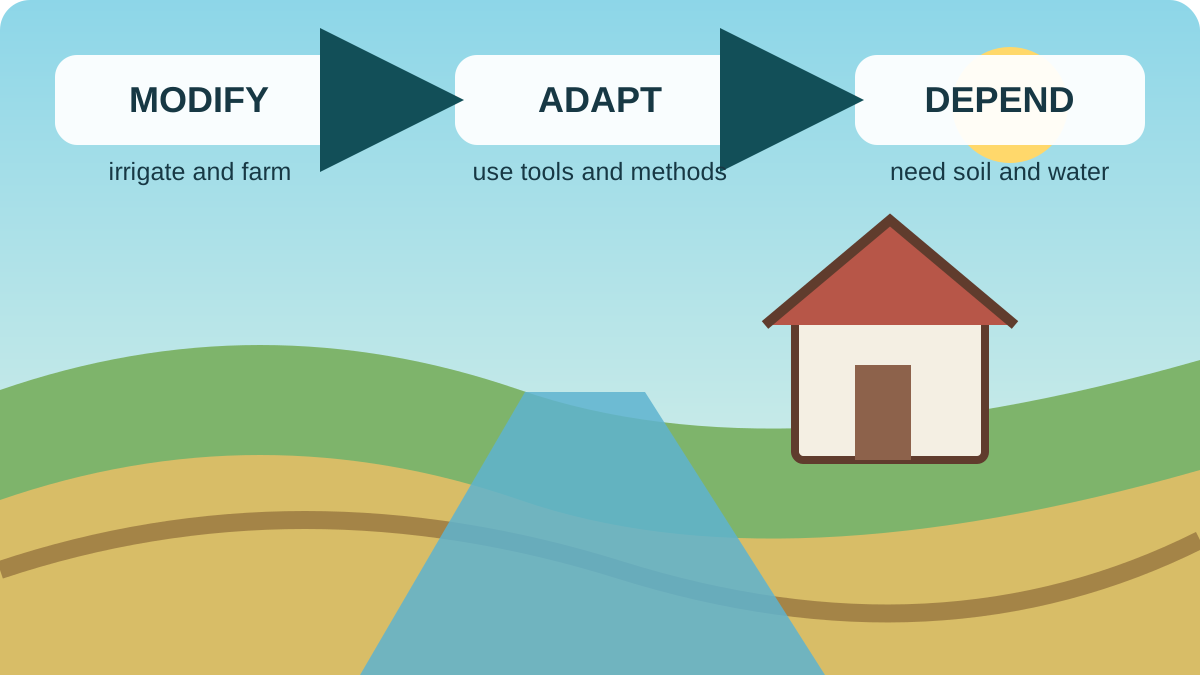
Human-environmental interaction asks three questions: How do people modify the environment? How do they adapt to it? How do they depend on it? Apex's Great Plains example combines all three: tools and irrigation help turn grassland into cornfields, while farming still depends on soil, water, and the aquifer.

A farm diagram showing modify, adapt, and depend
Technology can change an environment, but it does not erase dependence on water, soil, and other conditions.
Likely on the quiz A dam or irrigation system modifies. Clothing or building methods can be adaptations. Water, soil, and food are dependencies.

Build the 1.4.8 country response

Pick one country from the CIA World Factbook and keep the same country for every theme. Write complete sentences.

  1. Location, 4 points: latitude and longitude, then two relative descriptions.
  2. Place, 5 points: physical characteristics and human characteristics.
  3. Region, 5 points: name the region or subregion and explain what unifies it.
  4. Movement, 4 points: transportation and trade relationships.
  5. Human-environmental interaction, 6 points: one modification, one adaptation, and one dependency.
  6. Sources: list any extra sources you used.
An open geography notebook beside an atlas and pencil
The assignment is a five-theme organizer. Each answer stays attached to the same country.
Likely on the quiz The highest-value part is human-environmental interaction: modification, adaptation, and dependence are three separate answers.
Not sure about this bit?

Quiz rehearsal

Answer one item at a time. Read the explanation before moving on. These questions use the lesson's definitions and examples, not the hidden Apex quiz bank.

A geography study desk with a map and notebook
A short active pass before the quiz.
1 / 15 0 correct

Final checklist

Tick these off as you go. Saved in this browser.