1.4.0 Five Themes

Unit 1 Β· Introduction to Geography Β· Lesson 1.4 Five Themes

The big idea Geographers do not start with a pile of random facts. They start with five questions. Those questions are the five themes: location, place, human-environmental interaction, movement, and region. This page is the lesson overview. The next study, Location, is the first theme in full.

Apex photo of sandy dunes

By the end you can

  • Name the five themes of geography in order.
  • Match each theme to the question it answers.
  • Preview the key terms this lesson will use: absolute and relative location, push and pull factors, chain migration, and the three kinds of region.
Before you start: five questions, not five extra map types

The last lesson was maps. This one is how geographers decide what to ask. Open this if 'theme' still sounds like a party.

Not sure about the basics underneath this lesson?

Where on Earth is this?

Look at Apex's picture. Where do you think it is? Apex's line: no, it is not a planet in a far-off galaxy. It is right here on Earth. It is one of the largest and most distinct areas on this planet. Its main physical feature, bleak, sandy terrain, is clearly visible from space.

Where on Earth is this? (2)

The picture is supposed to raise questions. Apex lists them:
β€’ Where on Earth is it?
β€’ What goes on in that place?
β€’ How could people live there?
β€’ Does it resemble any other place on Earth?
β€’ Why would anyone go there?

Where on Earth is this? (3)

Those are the questions geographers ask. The five themes of geography are based on them.

Apex's opening photo. Bleak, sandy terrain, visible from space. The lesson does not name the desert.
Likely on the quiz The photo is a hook. The real job of this page is those five questions, then the five theme names.

The five themes

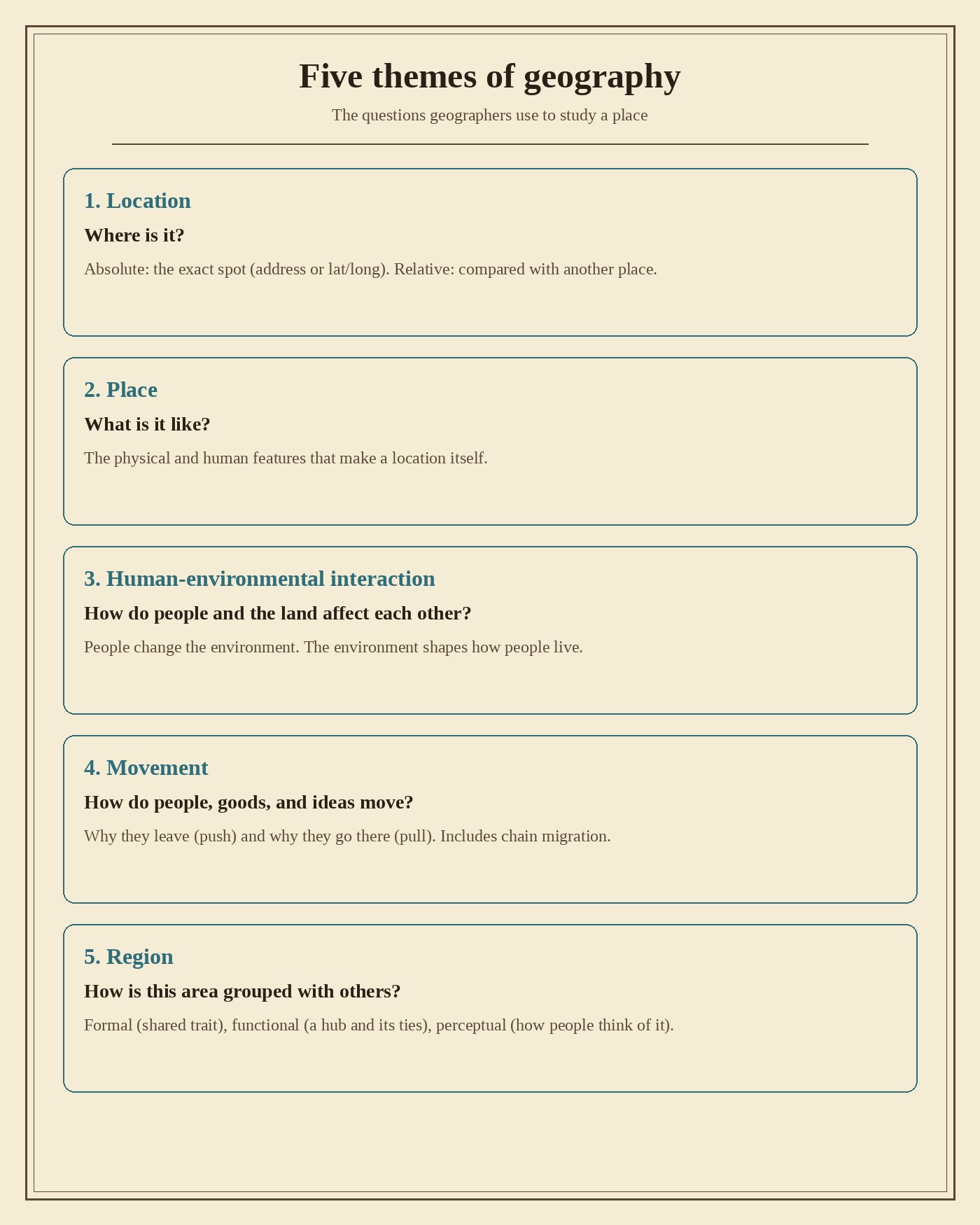
The five themes of geography, in the lesson's order:

The five themes (2)

1. Location β€” Where is it?
2. Place β€” What is it like?
3. Human-environmental interaction β€” How do people and the land affect each other?
4. Movement β€” How do people, goods, and ideas move? Why leave, and why go there?
5. Region β€” How is this area grouped with others?

The five themes (3)

In this lesson you will identify the five themes, describe specific locations using them, and analyze geographic problems by combining them. Location is the first full study (1.4.1). The others follow.

The five themes and the question each one answers. Location is today's study.
Likely on the quiz If a quiz asks you to list the five, use this order: location, place, human-environmental interaction, movement, region.
Not sure about this bit?

Words this lesson will keep using

The overview already hands you the vocabulary for later studies. You do not need every one today, but Location uses the first pair immediately.

Words this lesson will keep using (2)

Absolute location β€” the exact spot on the planet. Relative location β€” one place defined in terms of another.

Words this lesson will keep using (3)

Movement later: push factors (reasons for leaving), pull factors (reasons for going), chain migration (first arrivals bring family and neighbors to the same place).

Words this lesson will keep using (4)

Region later: formal regions (a shared human property, like language or government), functional regions (a focal point and its connections, like suburbs around a city), perceptual regions (based on attitude, like 'Southern California').

Likely on the quiz Today's pair is absolute vs relative. The rest of the list is so later studies do not feel like a new language.

Final checklist

Tick these off as you go. Saved in this browser.