By the end you can
- Connect each statement to a valid reason.
- Build and explain the six triangle-theorem proofs in your course.
- Distinguish a theorem from its converse and use CPCTC in the correct order.
Module 02 — Transformations and Congruence
By the end you can
Use this if the statements make sense but the reasons feel unfamiliar.
You may cite Given only for information supplied in the problem—not a conclusion you hope is true.
Midpoint gives two equal pieces. Angle bisector gives two equal angles. Perpendicular gives right angles.
Check the conditions before using the conclusion. Midsegment needs two midpoints; alternate interior angles need parallel lines; CPCTC needs congruent triangles.
Does a line from a vertex automatically count as a median?
No. Its other endpoint must be the midpoint of the opposite side.
Got it now? Scroll back up and re-read the section — it should land differently.
Batman, the goal is not to guess the teacher’s next sentence. Start with what you know, name what you must prove, and connect them with reasons.
Every statement needs a reason that actually supports it. Marks and givens count; “it looks equal” does not.
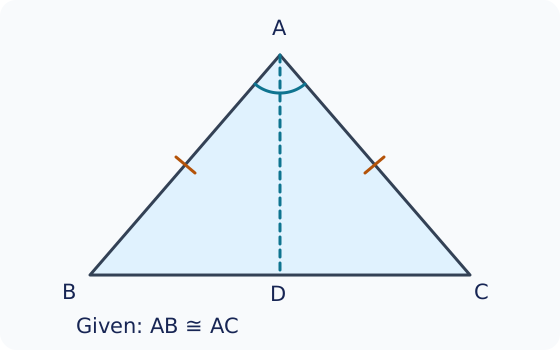
Given: AB ≅ AC. Prove: ∠ABC ≅ ∠BCA.
Those are the angles at B and C, opposite the equal sides. Work backward: if you can prove two smaller triangles congruent, CPCTC will give you the matching angles.
A two-column proof pairs each statement with its reason. A paragraph proof puts the same links into sentences. A flow proof uses arrows to show which facts support the next fact.
Changing the format does not remove any evidence. Try saying “because…” after every claim.
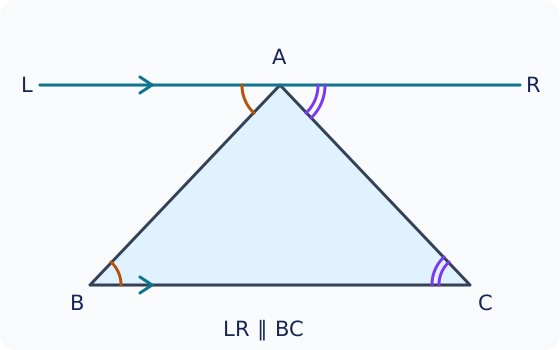
Construct LR through A parallel to BC. AB and AC now act as transversals.
The angle at B matches ∠LAB; the angle at C matches ∠CAR, by alternate interior angles. These two angles and ∠BAC fill a straight angle at A.
Predict each reason, then reveal one row. We are proving Triangle Sum, so using Triangle Sum as a reason here would be circular.
Once Triangle Sum is established, you may use it to find an unknown angle. With angles 27° and 100°, the third is 180° − 27° − 100° = 53°.
If a given 80° is an outside neighbor on a straight line, find the inside angle first: 180° − 80° = 100°. Do not subtract the outside 80° as though it were inside.
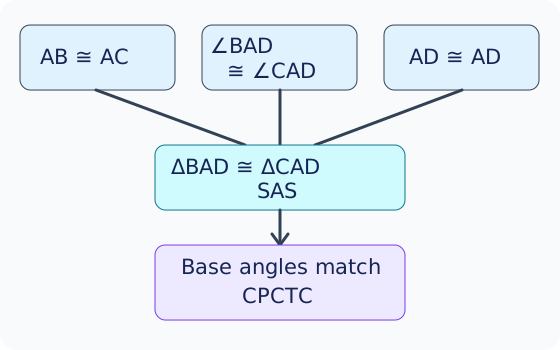
Given AB ≅ AC, construct AD as the bisector of ∠BAC. D lies on BC. We want the base angles at B and C to match.
Compare BAD with CAD: B matches C, A matches A, D matches D.
AB matches AC (given). AD matches itself (reflexive). The included angles BAD and CAD match (angle bisector).
Once BAD and CAD are congruent, their angles at B and C match.
Got it now? Scroll back up and re-read the section — it should land differently.
Isosceles: AB ≅ AC → ∠B ≅ ∠C.
Converse: ∠B ≅ ∠C → AB ≅ AC.
Read what was given before choosing a direction. Equal sides lead to opposite equal angles; equal angles lead to opposite equal sides.
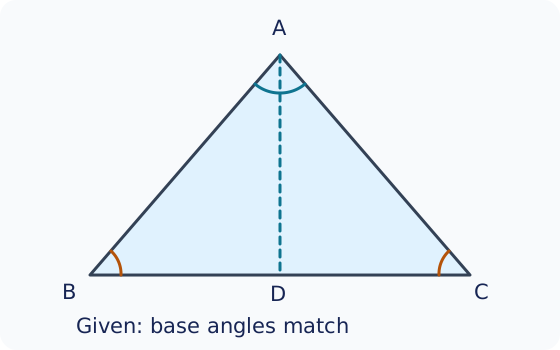
Now suppose only ∠ABC ≅ ∠BCA. Construct the angle bisector AD. Do not mark AB and AC equal yet: that is what we must prove.
If AB = AC and ∠A = 90°, Isosceles gives ∠B ≅ ∠C. Triangle Sum gives m∠B + m∠C = 90°.
Let each equal angle be x: 2x = 90°, so x = 45°. Neither theorem does both jobs alone.
With equal legs and a 90° vertex angle, why are the other two angles 45°?
Isosceles makes them equal. Triangle Sum leaves 90° for the pair. Divide that total equally to get 45° each.
Got it now? Scroll back up and re-read the section — it should land differently.
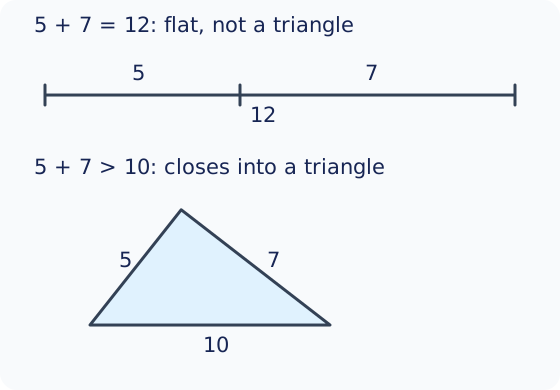
For side lengths a, b, and c, each pair’s sum must be greater than the third: a + b > c, a + c > b, b + c > a.
For 5, 7, and 12, the two shorter sides add to exactly 12. The shape lies flat—it is not a triangle. With two sides 5 and 7, the third side x must satisfy 2 < x < 12.
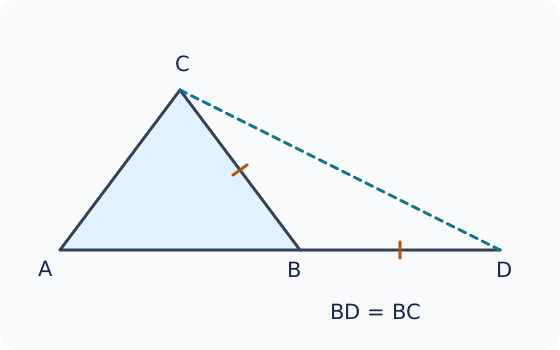
This workshop example adapts the course’s side–angle relationship. Extend AB beyond B to D so BD = BC. Then prove AB + BC > AC.
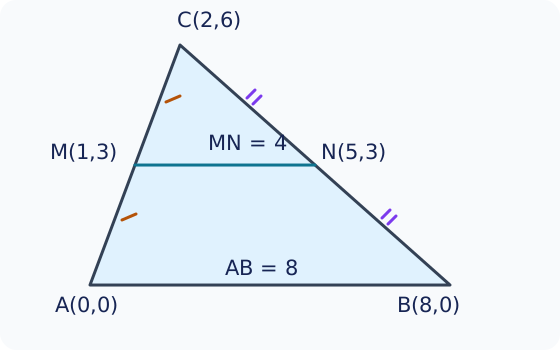
A midsegment joins the midpoints of two sides. It is parallel to the third side and half as long.
If M and N are the midpoints of AC and BC, then MN ∥ AB and MN = ½AB. If AB = 8, MN = 4. If MN = 4, work backward: AB = 8.
Use the general triangle A(0,0), B(2b,0), C(2u,2v), where b > 0 and v > 0. The drawing uses one numeric example, but the algebra works for every such triangle.
A median joins a vertex to the midpoint of the opposite side. A midsegment joins two side midpoints.
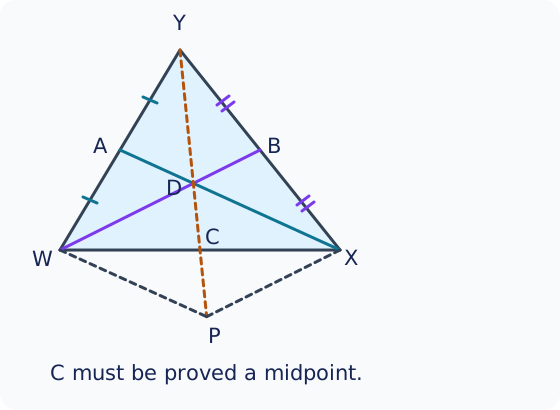
The three medians meet at the centroid. To prove concurrency, draw two medians, call their intersection D, then show the line through the third vertex and D hits the remaining side at its midpoint.
Given A is the midpoint of WY and B is the midpoint of XY, XA and WB meet at D. Let line YD meet WX at C. Predict why each new construction helps.
Setting DP = YD makes D the midpoint of YP. That unlocks Midsegment twice in the new triangles.
DX ∥ WP and WD ∥ PX give a parallelogram WDXP.
Its diagonals WX and DP bisect each other at C. That proves WC = CX, the missing midpoint fact.
Got it now? Scroll back up and re-read the section — it should land differently.
Since A and D are midpoints of YW and YP, AD is parallel to WP by Midsegment. Because A, D, and X are collinear, DX is parallel to WP. Similarly, DB—and therefore WD—is parallel to PX. Thus WDXP is a parallelogram. Its diagonals bisect each other, so WC = CX. C is the midpoint of WX, making YC a median through D. Therefore the three medians are concurrent.
Same evidence, now in sentences. Keep the reasons; do not replace them with “obviously.”
CPCTC comes after congruence. It does not prove triangles congruent. ASA needs the side between its two angles; SAS needs the angle between its two sides.
Do not prove a theorem with itself. You may use established earlier results. Do not assume the conclusion, rely on a picture’s apparent size, or claim a midpoint merely because it looks centered.
Choose the statement or reason that completes each link. Read the explanation after your answer; mistakes here are practice.
Tick these off as you go. Saved in this browser.