Transformations and congruence exam: Part One review

Module 02 β€” Transformations and Congruence

The big idea Read the figure, choose a rule, and check the result. Part One is multiple choice.
Triangle P(1,-2), Q(3,-2), R(1,-4) slides left 2 and up 1 to P₁(-1,-1), Q₁(1,-1), R₁(-1,-3), then reflects across y=1 to Pβ‚‚(-1,3), Qβ‚‚(1,3), Rβ‚‚(-1,5).

By the end you can

  • Recognize and combine translations, reflections, and rotations.
  • Choose a justified triangle-congruence test.
  • Use triangle theorems, symmetry, and quadrilateral properties to eliminate wrong answers.
Start with one point

A whole figure is easier when you track one vertex at a time.

Not sure about the basics underneath this lesson?

How to use this review

First work through the short cards. Then try the practice quiz. Each answer includes a reason.

Your course says Part One uses multiple-choice questions. The questions here are new practice across the module; they do not predict the exact questions on your test.

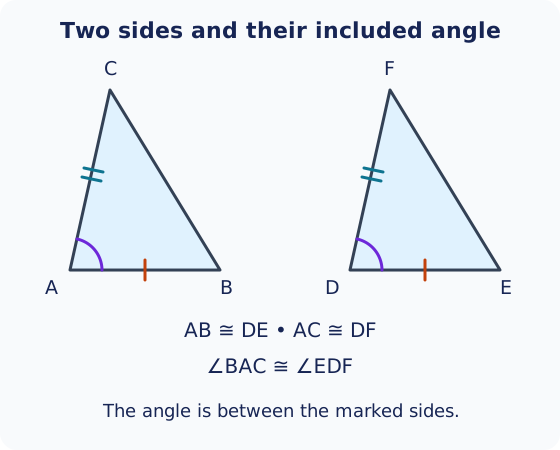
A pair of triangles with corresponding side and included angle marks to support a written justification.

Coordinates: sideways first, then up or down

In (x, y), x is the sideways position and y is the height. Positive x means right; negative x means left. Positive y means up; negative y means down.

Aβ€² is read β€œA prime.” It names the point after a transformation. It does not mean a different kind of coordinate.

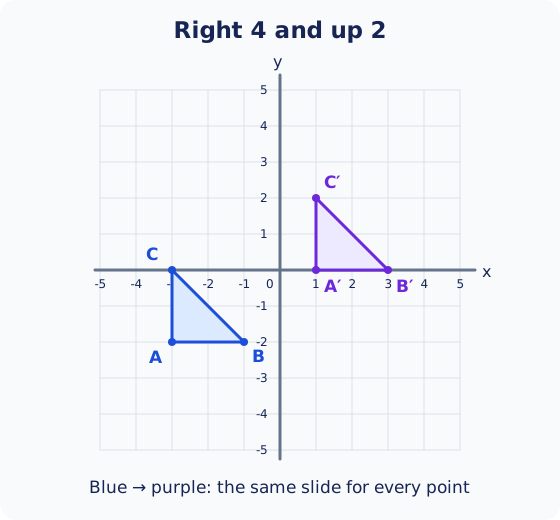
Blue triangle A(-3,-2), B(-1,-2), C(-3,0) and purple image Aβ€²(1,0), Bβ€²(3,0), Cβ€²(1,2).
Read A at (βˆ’3, βˆ’2): left 3, down 2.

Translate: use the same slide for every vertex

Blue A(βˆ’3, βˆ’2) becomes purple Aβ€²(1, 0). The changes are +4 in x and +2 in y: right 4 and up 2.

Check B too: (βˆ’1, βˆ’2) β†’ (3, 0). Same slide. The rule is (x, y) β†’ (x + 4, y + 2). A translation does not turn or flip a figure.

Blue triangle A(-3,-2), B(-1,-2), C(-3,0) and purple image Aβ€²(1,0), Bβ€²(3,0), Cβ€²(1,2).

Reflect: find the mirror before counting

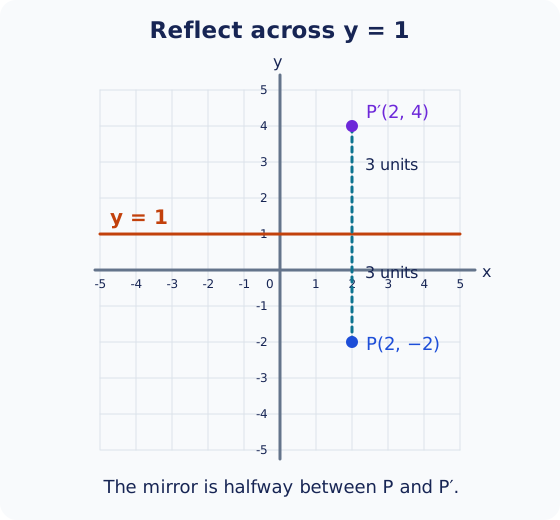
y = 1 is horizontal, one unit above the x-axis. P(2, βˆ’2) is 3 units below it, so its reflection is 3 units above it: Pβ€²(2, 4). The x-coordinate stays 2.

The y-axis is vertical and has equation x = 0. Do not confuse a line such as y = 1 with the y-axis.

Point P(2,-2) and its image Pβ€²(2,4) on opposite sides of the horizontal mirror y=1, three units away on each side.
The dashed segment is perpendicular to the mirror and is split into equal halves.
Not sure about this bit?

Axis and diagonal reflections

Across the x-axis: (x, y) β†’ (x, βˆ’y). Across the y-axis: (x, y) β†’ (βˆ’x, y). Across y = x: (x, y) β†’ (y, x).

For a horizontal or vertical mirror that is not an axis, count to the mirror and then the same distance beyond it. Points already on the mirror stay in place.

Point P(2,-2) and its image Pβ€²(2,4) on opposite sides of the horizontal mirror y=1, three units away on each side.

Rotate: include the center and direction

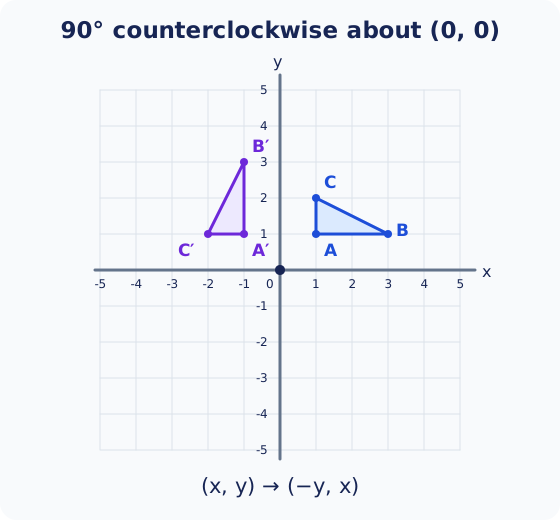
These rules use the origin as the center: 90Β° counterclockwise sends (x, y) to (βˆ’y, x); 90Β° clockwise sends it to (y, βˆ’x); 180Β° sends it to (βˆ’x, βˆ’y).

Here A(1, 1) turns to Aβ€²(βˆ’1, 1). Also check B(3, 1) β†’ Bβ€²(βˆ’1, 3). A 270Β° clockwise turn equals a 90Β° counterclockwise turn.

Triangle A(1,1), B(3,1), C(1,2) rotates 90 degrees counterclockwise about the origin to Aβ€²(-1,1), Bβ€²(-1,3), Cβ€²(-2,1).

Two moves: keep an intermediate point

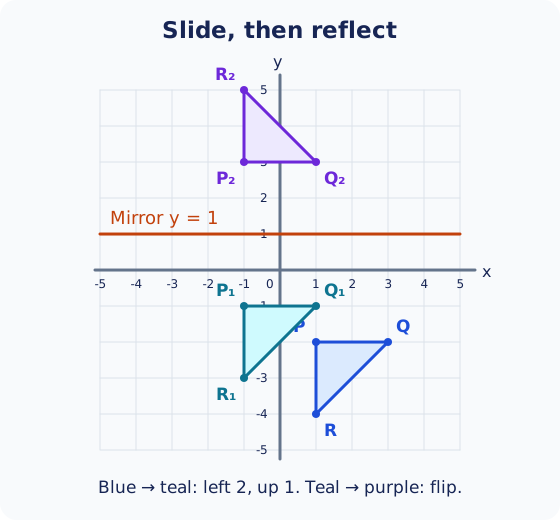
Apply the moves in their stated order. For P(1, βˆ’2), moving left 2 and up 1 gives P₁(βˆ’1, βˆ’1).

Then reflect across y = 1. P₁ is 2 below the mirror, so Pβ‚‚ is 2 above it: Pβ‚‚(βˆ’1, 3). Check every vertex when deciding whether the entire figure matches.

Triangle P(1,-2), Q(3,-2), R(1,-4) slides left 2 and up 1 to P₁(-1,-1), Q₁(1,-1), R₁(-1,-3), then reflects across y=1 to Pβ‚‚(-1,3), Qβ‚‚(1,3), Rβ‚‚(-1,5).
Blue: original. Teal: after the slide. Purple: after the reflection.

Rigid motion and mapping onto itself

Translations, reflections, and rotations preserve lengths and angle measures. The image is congruent to the original. A reflection reverses clockwise/counterclockwise vertex order; translations and rotations preserve it.

For symmetry, the figure must land exactly on itself. A non-square rectangle does this after a 180Β° turn about its center, but not a 90Β° turn. A regular hexagon’s smallest positive turn is 360Β° Γ· 6 = 60Β°.

Triangle A(1,1), B(3,1), C(1,2) rotates 90 degrees counterclockwise about the origin to Aβ€²(-1,1), Bβ€²(-1,3), Cβ€²(-2,1).

Congruence: identify the marked evidence

Valid tests are SSS, SAS, ASA, AAS, and HL. HL requires right triangles, a matching hypotenuse, and a matching leg.

β€œIncluded” means between: SAS needs the angle between the two known sides. ASA needs the side between the two known angles. AAA proves the same shape, not necessarily the same size. SSA is not a general congruence test.

Triangles ABC and DEF with AB congruent DE, AC congruent DF, and included angle BAC congruent EDF.
The marked angle lies between the marked sides: SAS.

Proof reasons: use them in order

A shared side matches itself by the Reflexive Property. An angle bisector makes two equal angles; a midpoint splits a segment into two equal parts.

First prove the triangles congruent. Then use CPCTC for their corresponding parts. Do not use CPCTC as the reason that the triangles are congruent.

Triangles ABC and DEF with AB congruent DE, AC congruent DF, and included angle BAC congruent EDF.

Triangle numbers and midpoints

Triangle angles total 180Β°. Equal sides have equal opposite angles; the converse starts with equal angles and concludes equal opposite sides.

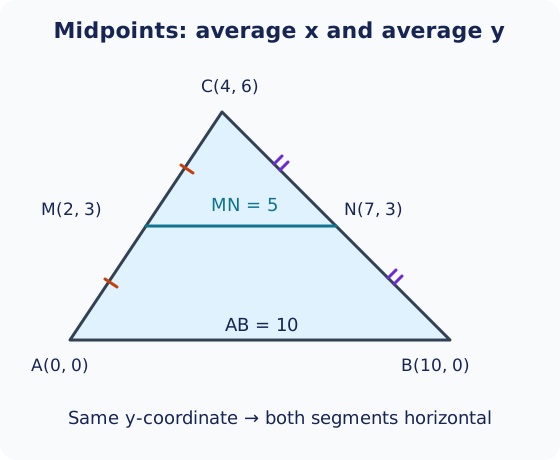
For sides 6 and 9, a third side x must satisfy 3 < x < 15. The endpoints are excluded. A midsegment joins two side midpoints, is parallel to the third side, and is half as long. Here MN = 5 because AB = 10.

An exterior angle equals the sum of the two nonadjacent interior angles. Within a triangle, the larger side is opposite the larger angle.

A(0,0), B(10,0), C(4,6); M(2,3) is the midpoint of AC and N(7,3) is the midpoint of BC. MN is parallel to AB and half as long.
Not sure about this bit?

Median, altitude, and the four centers

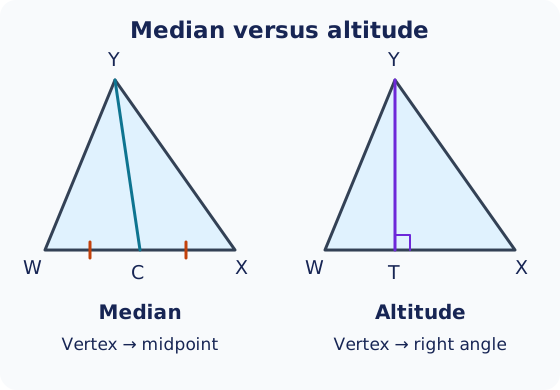
A median joins a vertex to the midpoint of the opposite side; medians meet at the centroid. An altitude is perpendicular to the opposite side or its extension; altitudes meet at the orthocenter.

Angle bisectors meet at the incenter. Perpendicular bisectors of sides meet at the circumcenter. The centroid and incenter are always inside; the other two can be inside, on, or outside depending on the triangle.

Two copies of triangle WXY: median YC reaches midpoint C of WX with equal-half marks; altitude YT meets WX at a right angle and T is not the midpoint.
Not sure about this bit?

Quadrilaterals: keep the diagonal facts separate

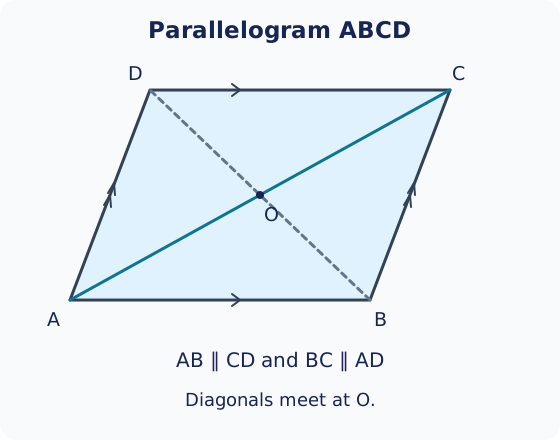
In a parallelogram, opposite sides and angles match, consecutive angles total 180Β°, and the diagonals bisect each other. AO = OC and BO = OD. This does not automatically mean AC = BD.

A rectangle adds congruent diagonals. A rhombus adds four equal sides, perpendicular diagonals, and diagonals that bisect opposite angles. A square has both sets of properties.

Parallelogram ABCD, with A bottom left, B bottom right, C top right, D top left. Diagonals AC and BD meet at O.

Kites and trapezoids

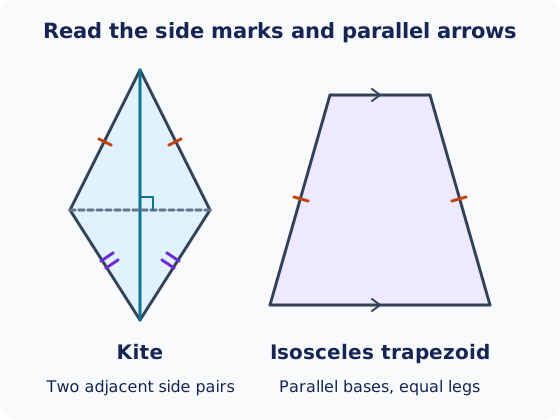
A kite has two pairs of adjacent congruent sides; its diagonals are perpendicular. Only the symmetry diagonal necessarily bisects the other diagonal.

Your course uses a trapezoid with exactly one pair of parallel sides. An isosceles trapezoid also has congruent legs, congruent base angles, and congruent diagonals.

A kite shows two pairs of adjacent equal sides and perpendicular diagonals. An isosceles trapezoid shows parallel bases and equal legs.

Part One practice

Try the full set, then revisit the explanations for any misses. The score is practice feedback, not a school grade.

1 / 18 0 correct

Final checklist

Tick these off as you go. Saved in this browser.