Explain it

02.08 — 3 short write-ups

Question 1 of 3

A checkpoint, not a test
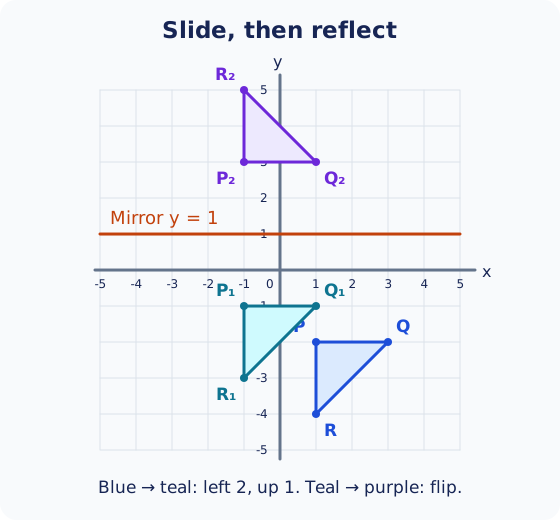
Explain a rigid motion

Triangle P(1,-2), Q(3,-2), R(1,-4) slides left 2 and up 1 to P₁(-1,-1), Q₁(1,-1), R₁(-1,-3), then reflects across y=1 to P₂(-1,3), Q₂(1,3), R₂(-1,5).
Blue: original. Teal: after the slide. Purple: after the reflection.
Explain why a translation, reflection, or rotation produces a figure congruent to the original even when its position changes.

Name the side lengths and angle measures that stay unchanged.

Question 2 of 3

A checkpoint, not a test
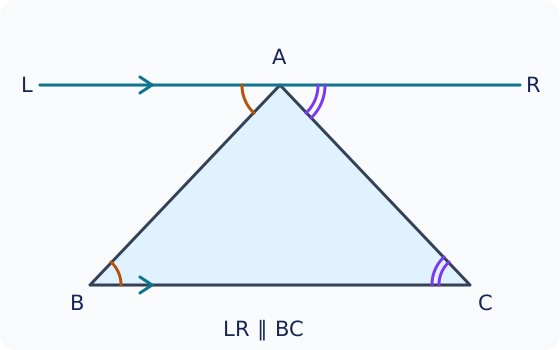
Explain the triangle-angle proof

LR passes through A parallel to BC. The angle LAB matches angle ABC, and CAR matches BCA; together with BAC they fill the straight angle LAR.
Triangle ABC has a line LR through A parallel to BC, as shown. Explain how alternate interior angles connect the angles at B and C to the straight angle at A. Why does that prove the three triangle angles total 180°?

Match ∠ABC with ∠LAB and ∠BCA with ∠CAR. Which three neighboring angles fill straight angle LAR?

Question 3 of 3

A checkpoint, not a test
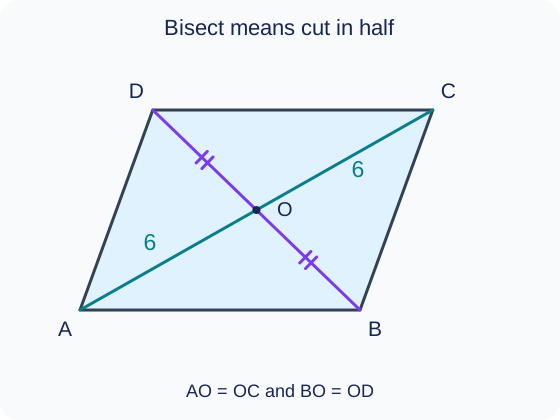
Read the diagonal marks

Diagonals of parallelogram ABCD meet at O. AO and OC are each 6. Matching double ticks show BO equals OD.
A parallelogram’s diagonals bisect each other. Explain what that means about the halves of each diagonal. Does that property alone guarantee that the parallelogram is a rectangle?

Describe the two equal halves of each diagonal. Does that alone give four 90° corner angles?