01.10 Geometry Foundations Exam Part One — Complete Walkthrough

Module 01 — Geometry Foundations · quiz worth 100 pts · 2026-09-04
The big idea Learn the Module 01 ideas one step at a time, then use the separate practice pages to check constructions, angle relationships, and proof reasons.

One module, three buckets

The test mixes construction marks, angle-pair position, and proof reasons. Sorting the stem first keeps the lookalike choices from blending together.

Not sure about the basics underneath this lesson?

Start with the walkthrough

This page teaches the ideas before it tests you. Move through each card in order. On every diagram, first name what you see; then say the rule; then do any math.

This page is only for Geometry Foundations Exam Part One. Its 15 original multiple-choice questions use material from lessons 01.01–01.09. It does not include triangle-congruence shortcuts or anything from Module 02.

A geometry diagram paired with proof reasoning
The exam moves from recognizing a figure to explaining why a conclusion is true.

Point, line, plane—and the figures they build

Point, line, and plane are undefined terms. A point has no dimension. A line has one dimension and continues forever in both directions. A plane is flat, has two dimensions, and continues forever.

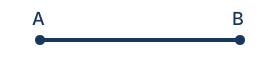
A segment has two endpoints. A ray has one endpoint and continues in one direction. Opposite rays share an endpoint and form a line.

A segment with endpoints A and B
Two endpoints make a segment.
A ray beginning at A and passing through B
One endpoint and one continuing direction make a ray.

Postulate, theorem, or definition?

A definition tells exactly what a term means. A postulate is accepted as true without proof. A theorem has been proven from definitions, postulates, and earlier results.

Example: “Through any two points, there is exactly one line” is the Points Postulate. “Vertical angles are congruent” is the Vertical Angles Theorem.

A geometry diagram beside proof statements
Postulates are starting facts; theorems are conclusions that have been proved.

Copy a segment

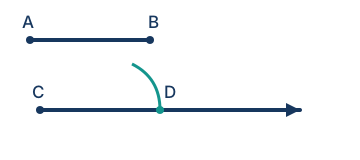
Draw a new ray. Open the compass to the full length of the given segment. Without changing that width, place the compass point on the new ray’s endpoint and swing an arc across the ray. The endpoint and the arc intersection form the congruent segment.

Construction clue: one fixed compass opening transfers one length.
A compass transferring a segment length to a new ray
The compass carries the original segment length to the new ray.

Copy an angle

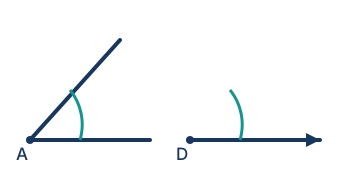
Draw a new ray. From the original vertex, draw an arc that crosses both sides of the original angle. Keep that radius and draw the same arc from the new vertex. Now copy the distance between the original arc’s two crossing points onto the new arc. Draw the second ray through the new intersection.

Construction clue: the first arcs copy the radius; the copied chord controls the angle opening.
A copied-angle construction with matching vertex arcs and a transferred chord
The chord between the original arc hits is the distance copied in the final compass step.
Not sure about this bit?

Bisect a segment or an angle

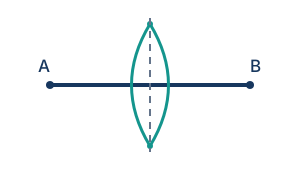
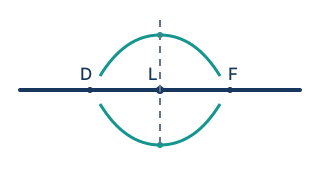
Segment: use the same compass width—more than half the segment—from both endpoints. The paired arcs cross above and below. The line through those crossings cuts the segment in half.

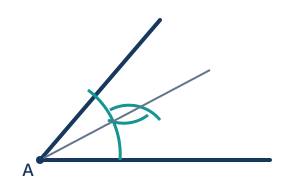
Angle: make one arc from the vertex that hits both rays. From those two hits, draw equal interior arcs. The ray from the vertex through their crossing splits the angle in half.

A segment bisector made with paired intersecting arcs
Paired arcs from both endpoints locate the perpendicular bisector.
An angle bisector made with equal intersecting arcs
The new ray passes through the crossing of the two equal interior arcs.
Not sure about this bit?

Construct parallel or perpendicular lines

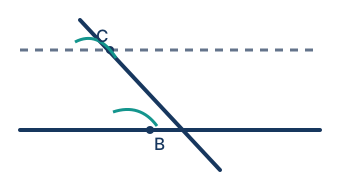
Parallel through a point: draw a transversal and copy the angle at its first intersection to the new point. Equal corresponding angles make the new line parallel.

Perpendicular: create two equal points on the given line, draw equal arcs from those points, and connect the arc crossings. The new line meets the original at 90°.

A parallel-line construction made by copying a corresponding angle
Copying the angle along the transversal creates a parallel line.
A perpendicular line construction through a point on a line
Equal arc crossings determine the 90-degree line.
Not sure about this bit?

Build polygons inside a circle

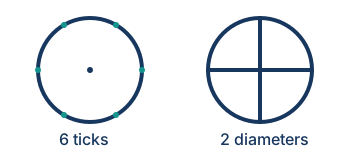
Keep the compass set to the circle’s radius and step around the circle to make six equal marks. Connect every other mark for an equilateral triangle. Connect all six neighboring marks for a regular hexagon.

For a square, construct two perpendicular diameters and connect the four places where the diameters meet the circle.

An equilateral triangle, square, and regular hexagon inscribed in circles
Triangle: every other mark. Hexagon: all six. Square: four perpendicular-diameter endpoints.

Read one intersection

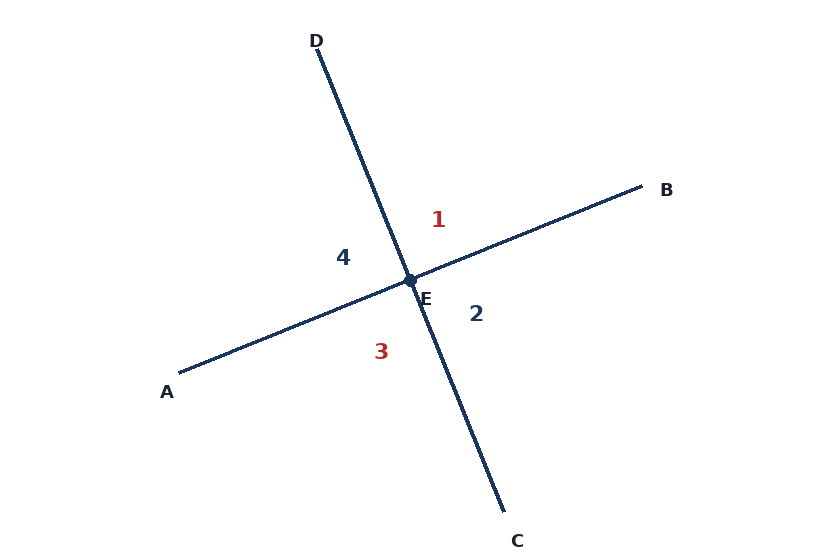
Vertical angles are opposite each other and are congruent. Adjacent angles share a side. A linear pair is adjacent and forms a straight line, so its measures add to 180°. Complementary angles add to 90°; supplementary angles add to 180°.

First ask: opposite or touching? Then ask: equal, 90°, or 180°?

Two intersecting lines forming four numbered angles
Opposite corners are vertical. Neighboring corners along a line form a linear pair.

Decode a transversal

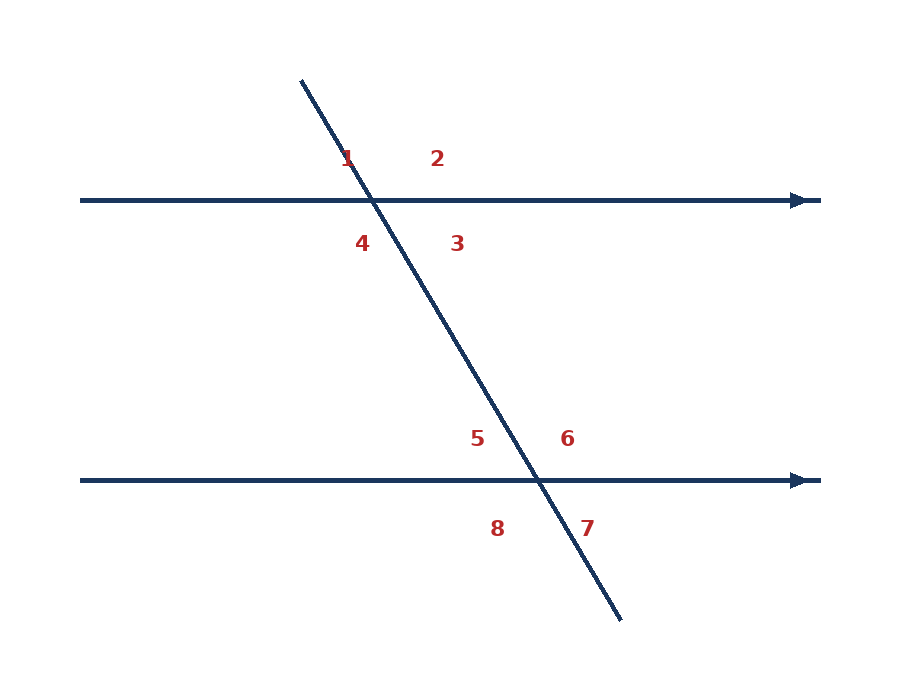
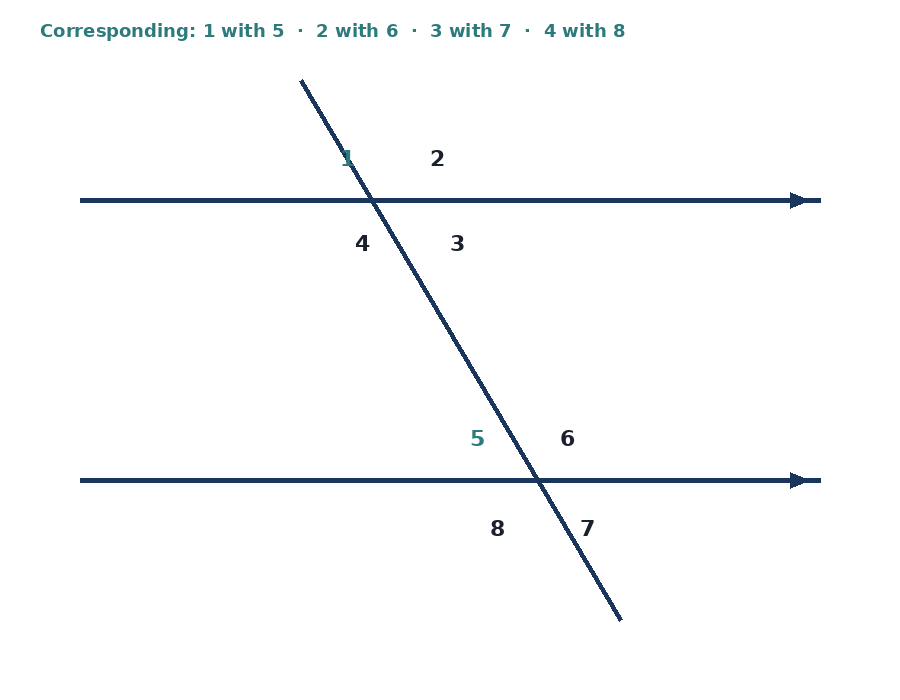
When a transversal crosses two parallel lines, classify the pair by position:

Corresponding: same corner at each intersection. Alternate interior: inside, opposite sides. Alternate exterior: outside, opposite sides. Same-side interior: inside, same side.

Use the picture’s position before looking at any answer choices.

Two parallel lines cut by a transversal with eight angle positions
Locate inside or outside first; then decide same side or opposite side.
Not sure about this bit?

Know the transversal results

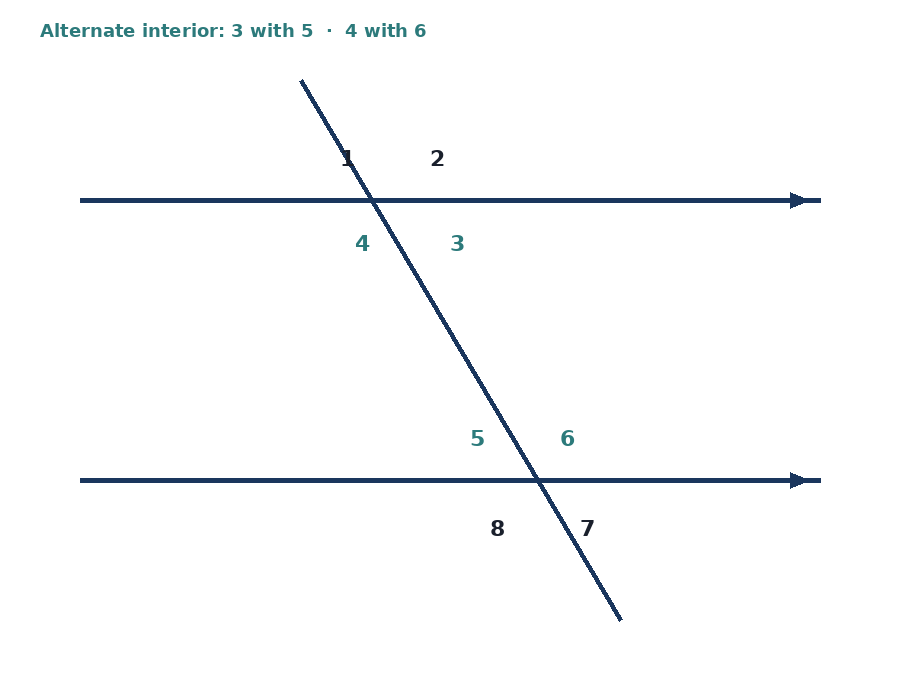
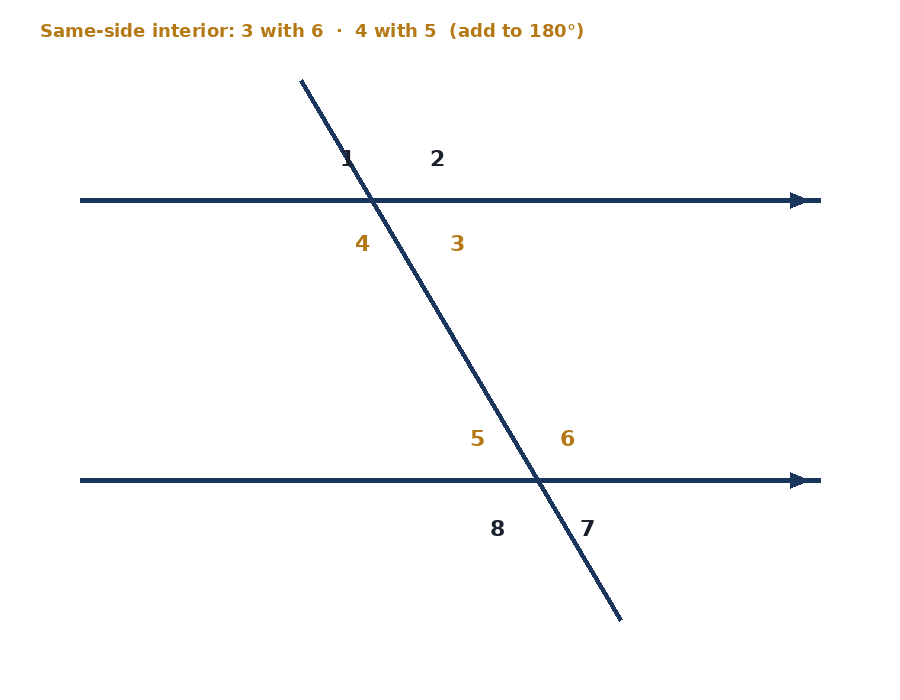
If the lines are parallel, corresponding, alternate interior, and alternate exterior angles are congruent. Same-side interior angles are supplementary.

Memory check: three relationships give equal measures; the inside-and-same-side pair gives 180°.

Alternate interior angles highlighted on parallel lines
Alternate interior angles sit between the lines on opposite sides and are congruent.
Same-side interior angles highlighted on parallel lines
Same-side interior angles sit between the lines on the same side and add to 180 degrees.

Work an angle equation

Suppose same-side interior angles measure (6x + 12)° and (4x + 18)°. Same-side interior angles are supplementary, so begin with:

(6x+12)+(4x+18)=180(6x+12)+(4x+18)=180

Combine like terms: 10x + 30 = 180. Subtract 30: 10x = 150. Divide by 10: x = 15. Substitute back to get 102° and 78°. Check: 102 + 78 = 180.

Same-side interior angles on two parallel lines
The relationship supplies the 180-degree equation; algebra finishes the problem.
Not sure about this bit?

Choose the proof reason

Match the reason to the move you just made. A geometry theorem creates an angle relationship. Substitution replaces something with a known equal value. An Equality Property performs the same operation on both sides. Transitive links A to B and B to C. The definition of congruent angles changes equal measures into congruent angles.

Watch the symbols: equal measures use =. Congruent angles use ≅.
A geometry proof with statements and reasons
Read the new statement, then identify the one move that produced it.
Not sure about this bit?

Prove vertical angles without using the theorem

When the problem asks you to prove the Vertical Angles Theorem, you cannot cite that theorem as the reason. Build it from two straight-angle sums instead. Reveal the chain one line at a time.

Two intersecting lines forming angles 1 through 4
Both linear pairs total 180 degrees and share angle 2.

Part One game plan

For each multiple-choice question: 1. name the topic; 2. point to the diagram clue or proof move; 3. state the rule in your own words; 4. solve only if math is needed; 5. choose the answer that matches your reasoning.

If two choices look possible, compare their exact words: endpoint count, inside versus outside, congruent versus supplementary, or theorem versus equality property.

Corresponding angles marked on parallel lines
Name the position first; then choose the theorem.

Practice when you are ready

Open the 15-question Part One practice exam. Retry every miss after reading its explanation. The practice stays entirely inside Geometry Foundations material from lessons 01.01–01.09.

Three completed inscribed polygon constructions
Walkthrough first, practice second, Canvas exam last.