

The big idea Review the compass-and-straightedge constructions that can appear on the Geometry Foundations test.
Geometry Foundations Exam Part One — Study 2/4
Module 01 — Geometry Foundations
Module 01 — Geometry Foundations
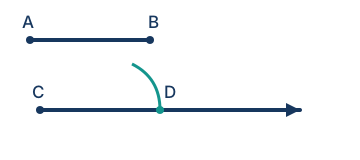
Draw a new ray. Open the compass to the full length of the given segment. Do not change the width. Put the compass point on the new ray’s endpoint and swing an arc across the ray. The endpoint and arc intersection form the copied segment.
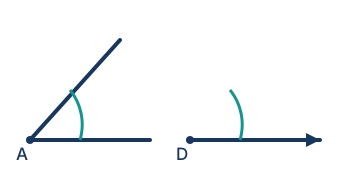
Draw a new ray. From the original vertex, draw an arc crossing both sides of the angle. Keep that radius and draw the same arc from the new vertex. Then copy the distance between the original arc’s two crossing points onto the new arc. Draw the second ray through the new intersection.
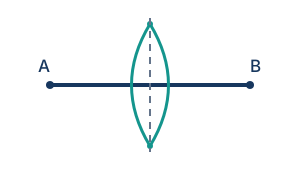
Segment: use one compass width—more than half the segment—from both endpoints. The arcs cross above and below. Draw the line through those crossings.
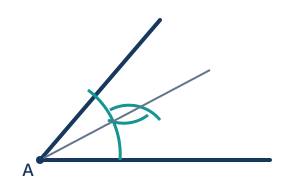
Angle: draw one arc from the vertex that hits both rays. From those two hits, draw equal interior arcs. Draw a ray from the vertex through their intersection.
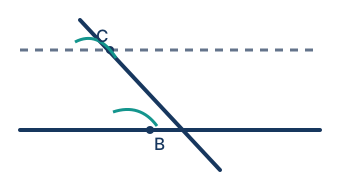
To construct a parallel line through a point, draw a transversal and copy the corresponding angle at the new point. To construct a perpendicular line, use equal arcs to locate a line that meets the original at 90°.
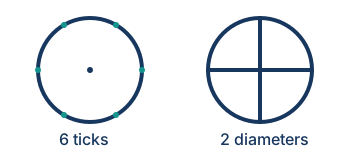
For an inscribed triangle, step the circle’s radius around the circle and connect every other mark. For a square, construct perpendicular diameters and connect their four endpoints. For a hexagon, connect all six neighboring radius-width marks.
Use the construction order—not how the finished picture looks—to choose each answer.