01.07 Line and Angle Proofs

Module 01 — Geometry Foundations

The big idea Prove vertical-angle and parallel-line relationships by linking definitions, angle addition, theorem facts, and equality properties.

By the end you can

  • Prove vertical angles are congruent without quoting the theorem being proven.
  • Recognize corresponding, alternate interior, alternate exterior, and same-side interior pairs.
  • Choose the reason that justifies each line of an angle proof.
The case file

A proof is a case file: nobody accepts “those angles match” only because the picture looks that way. In this lesson you prove that opposite angles at an X are congruent and that certain angles match—or add to 180°—when a transversal cuts parallel lines.

Forbidden move: when proving the Vertical Angles Theorem, you cannot say “because vertical angles are congruent.” That is the claim you still have to establish.

Twins across the X

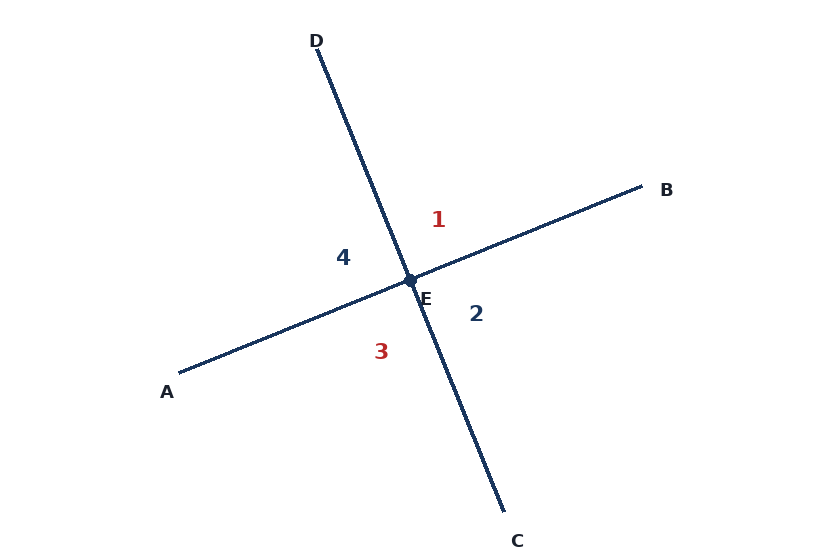
Two lines cross. Four angles. The ones that sit across from each other are vertical. They share a vertex, they do not share a side (they are nonadjacent), and they are congruent.

Tap a numbered corner on the picture. Its twin lights up with it.

Lookalike words: vertical = across, nonadjacent, congruent. Linear pair = next to each other on a straight line, add to 180°. If a question says “best describes a vertical angle,” “nonadjacent” can be the keyed word.

Tap 1, 2, 3, or 4 on the drawing.

Prove the twins

Canvas walks this as a two-column proof. Here it is as peeling off a shared neighbor.

∠1 and ∠2 make a straight line → they add to 180°.
∠3 and ∠2 make a straight line → they also add to 180°.

So both pairs equal 180°. That’s the Transitive Property: two things equal to the same thing are equal to each other.

Now subtract the shared neighbor ∠2 from both sides. What’s left is m∠1 = m∠3. Definition of congruent angles: ∠1 ≅ ∠3.

Intersecting lines used to prove vertical angles congruent
Subtract the same neighboring angle from two 180° sums.

Eight corners, three letters

Two parallel streets. A diagonal bike path. Eight corners. Canvas names four theorems. The cheat codes:

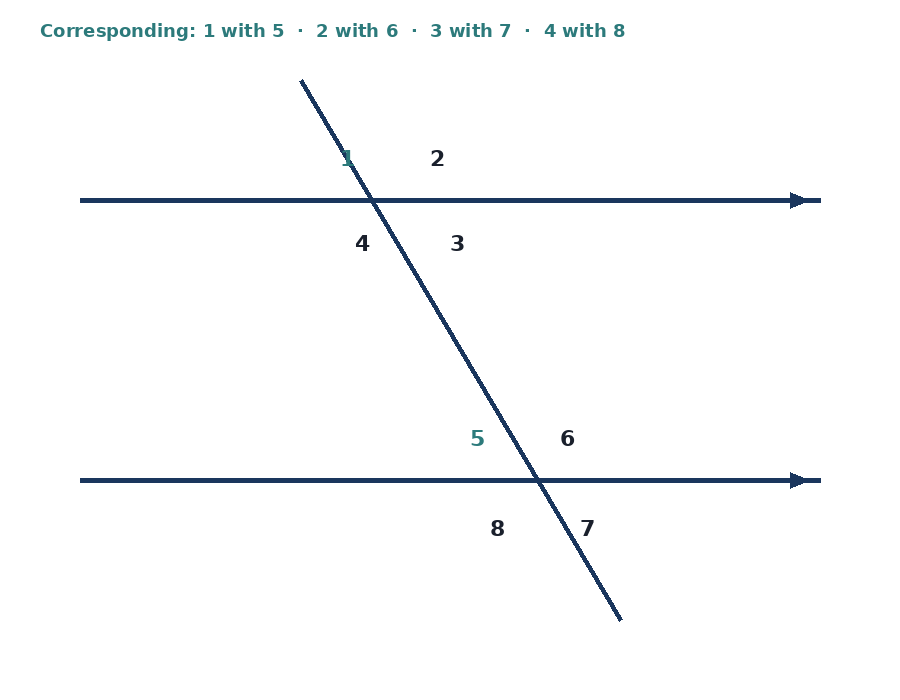
  • F — corresponding. Same side of the bike path, same “slot.” If the streets are parallel, they match.
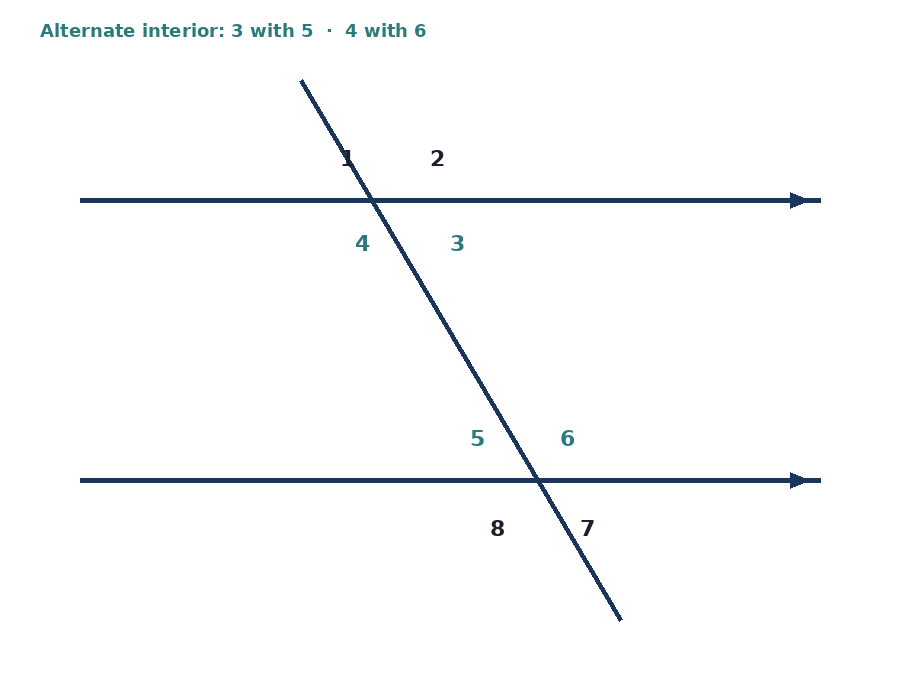
  • Z — alternate interior. Inside the streets, opposite sides of the path. The Z. They match.
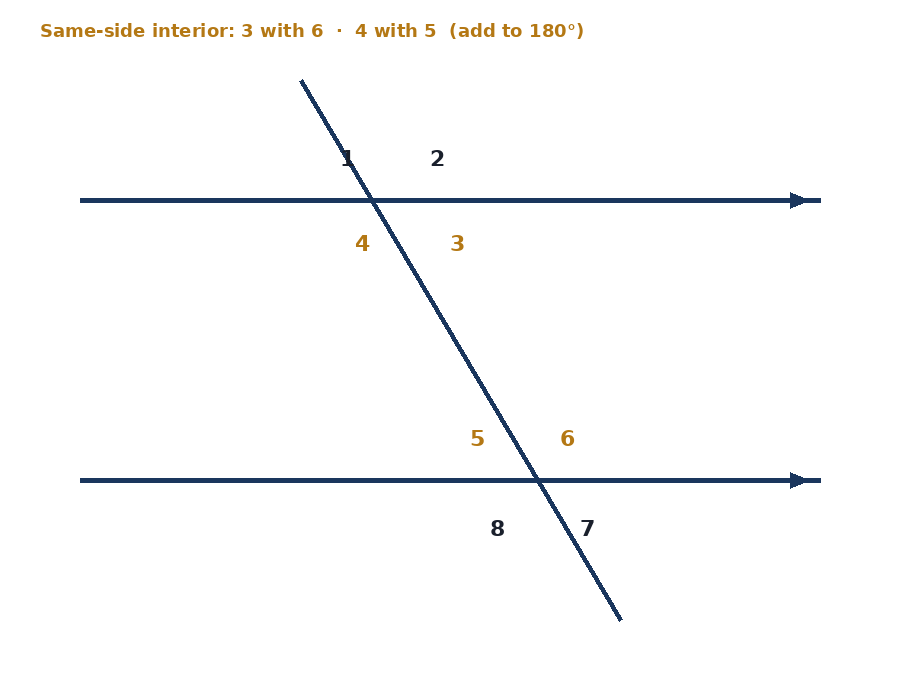
  • C — same-side interior. Inside the streets, same side of the path. They add to 180° (supplementary), they are not congruent (unless each is 90°).

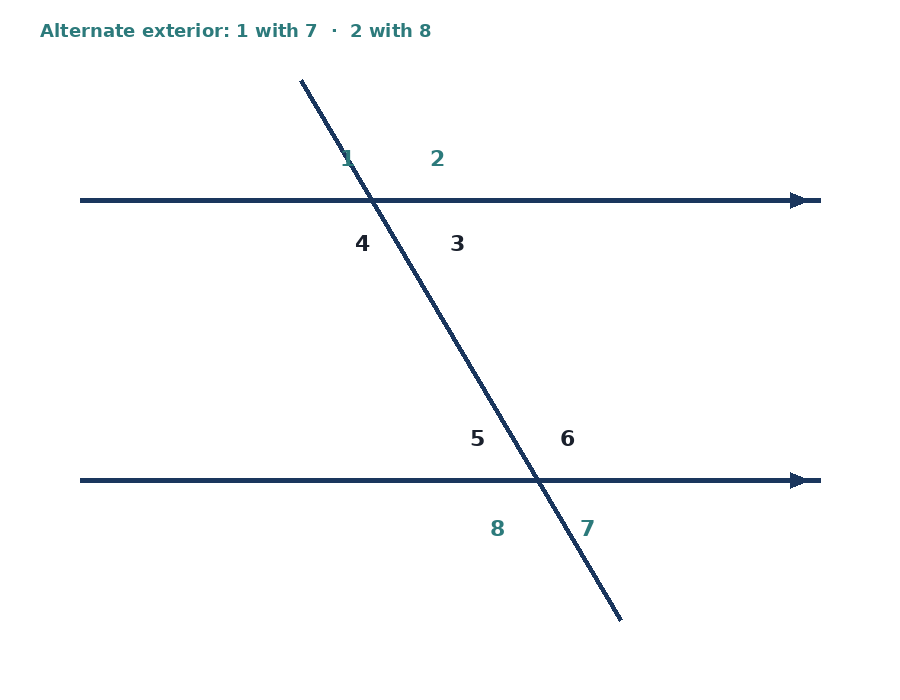
Alternate exterior is the Z on the outside: opposite sides, outside the streets. They match too.

Lookalike pair: corresponding vs alternate interior both say “congruent if parallel.” The difference is where they sit — same corner of the F, or the inside corners of the Z.

Tap F, Z, or C — the matching corners light up on the picture. You can also tap a numbered corner.

The four parallel-line theorems

These conclusions require parallel lines.

  • Corresponding Angles Theorem: corresponding pairs are congruent.
  • Alternate Interior Angles Theorem: inside-opposite pairs are congruent.
  • Alternate Exterior Angles Theorem: outside-opposite pairs are congruent.
  • Same-Side Interior Angles Theorem: inside-same-side pairs are supplementary.

One known angle plus these facts and vertical angles lets you fill all eight measures.

Corresponding angle pairs on parallel lines
Alternate interior angle pairs on parallel lines
Alternate exterior angle pairs on parallel lines
Same-side interior angle pairs on parallel lines

Build the corresponding-angles case

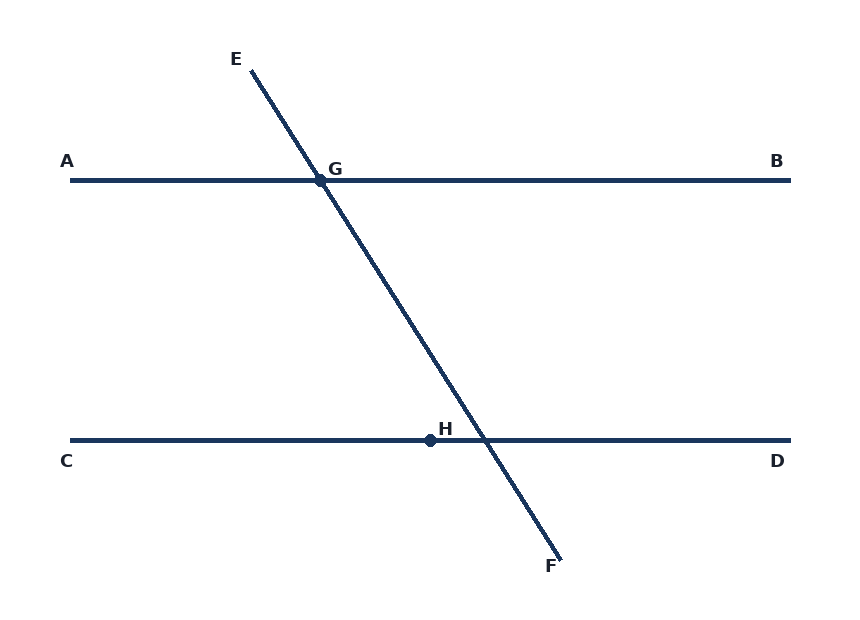
Given: AB ∥ CD. Prove: ∠AGE ≅ ∠CHE.

m∠AGE + m∠AGF = 180° by the straight line and Angle Addition. m∠CHE + m∠AGF = 180° by the Same-Side Interior Angles Theorem. Both sums share m∠AGF. Subtract it to get m∠AGE = m∠CHE, then use the definition of congruence.

Same number, different reasons: both lines equal 180°, but one comes from a straight angle and one from the Same-Side Interior Angles Theorem.
Parallel lines AB and CD cut by transversal EF
The proof subtracts the shared angle AGF from two 180° sums.

The Z is a shortcut

Alternate interior follows in three links:

  1. ∠AGF ≅ ∠EGB because they are vertical.
  2. ∠EGB ≅ ∠EHD because they are corresponding.
  3. Therefore ∠AGF ≅ ∠EHD by the Transitive Property.

That is the Alternate Interior Angles Theorem built from vertical angles, corresponding angles, and transitivity.

Parallel lines and transversal used for an alternate-interior proof

Your turn — pick the reason

Same practice story as the lesson: AC ∥ GD, m∠CBE = 60°, m∠BFG = 120°. Prove ∠BED ≅ ∠BFG.

Watch for lookalike theorems and for “same 60°, different why.”

1 / 4 0 correct