01.03 Advanced Constructions

Module 01 — Geometry Foundations

The big idea Copy an angle to make a parallel, use paired arcs to make a perpendicular, and use a circle's radius or diameters to build regular polygons.

By the end you can

  • Construct parallel and perpendicular lines.
  • Construct an inscribed regular hexagon, equilateral triangle, and square.
  • Identify the next step from a partial construction.
The two symbols

AB ∄ CD means line AB is parallel to line CD: the lines share a plane and never meet. Matching arrow marks identify them.

AB ⊄ CD means the lines meet at 90°. A square in the corner marks the right angle.

Check a parallel by sliding a fixed compass gap along it. Check a perpendicular with the corner of a sheet of paper.

Parallel is a copied angle

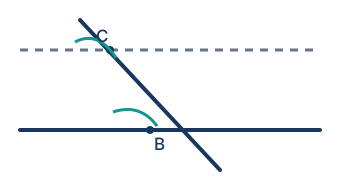
To make a parallel through a point off a given line, first draw a transversal through the point and across the line. Copy the angle at the first intersection onto the point. Congruent corresponding angles force the new line to be parallel.

  1. Draw the transversal.
  2. From its first intersection, swing an arc across both lines.
  3. Keep that width and swing a matching arc from the given point.
  4. Copy the chord of the first angle onto the new arc.
  5. Draw the line through the given point and the new cut.
Quiz wording: ā€œcopy the angle formed by the given line and a transversalā€ is the parallel move. Joining two arc crossings is the perpendicular move.
A parallel line constructed by copying an angle along a transversal
The dashed line becomes parallel because the corresponding angles were copied.

Perpendicular through a point on the line

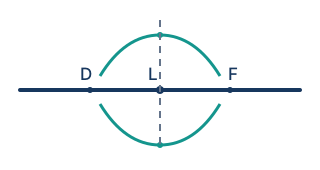
Point L is already on the line. You want a line through L at 90°.

  1. From L, swing an arc that hits the line on both sides. Call the hits D and F.
  2. From D, swing arcs above and below.
  3. Keep that width. From F, swing arcs that cross the first pair.
  4. Draw the line through those two crossings. It also runs through L.

The first move makes two hits on the original line, one on either side of L.

Equal construction arcs forming a perpendicular through point L on a line
D and F are the two line hits; their equal arcs locate the perpendicular.

Perpendicular through a point off the line

Point P sits off the line. You want the line through P to meet the original line at 90°.

  1. From P, open the compass wider than the distance to the line.
  2. Swing an arc that cuts the line in two places.
  3. From those two hits, swing equal-width arcs on the far side of the line until they meet.
  4. Draw the line from P through that meeting point.

This has the same skeleton as a segment bisector: make two equal distances on the line, then draw through the point equally far from both.

Shared step: both on-line and off-line versions create two hits on the original line.

Three polygons on a circle

Inscribed means every vertex sits on the circle. Regular means equal sides and equal angles.

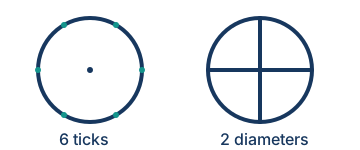
A regular hexagon and an equilateral triangle start the same way: set the compass to the radius and walk six equal ticks around the circle.

  • Connect every tick for a regular hexagon.
  • Connect every other tick for an equilateral triangle.

Three polygons on a circle (2)

A square starts differently: draw a diameter, construct its perpendicular bisector to make a second diameter, then connect the four points where the diameters meet the circle.

Do not swap them: the square uses diameters. The hexagon and triangle use six radius-width ticks.
Six radius ticks compared with two perpendicular diameters in a circle
Six ticks begin a hexagon or triangle; perpendicular diameters begin a square.

What is this drawing doing?

Partial constructions. Name them before the quiz does.

Practice like 01.03

Ten questions. Next-step on a diagram, same-step in two constructions, square vs hexagon. New items.

1 / 10 0 correct