01.02 Basic Constructions

Module 01 — Geometry Foundations

The big idea A compass copies a distance. Every valid construction depends on keeping the required compass width unchanged.

By the end you can

  • Copy a segment and an angle with a compass and straightedge.
  • Bisect a segment and an angle.
  • Recognize a construction from its arcs and decide the next valid step.
Congruent means the measures match

is the sign for congruent. Matching hash marks on two segments mean their measures match. Different hash counts mean they do not. Never trust “they look the same.”

A construction copies a figure using only a compass and straightedge: no ruler numbers and no protractor. The compass opening is a radius. Locking that width is what makes a copied length congruent.

Tool rule: a dynamic geometry program counts because its circles stay circles when a point moves. A freehand paint program does not.

Copy a segment

You are given AB and need the same length somewhere else.

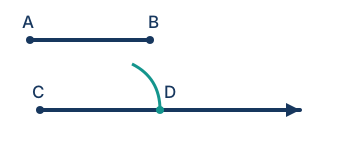
  1. Draw a ray longer than AB and name its endpoint C.
  2. Open the compass to AB.
  3. Without changing the width, park the compass on C and swing an arc through the ray. Name the cut D.
  4. CD ≅ AB.

The copied distance is AB itself, not its midpoint or a distance to some extra point.

Usual miss: if the arc from C uses a different width than AB, it is not a copy.
Segment AB copied to ray CD with a compass arc
The compass takes the length AB to the new ray. The arc marks D.

Copy an angle

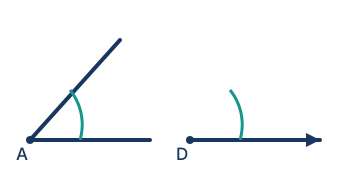
Copying an angle copies two distances: first the radius of an arc from the vertex, then the chord between the arc's two hits.

  1. For given ∠ABC, draw a new ray with endpoint D.
  2. From B, swing an arc through both rays; mark hits E and F.
  3. Keep that width and swing the matching arc from D; mark its hit G.
  4. Open the compass to chord EF.
  5. From G, cut the new arc at H.
  6. Draw ray DH. Then ∠HDG ≅ ∠ABC.

Original angle plus a lone new ray and matching arc means an angle copy is in progress.

Original angle and new ray with matching construction arcs
Copy the vertex arc first; copy its chord second.

Bisect a segment

Bi- means two; sect means cut. A segment bisector cuts the segment into congruent pieces at its midpoint. This construction also makes a perpendicular bisector.

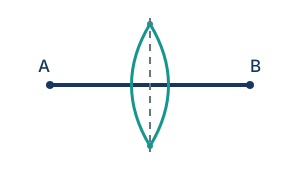
  1. From one endpoint, open the compass more than halfway and swing arcs above and below.
  2. Keep the width. From the other endpoint, swing arcs that cross the first pair.
  3. Draw the line through the two crossings. It hits the midpoint at 90°.
Width trap: changing the compass before moving to the second endpoint breaks the construction.
Equal construction arcs crossing above and below segment AB
The line through both arc crossings is the perpendicular bisector.

Bisect an angle

The angle bisector splits an angle into two congruent angles.

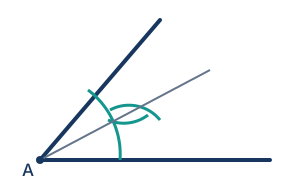
  1. From the vertex, swing an arc through both rays and mark the two hits.
  2. From one hit, swing an arc inside the angle.
  3. Keep that width. From the other hit, swing an arc that crosses the first inner arc.
  4. Draw a ray from the vertex through the inner crossing.

The inner arcs start at the two hits on the first arc, not at the vertex again.

Angle bisected with an outer vertex arc and two equal inner arcs
The ray through the inner crossing splits the angle in half.

What is this drawing doing?

This is the headline skill for 01.02. The quiz shows a mid-construction sketch and asks you to name it. Tap the name. Four drawings rotate.

Practice like 01.02

Ten questions. Diagram ID, next-step, “who changed the compass,” order of copy-an-angle. New items.

1 / 10 0 correct