

The big idea Finish and check your own researched argument, Works Cited page, and reflections.
The Art of Arguing
Open the Canvas upload and the From Start to Finish worksheet in the lesson. Record your selected prompt. Continue your own researched argument from the earlier work.
Use your own introduction and the body work from Argumentative Support. The course’s planning sequence places the counterclaim and evidence-based rebuttal before the support for your claim. Add further claim-support paragraphs when needed to develop your reasoning.
Use relevant evidence from multiple sources, with a mix of direct quotations and paraphrases. Introduce quotations and explain their importance. A paraphrase expresses the idea in new wording; changing a few words is not enough. Credit both forms.
Use this check on one part at a time.
Mark its source and the reason it supports.
Check that your own explanation says why this evidence supports the reason, rather than simply repeating the source.
Got it now? Scroll back up and re-read the section — it should land differently.
State the real counterclaim fairly. Use researched evidence to answer its points, then explain why that evidence weakens the opposing reasoning. Repeating your claim or criticizing the opponent leaves the rebuttal unfinished.
Review your introduction before writing the conclusion. Signal closure, return to the claim and counterclaim, and remind the reader of the main points and why the issue matters. Challenge the audience to think or act. Add no new ideas.
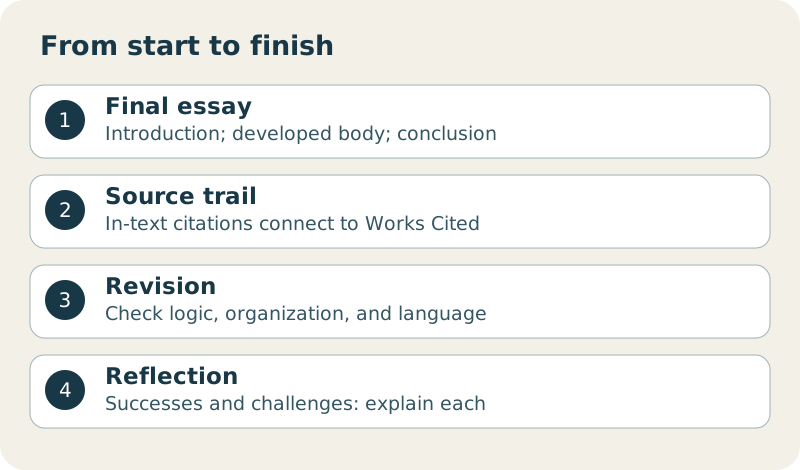
Check every borrowed fact, quotation, and paraphrase. Credit it in the essay with appropriate in-text references or signal phrases. Include each used source on Works Cited, and make sure each listed source is used in the essay.
The lesson specifies Times New Roman, size 12; a centered Works Cited heading; double spacing; alphabetical order by author or title when there is no author; and hanging indents on second and later lines. Check each entry against its actual source.
Read aloud to find gaps in logic, awkward connections, and missing explanations. Check paragraph purpose, transitions, precise academic wording, sentence variety, and a consistent voice. Then check spelling, punctuation, and grammar.
The final worksheet asks about your successes and your challenges in argumentative writing. Answer each in 2–3 complete sentences and explain why. Use your real work and experience; these are your reflections.
Purpose and structure, development, and language are 30 points each. Works Cited and reflection are 10 points each. Check all five categories, then open the saved worksheet to verify the prompt, essay, Works Cited, and both reflections before uploading and clicking Submit Assignment.
Answer first. Read the explanation after each choice.
Tick these off as you go. Saved in this browser.