

The big idea Trace a claim to its evidence, answer a counterclaim, and spot the break in faulty reasoning.
The Art of Arguing · quiz worth 33 pts
In this lesson, argumentation uses facts and reasoning to support a position and consider the opposing side. Persuasion may lean on emotion and present just one side. Ask what supports the message.
Logos appeals to logic. Pathos appeals to emotion. Ethos concerns ethics and credibility. A relevant, qualified expert can strengthen evidence; check the expertise and the support.
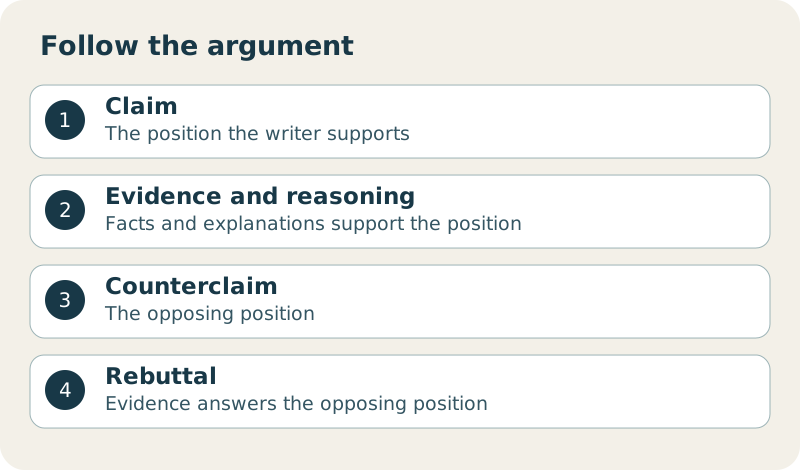
The claim is the writer’s debatable position. A counterclaim acknowledges the opposite side. A rebuttal uses evidence and reasoning to show why that opposing position is incorrect or flawed.
Deductive reasoning applies a general relationship to a specific case. Inductive reasoning draws a conclusion from observations. The course calls a conclusion from a pattern, such as symptoms leading to a diagnosis, abductive reasoning.
Ad hominem attacks a person. Bandwagon uses popularity. Circular reasoning repeats the claim as support. None supplies independent evidence for the position.
False analogy treats a similarity as proof of more similarities. Hasty generalization draws a broad conclusion from too little experience. Slippery slope predicts an unsupported chain of extreme outcomes.
A non sequitur introduces unrelated information. A red herring distracts with loosely related information. A strawman replaces the other side’s actual position with an unfair version.
Use this check on one part at a time.
Name the point the speaker is supposed to prove.
Ask whether the next sentence supplies evidence, attacks a person, repeats a claim, or changes the issue.
Got it now? Scroll back up and re-read the section — it should land differently.
The recovered self-check also includes false dichotomy, or either/or: treating two choices as the only possibilities when more positions exist.
In the Kennedy excerpts, identify the call for the United States to lead in space exploration. Then notice the acknowledged cost. A topic, a supporting detail, and an opposing concern do different jobs.
Answer first. Read the explanation after each choice.
Tick these off as you go. Saved in this browser.