03.06 Mendel

Module 03: Cell Reproduction

The big idea Use the generations to explain how a hidden recessive allele can reappear.
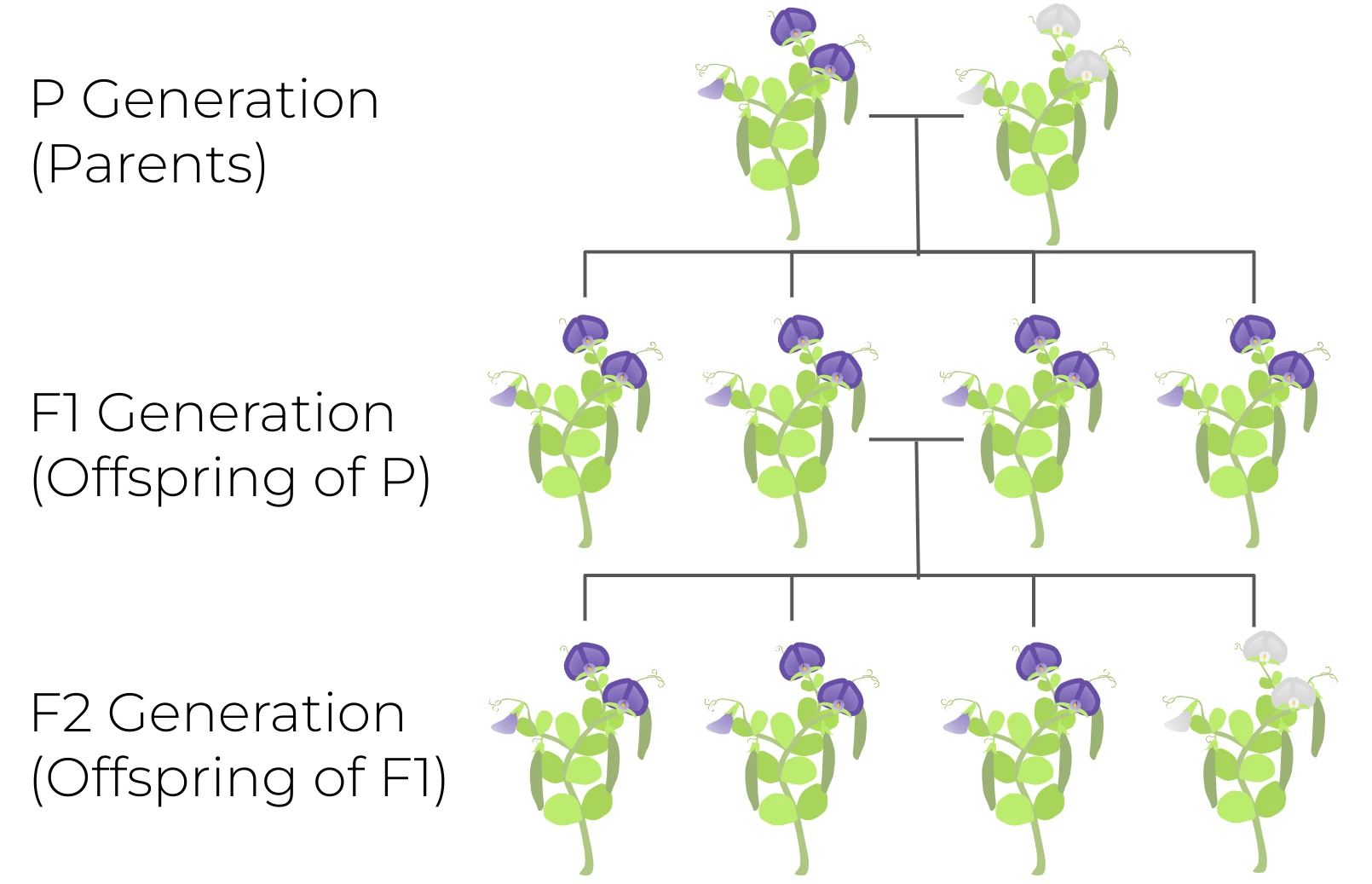
Course illustration of P, F1, and F2 pea-flower generations.

By the end you can

  • Explain Mendel’s controlled pea crosses.
  • Track P, F1, and F2 results.
  • Distinguish genotype, phenotype, and dominance.
  • Explain segregation and the reappearance of a recessive trait.
Why Mendel used peas

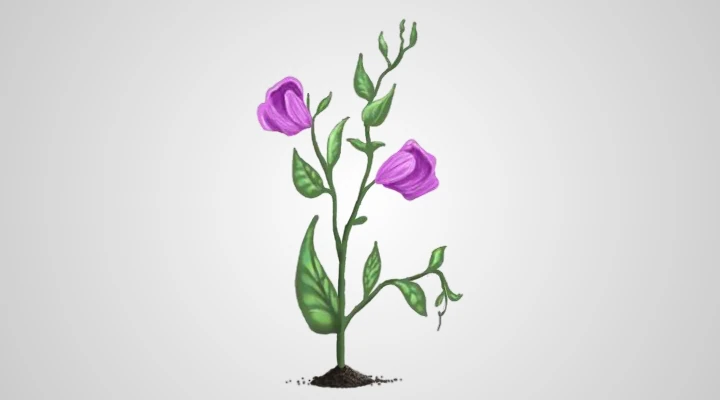
Genetics studies genes and inheritance. Mendel studied pea plants because they were easy to grow, had contrasting traits, produced many offspring, and had short life cycles. Controlling which plants reproduced let him connect parental traits with offspring traits.

Course illustration of garden pea plants used in Mendel’s experiments.
Course illustration. Tap to enlarge.

Control the pollen source

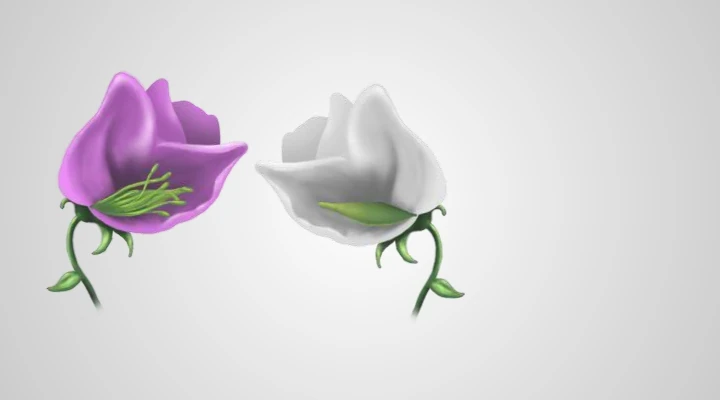
Peas can self-pollinate: sperm from pollen fertilizes an egg from the same plant. Mendel prevented this by removing the pollen-producing parts, then supplied pollen from a different plant. This cross-pollination let him compare parents with contrasting traits.

Course flower illustration used to explain controlled cross-pollination.
Course illustration. Tap to enlarge.
Not sure about this bit?

Follow P, F1, and F2

P labels the original parents. F1 labels their offspring. F2 labels offspring of the F1 plants. In the purple-and-white flower experiment, the F1 flowers were purple; white reappeared in about one quarter of F2. That reappearance matters: the white-flower allele was still present.

Course sequence of purple and white P flowers, purple F1 flowers, and F2 flowers including white.
Course illustration. Tap to enlarge.

Dominant describes expression

Alleles are different versions of a gene. In Mendel’s simple dominant/recessive pattern, one dominant allele is enough for its trait to appear. The recessive trait appears when both alleles are recessive. Dominant does not mean most common in a population.

Course illustration showing a purple-flower allele and a white-flower allele inherited together, with purple flowers expressed.
Course illustration. Tap to enlarge.

Genotype and phenotype

Genotype names the allele combination. Phenotype is the observable trait. Homozygous means two matching alleles; heterozygous means two different alleles. Two plants can look purple while carrying different allele combinations, so appearance alone does not always reveal genotype.

Course illustration of a purple-flowered plant that carries both purple and white versions of its flower-color gene.
Course illustration. Tap to enlarge.
Not sure about this bit?

Each gamete receives one allele

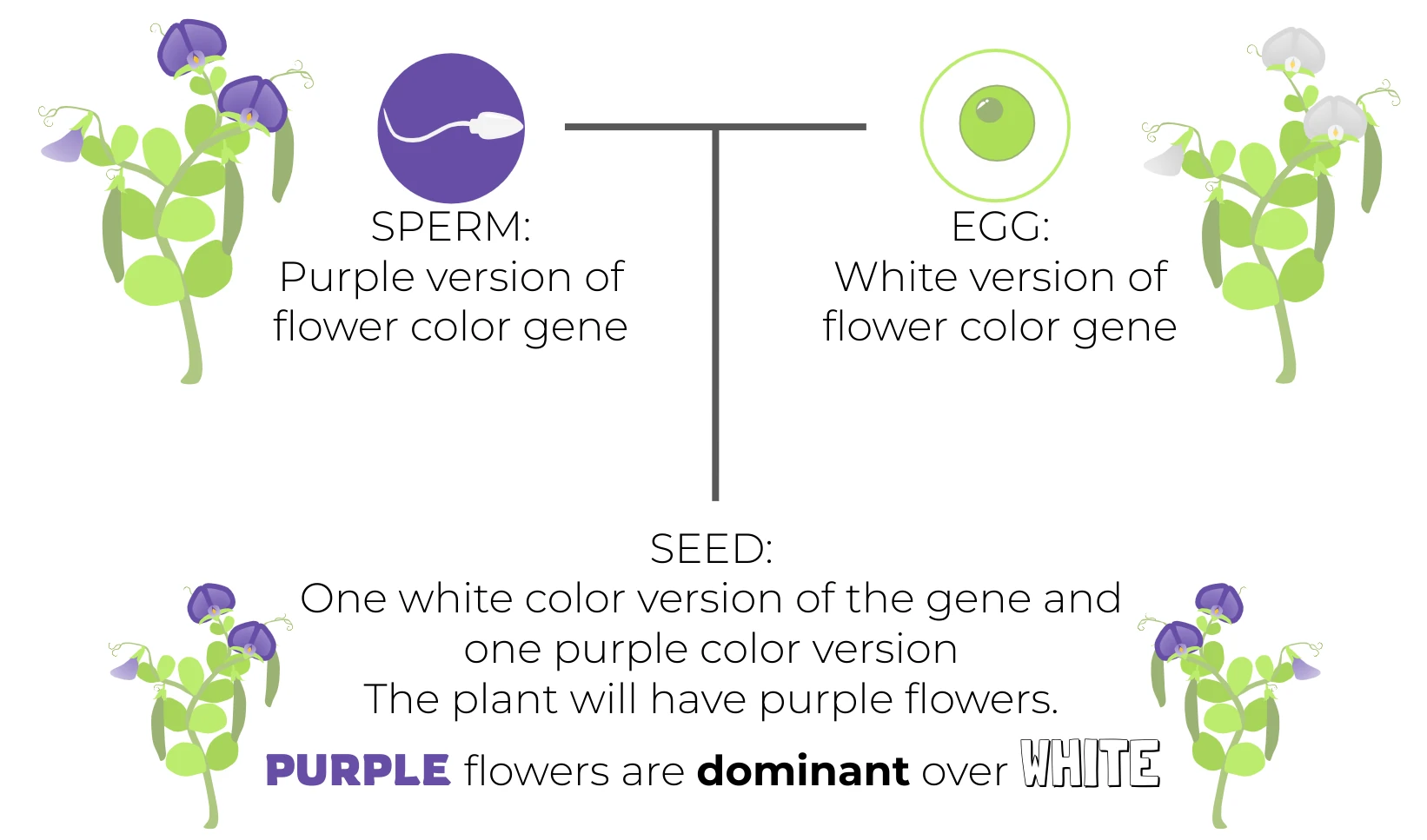
The law of segregation says the two alleles separate during gamete production. A heterozygous parent can make gametes carrying either allele. Fertilization brings one allele from each parent together again, restoring the pair in the offspring.

Course sperm and egg each contribute one version of the flower-color gene to the seed.
Course illustration. Tap to enlarge.

Explain the result across generations

The F1 hybrids can carry the recessive allele while showing the dominant trait. Their gametes separate the alleles. When two recessive alleles come together in an F2 plant, the recessive trait appears. The roughly 3:1 phenotype pattern describes many offspring, rather than an exact guarantee for every group of four.

Course P-to-F2 diagram with three purple and one white flower used to represent the F2 pattern.
Course illustration. Tap to enlarge.
Not sure about this bit?

Try it before the quiz

Choose an answer, then use the explanation to check your reasoning.

1 / 14 0 correct