By the end you can
- Compare sexual and asexual reproduction.
- Calculate haploid and diploid numbers.
- Recognize the stages and products of meiosis.
- Explain chromosome shuffling and distinguish mitosis.
Module 03: Cell Reproduction
By the end you can
Asexual reproduction uses one parent and generally produces genetically identical offspring, apart from mutations. Sexual reproduction combines gametes and produces new combinations of inherited genes. Fast reproduction can help an asexual population grow; low genetic variety can leave it vulnerable to the same disease.
Binary fission divides a cell after its DNA is copied. Budding grows a smaller outgrowth from the parent. Gemmules are internal buds that can develop into offspring. Fragmentation begins when a broken piece grows into a new organism. Bacterial binary fission is not mitosis; bacteria lack the nucleus involved in mitosis.
Got it now? Scroll back up and re-read the section — it should land differently.
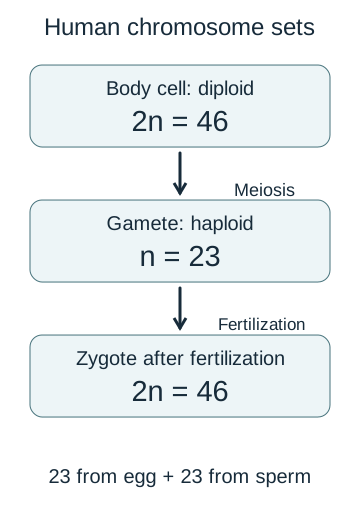
Diploid cells have two chromosome sets, written 2n. Haploid cells have one set, n. In humans, body cells usually have 46 chromosomes and gametes have 23. Meiosis halves the number; fertilization combines two gametes to restore a diploid zygote.
If a diploid cell has 18 chromosomes, its gametes have 9. If n is 7, then 2n is 14. The numbers 23 and 46 are the human example; other organisms have different counts.
Got it now? Scroll back up and re-read the section — it should land differently.
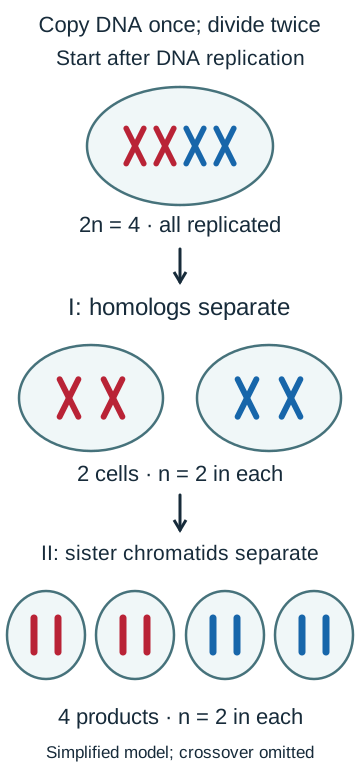
Homologous chromosomes carry the same kinds of genes, one chromosome inherited from each parent. They can carry different alleles. Sister chromatids are the copied halves of one replicated chromosome. DNA is copied once before meiosis I, and is not copied again before meiosis II.
A homologous pair contains one chromosome from each parent. Sister chromatids are copies of one chromosome joined at a centromere. Homologs can have different alleles at the same gene positions. The chromosomes are already replicated when meiosis I begins.
Got it now? Scroll back up and re-read the section — it should land differently.
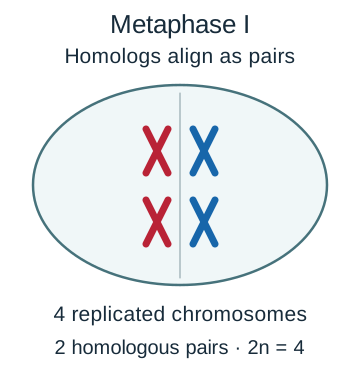
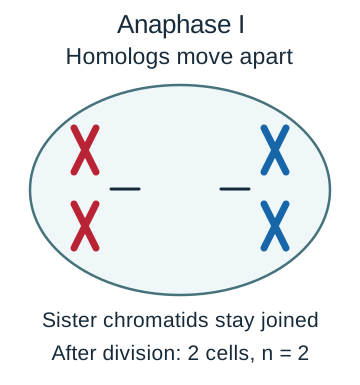
In prophase I, homologous chromosomes pair and crossing over can occur. In metaphase I, pairs line up at the middle. In anaphase I, homologs separate while sister chromatids stay joined. Telophase I and cytokinesis produce two cells with one chromosome from each homologous pair.
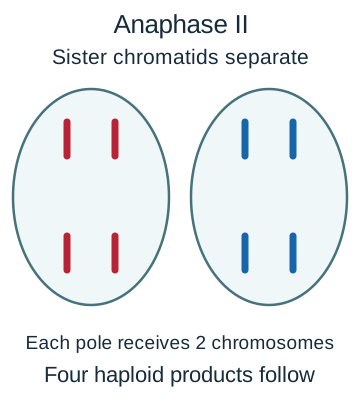
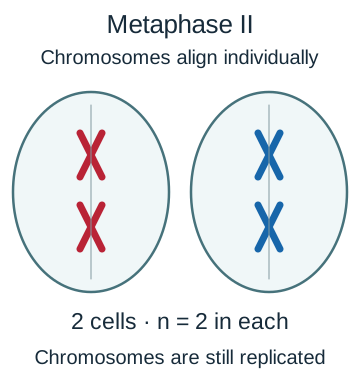
Each chromosome lines up individually in metaphase II. In anaphase II, sister chromatids separate. Telophase II and cytokinesis complete the divisions, forming four haploid products. The key difference is what separates: homologs in I, sister chromatids in II.
In prophase II, spindles form. In metaphase II, individual replicated chromosomes line up. Anaphase II splits sister chromatids. Telophase II reforms nuclei; cytokinesis divides the cytoplasm. There is no DNA replication between meiosis I and II.
Got it now? Scroll back up and re-read the section — it should land differently.
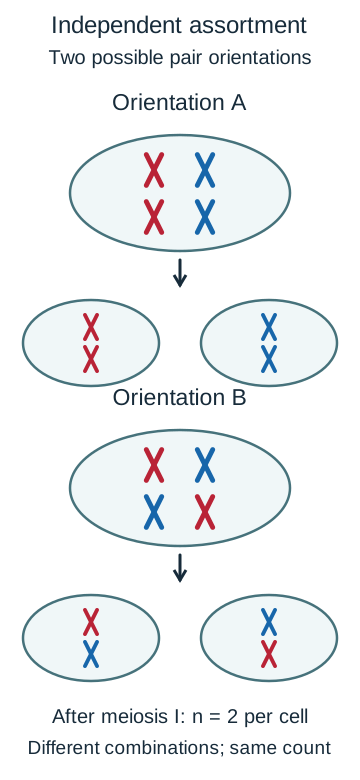
Crossing over exchanges DNA between nonsister chromatids of paired homologous chromosomes during prophase I. Independent assortment comes from the random orientation of homologous pairs at metaphase I. Random fertilization adds another source of variety when gametes combine.
Human sperm production yields four haploid sperm cells. Human egg production divides cytoplasm unequally, producing one large ovum and small polar bodies. Four haploid products therefore does not mean four functional eggs. The ovum retains materials needed for early development.
In the lesson’s typical human XX/XY model, eggs carry X and sperm carry X or Y. Body cells have 44 autosomes plus two sex chromosomes. A sex cell is an entire gamete; a sex chromosome is one chromosome inside a cell.
In the diploid body-cell examples in this course, mitosis gives two genetically matching diploid cells for growth or repair. Meiosis gives four genetically varied haploid products after two divisions. Both start after DNA replication. Meiosis reduces chromosome sets; ordinary mitosis preserves them.
Choose an answer, then use the explanation to check your reasoning.