03.02 Days of the Week

Time Will Tell Β· 30-point quiz Β· quiz worth 30 pts Β· 2026-10-30

The big idea ASL signs the days and the calendar, places past/present/future in physical space around the body, and can fold a number right into a time sign.
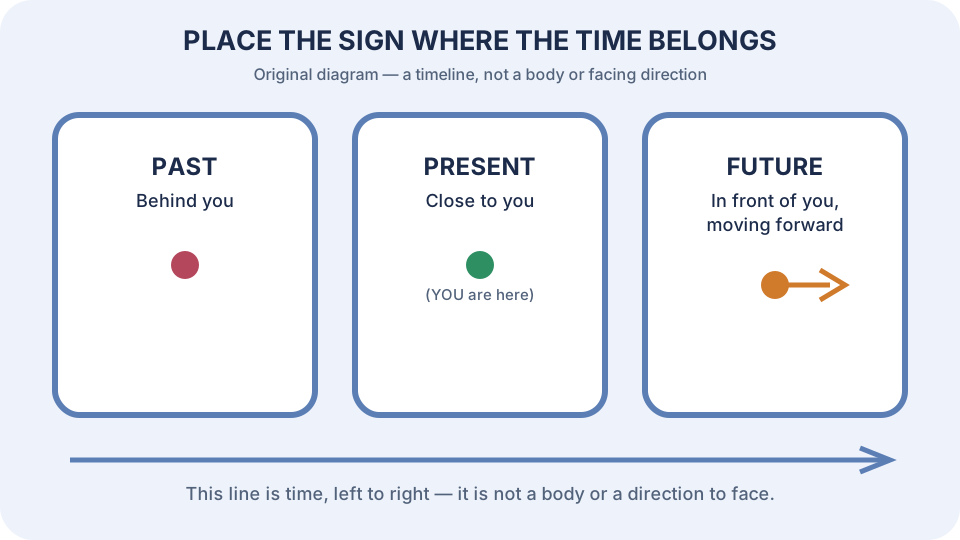
Diagram of past behind the body, present close to the body, and future in front of the body

By the end you can

  • Recognize all seven days of the week and five calendar words (week, weekend, day, year, month) by their course handshape and location.
  • Place past, present, and future in the correct signing space, and use numeral incorporation to fold a number into a time sign.
  • Read a short ASL dialogue about scheduling and answer questions about dates it establishes.

Before the Days of the Week quiz

Use this if the weekday signs and the time-space rule are running together.

Not sure about the basics underneath this lesson?

Watch Jacob and Meghan plan a party

Meghan and Jacob are on the couch with their phones. They decide to throw a holiday party and start checking the calendar. September is out — it's Cole's birthday month. October has Halloween competing for attention. December works, but Jacob has a dentist appointment the first Thursday, and Meghan is busy that Friday afternoon. They land on the second Friday in December.

Watch Jacob and Meghan plan a party (2)

Watch for Jacob signing “sure” while shaking his head “no” when he realizes he's busy the first Thursday — the head shake negates the sign, even while his hands look agreeable. Watch the course dialogue, twice: once for the gist, once for the signs and face.

Watch Jacob and Meghan plan a party (3)

The course also reminds you: select the 1x control in the lower right-hand corner of the video if you need to slow it down, and remember the on-screen captions are an English interpretation, not a word-for-word translation.

Time-space reminder — this page is a dialogue to comprehend, not new vocabulary.
Likely on the quiz They land on the second Friday in December. The future time sign (WILL) tells you the party hasn't happened yet.

Weekday signs: Monday through Friday

MONDAY: M handshape, neutral space on the dominant side, palm in. Make a small circular motion. (May also be signed with the palm facing back toward the body.)

Weekday signs: Monday through Friday (2)

TUESDAY: T handshape, same location and motion as Monday — neutral space on the dominant side, palm in, small circle.

Weekday signs: Monday through Friday (3)

WEDNESDAY: W handshape, same location and motion — neutral space on the dominant side, palm in, small circle.

Weekday signs: Monday through Friday (4)

THURSDAY: fingerspelled #TH, held with a small circular motion. You may also see it signed as an H handshape circling.

Weekday signs: Monday through Friday (5)

FRIDAY: F handshape, same location and motion as Monday through Wednesday — neutral space on the dominant side, palm in, small circle.

Weekday signs: Monday through Friday (6)

Monday, Tuesday, Wednesday, and Friday share one motion: the day's first letter, held at the dominant side, circling in. Only the handshape changes.

Weekday signs: Monday through Friday (7)

No demonstration video survived extraction for these five signs. This page's self-check only opens a blank video-recording tool, not a vendor clip, so the handshape/location/movement text above is the complete recovered record. Use the flashcards tool on this lesson to practice recall, and have an ASL speaker confirm your motion before the quiz.

Time-space reminder, not a picture of these signs — no course video survived extraction for this page.
Likely on the quiz Four of the five weekdays use the identical small-circle motion at the same location. The handshape (first letter of the day) is the only thing that changes, so check that first.

Weekend and calendar words

SATURDAY: S handshape, neutral space on the dominant side, palm in. Make a small circular motion — same family as the weekday signs.

Weekend and calendar words (2)

SUNDAY: Open B handshape on both hands, neutral space in front of the body at shoulder height, palms out. Tap the hands up high and then down low. (May also be signed with both hands as 5s, circling.)

Weekend and calendar words (3)

WEEK: 1 handshape (dominant) on top of Open B handshape (non-dominant). Start the dominant hand on top of the non-dominant hand near the wrist and slide it to the non-dominant fingertips — the course's own image: your non-dominant hand is a calendar row, and your dominant hand draws an arrow through the days.

Weekend and calendar words (4)

WEEKEND: Open B handshape on both hands, in front of the body. Place the dominant hand over the non-dominant hand near the wrist, then slide the dominant hand over and down.

Weekend and calendar words (5)

DAY: 1 handshape (dominant) and Open B handshape (non-dominant), in front of the body. The course's own text reads: “Place fingertips of non-dominant hand against middle of non-dominant arm, then fold dominant arm down on top of non-dominant arm.” That first clause looks like a transcription error in the source — a hand can't meaningfully press against its own arm, and the next sentence describes two separate arms. No demonstration video survived extraction to confirm the real motion, so check this one sign with a live ASL instructor or reference instead of trusting the literal wording.

Picture the non-dominant hand as a calendar row for WEEK — the course's own memory aid, not a drawn handshape.
Likely on the quiz SATURDAY matches the weekday circling pattern (S handshape); SUNDAY is the odd one out with two open hands tapping high-to-low. No demonstration video survived extraction for these five signs either — the flashcards tool covers this page too.

Where you put the sign changes the time

English changes a verb's form to show time (drove, drive, will drive). ASL instead moves the sign through space around your body.

Where you put the sign changes the time (2)

Past: move the sign toward the back of you, or at the shoulder or hip. Example: this is the space used for “last week.”

Where you put the sign changes the time (3)

Present: keep the sign close to your body. Example: this is the space used for “this week.”

Where you put the sign changes the time (4)

Future: sign directly in front of you with a forward motion. Example: this is the space and motion used for “next week.”

An original diagram built from the course's own rule (its real image wasn't recoverable): past behind you, present close to you, future in front of you with forward motion.
Likely on the quiz Practice it both directions: given a time word, say its space; given a described space (behind, close, in front with motion forward), say its time word.

Five more time words

YEAR: S handshape on both hands, in front of the body, palms in. Keep the non-dominant hand still and circle the dominant hand around it — the course's image: the non-dominant hand is the sun, the dominant hand is a planet revolving around it.

Five more time words (2)

YESTERDAY: Open A handshape, dominant side of the face, palm out. Touch the thumb on the side of the chin, then the cheek.

Five more time words (3)

TODAY: Y handshape on both hands, in front of the body, palms up. Bounce twice. (Bouncing only once changes the sign to NOW.)

Five more time words (4)

TOMORROW: Open A handshape, dominant side of the chin, palm out. Place the thumb on the dominant side of the chin and press outward.

Five more time words (5)

MONTH: 1 handshape on both hands. Dominant hand behind the non-dominant hand, palm in; non-dominant hand neutral in front of the body, palm out. Place the dominant 1 at the top of the non-dominant one and slide down it.

Time-space reminder, not a picture of these signs — no course video survived extraction for this page.
Likely on the quiz TODAY and NOW use the identical Y handshape; only the number of bounces (two vs. one) tells them apart. No demonstration video survived extraction for these five signs — the flashcards tool covers this page too.

Fold a number into the sign

Instead of signing PAST+WEEK, you can fold the number straight into WEEK: LAST-WEEK uses a 1 handshape thrown back over the shoulder into the past space. TWO-WEEKS-AGO uses the same motion with a 2 handshape. Watch the course's numeral-incorporation video for every example in this section.

Fold a number into the sign (2)

The same works forward: FUTURE WEEK can become NEXT-WEEK (1 handshape, forward space), and “in two weeks” becomes TWO-WEEKS-FUTURE (2 handshape, forward space). WEEK and YEAR both work this way — the direction in space alone carries past or future, so no separate PAST or FUTURE sign is needed.

Fold a number into the sign (3)

MONTH and DAY can also take a folded-in number, but they still need the separate PAST or FUTURE sign added: THREE-MONTHS-PAST signs the numeral-incorporated MONTH, then adds PAST. FOUR-MONTHS-AGO works the same way.

Direction in space (back = past, forward = future) is what the numeral-incorporated sign relies on.
Likely on the quiz The split to remember: WEEK and YEAR need no separate PAST/FUTURE sign once the number is folded in. MONTH and DAY still need PAST or FUTURE added.
Not sure about this bit?

Ask and answer about when

Course phrases, each linked to its real course video: NEXT-WEEK IX-I TEST (“I have a test next week”), eyebrows up on NEXT-WEEK. LAST-WEEK THURSDAY fs-D-A-T-E WHAT (“What was the date on Thursday last week?”), eyebrows up on LAST-WEEK THURSDAY and furrowed on WHAT. WEDNESDAY SIGN LANGUAGE IX-you STUDY CAN (“Can you study for sign language on Wednesday?”), eyebrows up the whole sentence. PAST WEEK+END IX-you DO-DO (“What did you do last weekend?”), eyebrows up on PAST WEEK+END and furrowed on DO-DO. NEXT MONTH WHAT (“What is next month?”), eyebrows up on NEXT MONTH and furrowed on WHAT.

Ask and answer about when (2)

The course's own calendar practice: on a January calendar where the 8th (Sunday) is a zoo trip, the 13th (Friday) is today and a football game, the 14th (Saturday) is Daniella's birthday, the 17th (Tuesday) is soccer practice, and the 18th (Wednesday) is a dentist appointment — “What was the date on Thursday last week?” answers January 5th, and “What did you do last weekend?” answers the zoo trip.

Yes/no questions raise the eyebrows for the whole sentence; WH-words like WHAT furrow them.
Likely on the quiz Match the eyebrow pattern to the sentence type: a yes/no question keeps eyebrows up throughout; a WH-word furrows them.

Practice the quiz moves

Match the day or calendar word to its sign, and place past/present/future in the right space.

Rehearse where each time word belongs in space, then check the vocabulary below.
1 / 5 0 correct

Final checklist

Tick these off as you go. Saved in this browser.