03.01 Celebrate Good Times

Time Will Tell Β· 30-point quiz Β· quiz worth 30 pts Β· 2026-10-27

The big idea Deaf culture shares most hearing holidays, adds its own Deaf President Now tradition, and signs a date by dropping English ordinal endings.
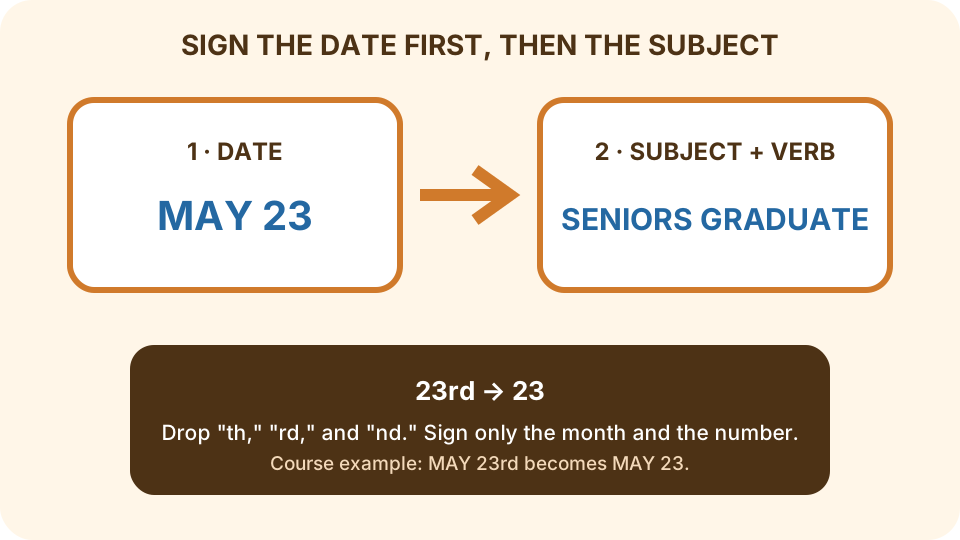
Diagram of signing a date first, then the subject, with the ordinal ending dropped

By the end you can

  • Recognize STAY, HOLD, and ten holiday/celebration signs by their course handshape and location.
  • Explain why most Deaf-community holidays match the surrounding hearing culture, and name Deaf President Now as the exception.
  • Sign a date the course's way: date first, then the subject, with no 'th,' 'rd,' or 'nd.'

Before the Celebrate Good Times quiz

Use this if the holiday signs and the history are running together.

Not sure about the basics underneath this lesson?

Two signs to warm up: STAY and HOLD

Before the holiday vocabulary, the course adds two everyday signs.

Two signs to warm up: STAY and HOLD (2)

STAY: Y handshape on both hands. Neutral space in front of the body, palms down. Place thumbs together and move the dominant hand forward. Watch the course video for STAY.

Two signs to warm up: STAY and HOLD (3)

HOLD: S handshape, neutral space on the dominant side, palm toward the non-dominant side. Slightly circle the hand inward. Watch the course video for HOLD.

This diagram is a date-grammar reminder, not a picture of STAY or HOLD. Copy the motion from the linked course videos.
Likely on the quiz The course's self-check only asks you to match the sign to its word, not to describe the handshape yourself.

Why most holidays are shared

More than 90 percent of deaf children are born to hearing parents, and many of those parents never learn to sign. Hearing screenings usually mean a health-care provider is the first to identify hearing loss, which routes many families toward hearing aids, speech therapy, and lipreading rather than ASL.

Why most holidays are shared (2)

On October 18, 2017, President Trump signed PL 115-71, which improved early-intervention services for families of children identified with hearing loss.

Why most holidays are shared (3)

Even so, Deaf culture stays entwined with the surrounding hearing world. Deaf individuals in Mexico are likely to observe Day of the Dead; deaf Christians worldwide typically celebrate Christmas. Which holiday a Deaf person celebrates tracks geography and religion, not hearing status.

No sign to show here — this page is history and culture, not vocabulary.
Likely on the quiz The note guide asks for the exact percentage (more than 90) and the law number/date (PL 115-71, Oct. 18, 2017).

Five more holiday signs

HOLIDAY: 5 handshape on both hands, at the front of the shoulders, palms in. Place thumbs on the front of the shoulders and tap in an alternating pattern. Course video.

Five more holiday signs (2)

EASTER: E handshape on both hands, neutral space at shoulder height, palms out. Circle outward. Course video.

Five more holiday signs (3)

HALLOWEEN: Relaxed C handshape on both hands, at the face, palms in. Place hands together in front of the face and move outward toward the ears, like covering your face with a mask. Course video.

Five more holiday signs (4)

ANNIVERSARY/CELEBRATE: Modified X handshape on both hands, neutral space at shoulder height, palms toward each other. Circle outward. Course video.

Five more holiday signs (5)

GRADUATION: G handshape (dominant) over Open B handshape (non-dominant), in front of the body. Place the G above the non-dominant hand, twist the wrist so the palm faces the non-dominant side, and land on top of the non-dominant hand. Course video.

Date-grammar reminder — the real handshape, location, and motion for each word are in the linked course video, not in this picture.
Likely on the quiz The self-check shows a video and asks you to pick the matching word out of these five, so know the videos, not just the written description.

Deaf President Now

Gallaudet University, the world's only all-Deaf university, opened in 1864 but had only ever had hearing presidents. When the university searched for its seventh president in March 1988, two of the three finalists were deaf. On March 6, the Board of Trustees chose the only hearing candidate, Elisabeth Zinser.

Deaf President Now (2)

Led by Greg Hlibok and Jerry Covell, students, alumni, faculty, and staff protested for a week: boycotting classes, blocking administrators from campus, and rallying across Washington, D.C. After national news coverage and hearing-advocate support, Zinser resigned on March 10. I. King Jordan became Gallaudet's first Deaf president.

Deaf President Now (3)

Jordan's words: “Deaf people can do anything hearing people can do, except hear.” The protest's demands were all met: Jane Spilman resigned from the Board, the Board gained a 51 percent Deaf majority, and no student or staff participant faced consequences.

Deaf President Now (4)

Every year near the March 6 anniversary, the Deaf community honors the protest, often inviting Hlibok, Covell, Bridgetta Bourne-Firl, and Tim Rarus — “the famous four” — back to speak. Senator Tom Harkin noted that between DPN and 1993, Congress passed more Deaf-rights legislation than in the nation's prior 216 years, including closed captioning and the Americans with Disabilities Act.

History page — no vocabulary sign here.
Likely on the quiz Know the date (March 6, 1988), the rejected and appointed candidates (Zinser, then Jordan), and what DPN stands for: Deaf President Now.

Five more traditions

THANKSGIVING: 3 handshape moving to Closed 3, from chin to chest, palm out. Start with a 3 handshape on the chin and pull downward into a closed 3 on the chest. Course video.

Five more traditions (2)

HANUKKAH: 4 handshape on both hands, neutral space at shoulder height, palms out. Place index fingers together and pull hands apart, like the candles of a menorah. Course video.

Five more traditions (3)

CHRISTMAS: C handshape (dominant) over Open B handshape (non-dominant), in front of the body. Place the dominant arm in front of the non-dominant arm with the C facing palm down, then pull the dominant arm upward so the palm faces the non-dominant side. Course video.

Five more traditions (4)

BIRTHDAY: Open 8 handshape, chin to chest, palm in. Tap the middle finger on the chin, then the chest. Course video.

Five more traditions (5)

WEDDING: Open B handshape on both hands, in front of the body, palms in. Start with the hands apart and swing the wrists so the dominant hand lands behind the non-dominant hand. Course video.

Date-grammar reminder again — copy each word's real motion from its linked video.
Likely on the quiz BIRTHDAY and THANKSGIVING both move from near the chin toward the chest or chin to chest — check handshape (Open 8 vs. 3-to-closed-3) to tell them apart.

Ask about a date: no 'th,' no 'rd' (2)

Questions about celebrations keep the usual ASL face grammar: CELEBRATION POSS-your FAVORITE WHAT raises the eyebrows on CELEBRATION and furrows them on the WH-word WHAT. POSS-your BIRTHDAY WHEN works the same way.

Date first, subject second, and the ordinal ending is dropped.
Likely on the quiz Any date gloss that keeps 'th' or 'rd' breaks the course's own date rule — drop the ordinal ending every time.
Not sure about this bit?

Practice the quiz moves

Match the holiday sign to its word, and pick the course-correct date gloss.

Rehearse the date rule, then check the holiday vocabulary below.
1 / 5 0 correct

Final checklist

Tick these off as you go. Saved in this browser.