01.05 Describe Yourself

A Family Affair Β· 30-point quiz Β· quiz worth 30 pts

The big idea Describe a person clearly in ASL: establish the topic, lead with the most visually useful descriptor, add only what clarifies, and use the right age and question grammar.
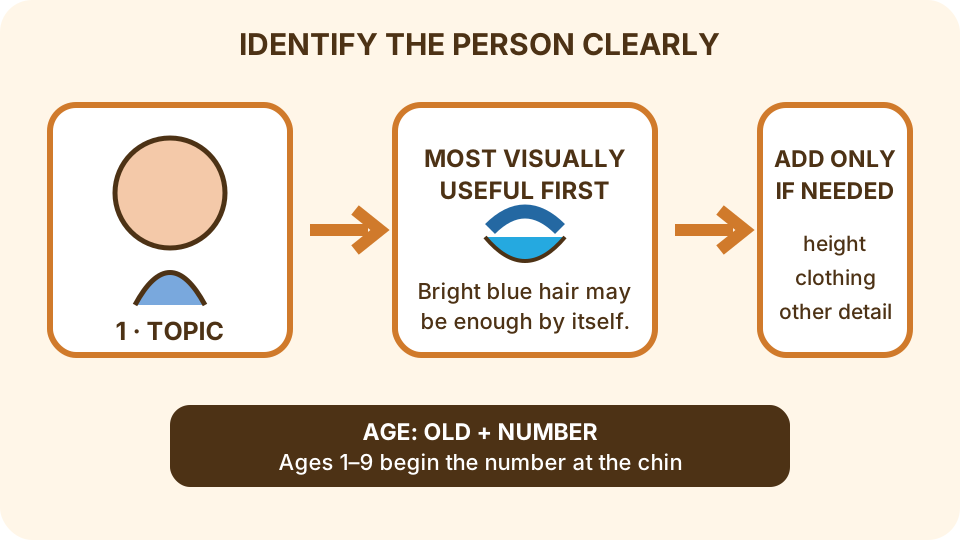
Course-derived diagram showing a topic followed by the most visually useful descriptor and only needed clarification

By the end you can

  • Apply the age-spot rule for ages 1–9 and ages 10 and above.
  • Turn short English sentences into topic-comment gloss.
  • Choose the most visually useful descriptor first, add only what clarifies, and use correct NMMs.

Before the description quiz

Use this if English order keeps taking over.

Not sure about the basics underneath this lesson?

Use the age spot once

The age spot is on the chin. For ages 10 and above, sign OLD and immediately add the number: OLD+13, OLD+25. Rewatch the actual course age demonstration and copy its motion.

Use the age spot once (2)

For ages 1–9, begin the number at the chin and move it outward into neutral space. Do not add OLD again afterward. That would say 'years old years old.'

Use the age spot once (3)

The question OLD IX-you means 'How old are you?' Furrow the eyebrows for the WH question.

Age begins at the chin. The course rule changes slightly for 1–9.
Likely on the quiz Avoid OLD + number + OLD. Use the age marker once.
Not sure about this bit?

Drop English word order

ASL is its own language. A common structure is topic, then comment. English filler words that cannot be visualized may disappear.

Drop English word order (2)

HOUSE I LIVE means 'I live in a house.' HER SHOES I LIKE means 'I like her shoes.' COLOR YOUR FAVORITE WHAT asks 'What is your favorite color?'

Drop English word order (3)

Find the thing being discussed first. Put what you say about it second. Then check the NMM.

Topic first. Comment second. Do not translate English one word at a time.
Likely on the quiz PHONE I WANT BUY is the course answer for 'I want to buy a phone.'

Lead with what identifies the person

For a person, establish the topic and give the most useful visual information first. The course phrase is BOY TALL HAIR BLACK HAPPY. Watch the actual signed phrase, then rehearse it without reading.

Lead with what identifies the person (2)

When the person is present, sign the most visually useful descriptor first. If bright blue hair already identifies one person in a crowd, it may be the first and only descriptor needed. Add height, body type, hair or eye color, clothing, or another visible trait only when it clarifies who you mean.

Lead with what identifies the person (3)

TALL uses a Bent B moving upward with the CHA mouth morpheme. SHORT uses a Bent B moving downward with the OO mouth morpheme. EYES points to each eye.

Lead with what identifies the person (4)

Yes/no questions raise the eyebrows throughout: POSS-your DAD EYES GREEN. WH questions furrow them: OLD IX-you.

Lead with the feature that identifies the person fastest. Add another visible detail only if it helps.
Likely on the quiz Do not force every description into the same list. Choose what is visually useful, then keep the NMM with the type of question.

Practice the quiz moves

Choose the course-faithful gloss or production rule.

Rehearse the course phrase, then practice choosing the fastest useful descriptor for a person you can see.
1 / 5 0 correct

Final checklist

Tick these off as you go. Saved in this browser.