By the end you can
- Distinguish family signs by handshape and face location.
- Use shoulder shifting instead of signing English 'and.'
- Use indexing and nonmanual markers to identify people and ask family questions.
A Family Affair Β· 30-point quiz Β· quiz worth 30 pts
By the end you can
Use this if the vocabulary and grammar are colliding.
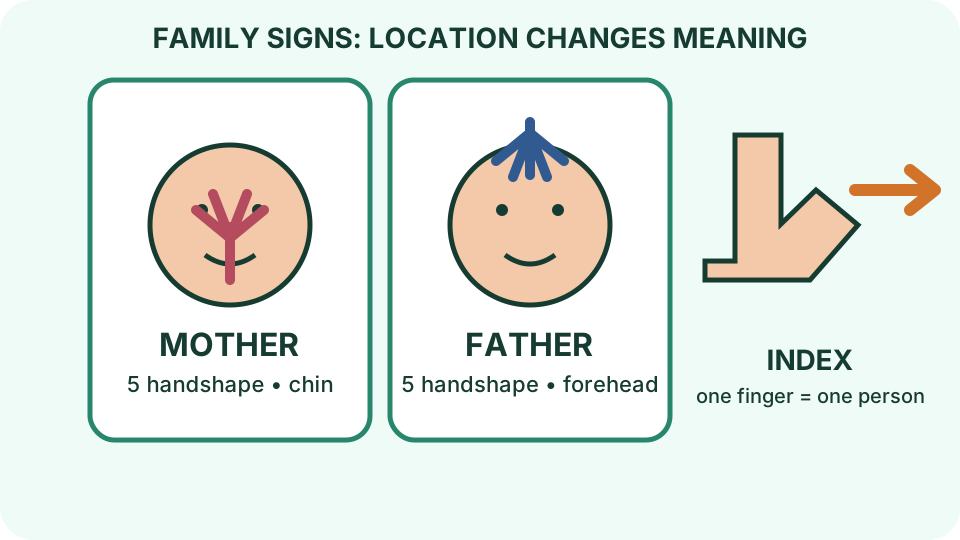
Family-sign location can change meaning: chin/jawline for feminine forms, above cheek for masculine forms.
Shoulder shifting separates two items. Indexing assigns a person to a stable place.
Raised brows for yes/no; furrowed brows on WH words.
What three channels carry meaning?
Hands/location, signing space/body shift, and facial grammar.
Got it now? Scroll back up and re-read the section β it should land differently.
Many masculine family signs happen above the cheek. Many feminine family signs happen at the chin or jawline. The location is part of the word.
MOTHER: 5 handshape at the chin. FATHER: 5 handshape at the forehead. PARENTS: move the 5 handshape from chin to forehead.
SISTER combines the feminine location at the chin with the related family sign. BROTHER starts in the masculine area at the forehead. Watch the actual course signers for MOTHER and FATHER, then copy the whole sign.
ASL does not sign the English word and in this lesson's family lists. Use a shoulder shift: place one item on one side, shift, then place the second item on the other side.
Course gloss: ss-nd SISTER TWO ss-d BROTHER FOUR IX-I HAVE. The shift separates the two groups. Rewatch the course's shoulder-shifting demonstration before practicing.
Keep numbers with the family member they count. Do not sign the English sentence word for word.
Indexing uses pointing to make pronouns and people clear. If someone is absent, assign that person a space and keep pointing to the same space until the conversation changes. The course indexing video shows this with MOM on one side and SISTER on the other.
One finger points to one person. Two fingers can track two people. Add the most visually useful description first when the person is present.
Facial grammar matters. The course raises eyebrows for yes/no questions. For HOW-MANY or WHO, the eyebrows furrow on the WH part.
Use three steps for an absent person.
Imagine where the person stands.
Assign one clear spot.
Index toward that same spot every time you refer to the person.
Can you switch the person's spot halfway through?
No, not unless you clearly establish something else there or the conversation ends.
Got it now? Scroll back up and re-read the section β it should land differently.
These questions use the exact grammar and vocabulary distinctions emphasized by the course.
Tick these off as you go. Saved in this browser.