06.06B Atomic spectra assignment

Module 06 — Heat and Particles Ā· quiz worth 20 pts

The big idea An atom's allowed energy differences create a characteristic pattern of spectral lines. Line positions identify possible elements; brightness also depends on physical conditions and the instrument.

Lines are energy differences

A spectrum makes more sense when each line is tied to a change between allowed atomic states.

Not sure about the basics underneath this lesson?

Visible hydrogen Balmer example

LineApproximate wavelength
H-delta 410 nm
H-gamma 434 nm
H-beta 486 nm
H-alpha 656 nm
Before you start Review E = hf and c = fĪ» from 06.06, plus the modern idea of allowed quantum states from 06.05. Open the assigned response document before taking notes.

What a spectroscope separates

A prism or diffraction grating separates light by wavelength. A hot dense object can produce a broad, nearly continuous spectrum. A low-density excited gas can produce bright emission lines. Cooler gas in front of a broad source can remove specific wavelengths and make absorption lines. Frequency f is measured in hertz (Hz), wavelength Ī» in meters (m), and photon energy E in joules (J) or electronvolts (eV).
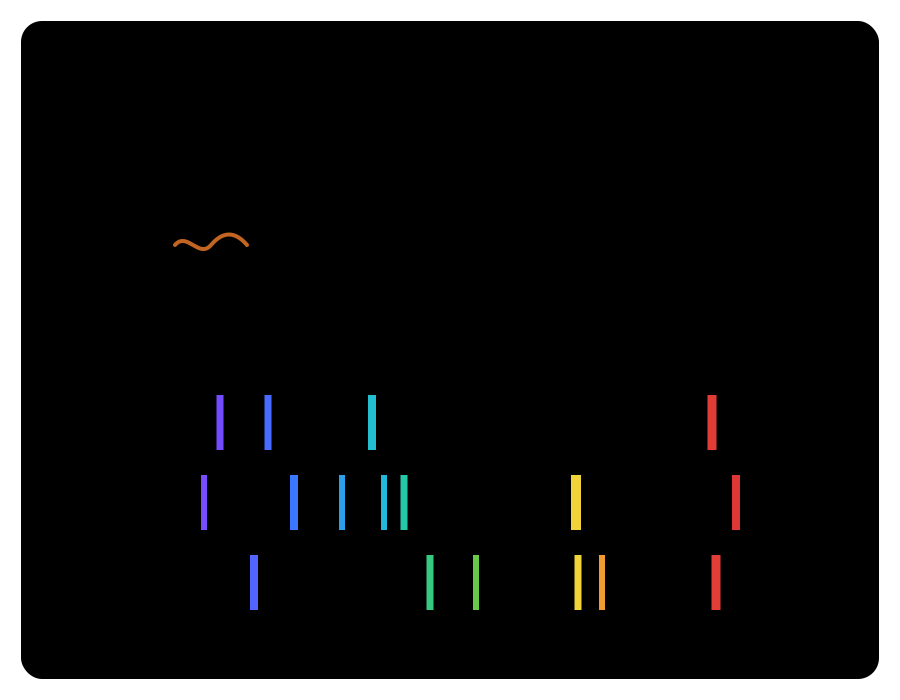
Why atoms make lines

Atomic electrons occupy allowed quantum states, not fixed classical orbits. When an atom changes from a higher-energy state to a lower-energy state, it can emit a photon whose energy equals the state-energy difference. Absorption reverses the process when a photon with an allowed energy is taken in. Different elements have different state structures, so their line patterns differ.

A downward electron transition emits a photon with ΔE = hf above three black emission strips whose distinct visible line patterns are labeled hydrogen, helium, and carbon from 400 to 700 nm.
A downward transition emits a photon whose energy sets one line. Hydrogen, helium, and carbon each show a distinct course-aligned emission pattern.

A real line-spectrum example

A familiar visible example is hydrogen's Balmer pattern, with prominent lines near 410 nm, 434 nm, 486 nm, and 656 nm. The ordered set of wavelength positions is the fingerprint. One isolated colored line would be a weaker match because more than one source can emit near a given wavelength.

Spectrum relations

Light speed
c=fλc=f\lambda

Use c = 2.998 Ɨ 10⁸ m/s for light in vacuum.

Photon energy
E=hfE=hf

Use h = 6.626 Ɨ 10⁻³⁓ JĀ·s.

Transition energy
āˆ£Ī”Eatom∣=hf\lvert\Delta E_{\text{atom}}\rvert=hf

Emission releases a photon; absorption takes in a photon.

Read a spectrum responsibly

Calibrate the wavelength axis

Identify where each measured line falls before naming a source.

Compare several lines

A reliable match uses a pattern of line positions, allowing for measurement uncertainty.

Separate position from brightness

Positions reflect allowed energy differences. Brightness can change with abundance, temperature, density, excitation, exposure, and instrument response.

State the evidence limit

A line match supports the presence of an element under the measured conditions; one isolated color is not enough.

Not sure about this bit?

Worked spectrum example

Energy of a 656 nm photon

  • Wavelength. Ī»=656 nm=6.56Ɨ10āˆ’7 m\lambda=656\,\text{nm}=6.56\times10^{-7}\,\text{m}
  • Constants. c=2.998Ɨ108 m/s,h=6.626Ɨ10āˆ’34 Jā‹…sc=2.998\times10^8\,\text{m/s},\quad h=6.626\times10^{-34}\,\text{JĀ·s}

Find the photon energy.

  1. Find frequency or combine the two relations.
    E=hcλE=\frac{hc}{\lambda}
  2. Substitute SI values.
    E=(6.626Ɨ10āˆ’34)(2.998Ɨ108)6.56Ɨ10āˆ’7 JE=\frac{(6.626\times10^{-34})(2.998\times10^8)}{6.56\times10^{-7}}\,\text{J}

E ā‰ˆ 3.03 Ɨ 10⁻¹⁹ J.

Complete the spectra assignment

Answer in the provided document

Keep each response beside the matching question and show calculation work with units.

Explain the quantum cause

Use allowed electron states and photon energy differences, not planets or a single electron circling a track.

Handle the fireworks section

Use an Internet photo or video to compare observed firework colors and connect them with element emission spectra. The course does not require formal citations here, but record a link or creator/title so the media can be found again.

Audit the submission

Confirm every prompt is answered, spectra are labeled, calculations are readable, and the requested file is attached before submitting.

Not sure about this bit?

Spectra traps

One line is weak identification

Use several matching wavelengths whenever the data allow it.

Brightness is not a simple concentration meter

It also depends on temperature, excitation, density, exposure, and the instrument.

A photon is tied to one transition

Do not call it a permanent property of copper, hydrogen, or another atom.

Nanometers are not meters

Multiply by 10⁻⁹ before using SI constants.

Spectra practice

Use line positions for identity, then use physics and context to discuss intensity.