04.04 Resistance and schematics

Module 04 — Circuits and Current · quiz worth 18 pts

The big idea Resistance is opposition to charge flow, measured in ohms. Current is charge per second, not speed. Schematics replace pictures of parts with standard symbols. Power is P = IV.

Ohm, ampere, watt

The schematic page is easy to skim as a picture dump. The units are the part the exam will mix with 04.02.

Not sure about the basics underneath this lesson?

Resistor color bands

Band 1 and band 2 are digits. Band 3 is the multiplier. Band 4 is tolerance. The memory letter is the course table's aid, not a second code.

ColorLetterDigitMultiplier
Black B 0 10⁰
Brown B 1 10¹
Red R 2 10²
Orange O 3 10³
Yellow Y 4 10⁴
Green G 5 10⁵
Blue B 6 10⁶
Violet V 7 10⁷
Grey G 8 10⁸
White W 9 10⁹
Gold none none 10⁻¹
Silver none none 10⁻²

What resistance is

This lesson describes current as electrons moving through a conductor and colliding with atoms and ions. That opposition is resistance. The quantity you calculate is still flow rate (charge per second). The right-hand rule in 04.02 still uses conventional current, positive to negative. A resistor is any component that hinders charge flow. A bulb filament is a resistor that also gives off light. Carbon resistors hinder flow without lighting. Low resistance lets charge move more easily. High resistance hinders it more strongly. Resistance is measured in ohms (Ω), named after Georg Simon Ohm. Longer wire means more collisions, so more resistance (proportional to length). Thinner wire means fewer charges in the cross-section, so more resistance (inversely proportional to cross-sectional area).
Current is not speed

In ordinary English, current can mean how fast water runs. In this lesson, current is flow rate: charge passing a point each second. It is measured in amperes, after André-Marie Ampère. Knowing the current does not tell you how fast each charge is moving. A coffee-filter picture in the lesson is the analog: a tight filter (high resistance) gives a low flow rate. Long bulbs have more resistance than round bulbs, which is why their lighting time is longer: the flow rate of charge is lower.

Not sure about this bit?

Circuit parts and symbols

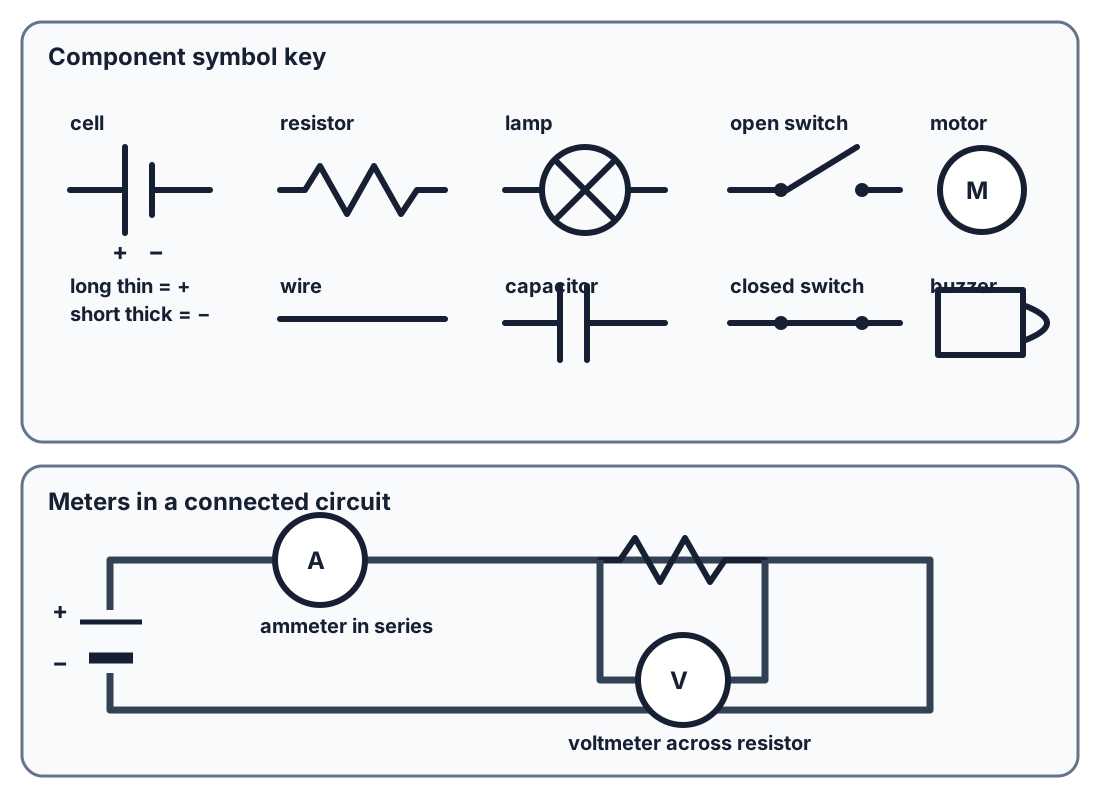
Schematic diagrams use conventional symbols so you are not drawing pictures of every bulb and cell. A battery converts stored chemical energy to electrical energy. A switch opens or closes the path. A bulb converts electrical energy to light. A buzzer converts electrical energy to mechanical and sound energy. A motor converts electrical energy to mechanical energy. A resistor decreases current. A voltmeter measures voltage. An ammeter measures current in amperes. The letter I on a diagram is current. A resistor is drawn as a zigzag.

Circuit-symbol key for a cell with a long thin positive bar and short thick negative bar, resistor, lamp, open and closed switches, wire, equal-plate capacitor, motor, and buzzer; a connected circuit places an ammeter in the loop and a voltmeter across a resistor.
Recognize each symbol, then trace the path. An ammeter belongs in series; a voltmeter connects across the component being measured.
Not sure about this bit?

Ohm's law and power

Ohm's law
V=IRV=IR

Voltage in volts, current in amperes, resistance in ohms.

Power
P=IVP=IV

Power in watts. Current, voltage, resistance, and power are interrelated.

Hair-dryer power

04.02 dryer numbers with the 04.04 power equation

  • Current. I=8.0 AI=8.0\,\text{A}
  • Voltage. V=120 VV=120\,\text{V}

Find the power.

  1. Use the power equation from this lesson.
    P=IVP=IV
  2. Substitute.
    P=(8.0 A)(120 V)P=(8.0\,\text{A})(120\,\text{V})

P = 960 W.

Traps on this lesson

Current is not velocity

Ampères tell you charge per second, not how fast a given electron travels.

Longer or thinner means more ohms

Length is proportional to resistance. Cross-sectional area is inverse. Do not swap those.

Ammeter vs voltmeter

Ammeter measures current. Voltmeter measures voltage. Mixing them is a common schematic miss.

Symbol and resistance practice

Name the job of the part, then the unit. For the power item, use P = IV with SI current.

Final checklist

Tick these off as you go. Saved in this browser.