Module 04 — Circuits and Current · quiz worth 16 pts
The big ideaCurrent in a wire is moving charge. That motion makes a magnetic field a compass can show. Ohm's law, V = IR, relates voltage, current, and resistance after the units are SI.
Current, field, and SI current
Ohm's law fails on paper when milliamperes are treated as amperes, and the right-hand rule fails if you point with electron flow.
Not sure about the basics underneath this lesson?
Current is rate of charge. The compass is a detector, not a circuit part.
1
Ampere
Charge per second. 1000 mA = 1 A.
2
Closed path first
No loop, no current, no magnetic field from that wire.
3
Thumb = conventional current
Positive to negative. Fingers curl with the field.
4
Magnets and Electromagnets sim
To see a compass array around a magnet or coil, open PhET Magnets and Electromagnets. The course bar-magnet widget with no accessible text still belongs in Canvas.
Watch someone else explain it
Ohms Law Equation — Use this if V = IR rearranging is the stuck point. Convert mA to A on paper before you watch another example.
Got it now? Scroll back up and re-read the section — it should land differently.
A compass shows moving charge
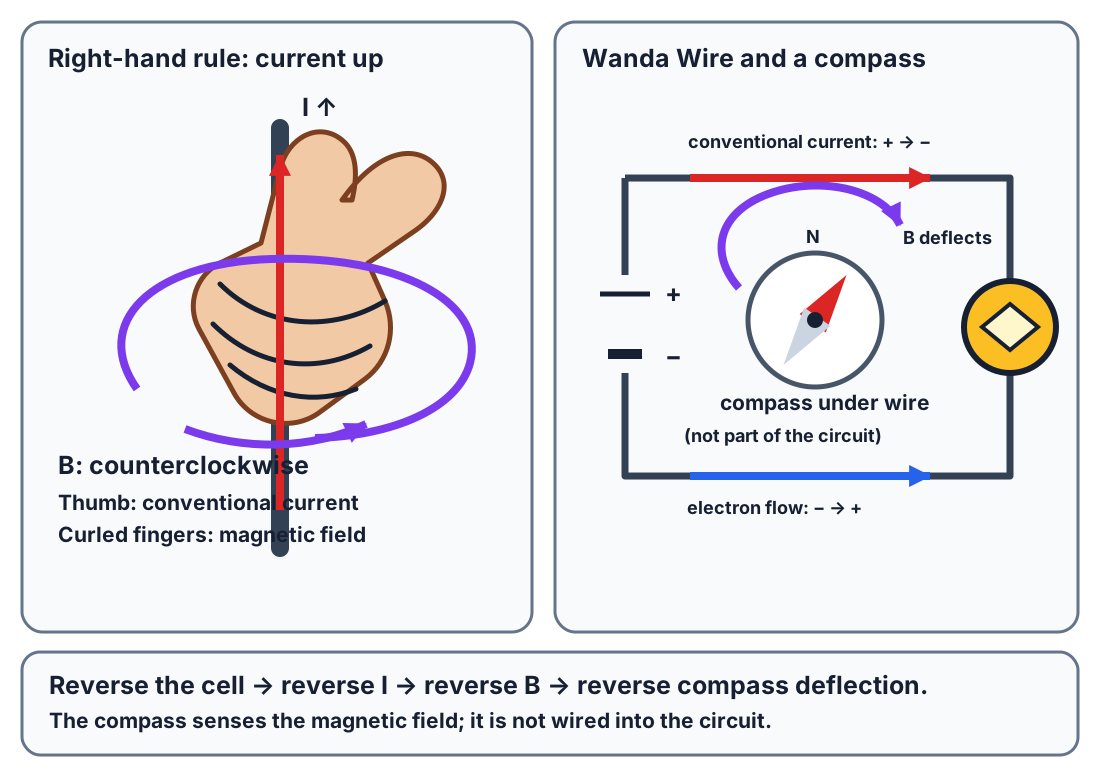
You cannot see current in a wire. A compass needle can. When charge moves through a closed circuit, it produces a magnetic field. That field, added to Earth's field, deflects the needle. Stronger current means a larger deflection. Ørsted reported this magnetic effect of current in 1820. The compass is not part of the circuit. It sits under the wire. If the switch is open, there is no charge flow and the needle does not deflect from the current.
For current upward, the right-hand rule gives a counterclockwise magnetic field. Reversing the cell reverses the current, field, and compass deflection; electron flow is opposite conventional current.
Conventional current vs electron flow
Electrons in a wire move from the negative terminal toward the positive terminal. Conventional current is the model used on schematics: positive charge leaving the battery's positive end and entering the negative end, the opposite of electron flow. Franklin's plus sign meant extra charge; his minus sign meant missing charge. In the course voltaic cell, zinc becomes negative and copper becomes positive. Reverse the battery and conventional current reverses. The compass then deflects the opposite way. The amount of motion is the same in every wire of that simple loop at one time: the needle deflects the same way around the loop.
Not sure about this bit?
Two arrows on the same wire.
1
Electrons
Negative to positive.
2
Conventional
Positive to negative. That is the arrow the right-hand rule uses.
Got it now? Scroll back up and re-read the section — it should land differently.
Right-hand rule
Point your thumb in the direction of conventional current. The fingers curled around the wire show the magnetic-field direction. Reverse the current, and the curl reverses. The course figure is a vertical arrow with a hand wrapped around it. If that picture is still unclear, look at it in Canvas. Do not invent a clockwise vs counterclockwise label the page did not give you for a particular drawing.
Ohm's law
Ohm's law
V=IR
V in volts, I in amperes, R in ohms. Also I = V/R and R = V/I.
Not sure about this bit?
Same three letters, three arrangements.
1
Find V
V = IR. Convert I to amperes first.
2
Find I
I = V/R. Larger R, smaller I at fixed V.
3
Find R
R = V/I.
Got it now? Scroll back up and re-read the section — it should land differently.
Convert milliamperes first
1. Name the unknown
Voltage, current, or resistance, with its unit.
2. Convert current to amperes
300 mA is 0.300 A. Ohm's law does not take milliamperes.
3. Rearrange, then substitute
Solve the symbol equation for the unknown. Then put the numbers in.
4. Check the inverse
At fixed voltage, double the resistance and current is cut in half. Double the voltage at fixed resistance and current doubles. A 110 V device on a 220 V outlet without a converter would draw twice the current.
Flashlight bulb
Flashlight from 04.02
Resistance.R=5.0Ω
Current.I=300mA=0.300A
Find the battery voltage.
Use Ohm's law.
V=IR
Substitute the current in amperes.
V=(0.300A)(5.0Ω)
V = 1.5 V.
Hair dryer from 04.02
Current.I=8.0A
Voltage.V=120V
Find the resistance. Then find the current if the resistance is doubled on the same 120 V line.
Rearrange Ohm's law for resistance.
R=V/I=120/8.0=15Ω
Double the resistance to 30 Ω and solve for current.
I=V/R=120/30=4.0A
R = 15 Ω. Doubling R cuts I to 4.0 A.
Why some materials are magnetic
A spinning electron is a moving charge, so it has a magnetic field. In rubber, plastic, and wood, electrons pair with opposite spins and the fields cancel. Iron, cobalt, and nickel have unpaired electrons. Random orientations give a weak field. Aligned orientations give a strong field. Electromagnetism is the joint appearance of electric and magnetic fields: moving charge induces a magnetic field, and a magnetic field can induce charge to move. The bar-magnet field interactive has no accessible text version. Use the Canvas widget if you need to see the compass array.
Genecon vs battery
A Genecon is a small hand generator. Turning the crank converts mechanical energy into electrical energy. A battery uses stored chemical energy. Faster cranking makes the bulbs brighter, like adding batteries. A stopped Genecon supplies no energy, so the bulb goes dark even if the wires still form a loop. The energy to move charge in the Genecon comes from the person turning the crank.
Traps on this lesson
mA is not A
300 mA substituted as 300 A makes the voltage 1000 times too large.
Electron flow is not conventional current
Electrons go negative to positive. Conventional current is drawn the other way. The right-hand rule uses conventional current.
Open switch, no deflection from the wire
No closed path, no current, no magnetic field from that wire. Earth's field is still there; the lesson's point is the extra deflection caused by current.
Current and Ohm practice
Convert milliamperes before using V = IR. For compass items, say what the needle is evidence of.