Module 04 — Circuits and Current · quiz worth 20 pts
The big ideaCharge moves through a closed conducting path. Like charges repel and opposite charges attract. Coulomb's law and E = F/q turn that push into numbers with units.
Charge, path, and units
Coulomb's law looks like a formula dump if the path idea is still fuzzy.
Not sure about the basics underneath this lesson?
Ask three questions: Can charge move in this material? Is the loop closed? Are the units already SI?
1
Free electrons
In a metal, some electrons are loosely held and can hop from atom to atom. That is why the bulbs light when a metal object closes the board.
2
Closed loop
Source, switch, wires, and device must join into one return path. A gap is an open circuit.
3
SI checklist
Charge in C, distance in m, force in N, field in N/C. Convert millimetres or centimetres before substituting.
4
Charges and Fields sim
If you want to drag charges and watch field arrows, open PhET Charges and Fields. It is extra practice, not the Canvas quiz. The unlabeled Canvas animation still belongs in Canvas.
Watch someone else explain it
Coulomb's Law of Electric Force — Watch if the 1/d² dependence is still fuzzy. Then come back and work the cereal and coins examples on paper.
Got it now? Scroll back up and re-read the section — it should land differently.
Conductors and insulators
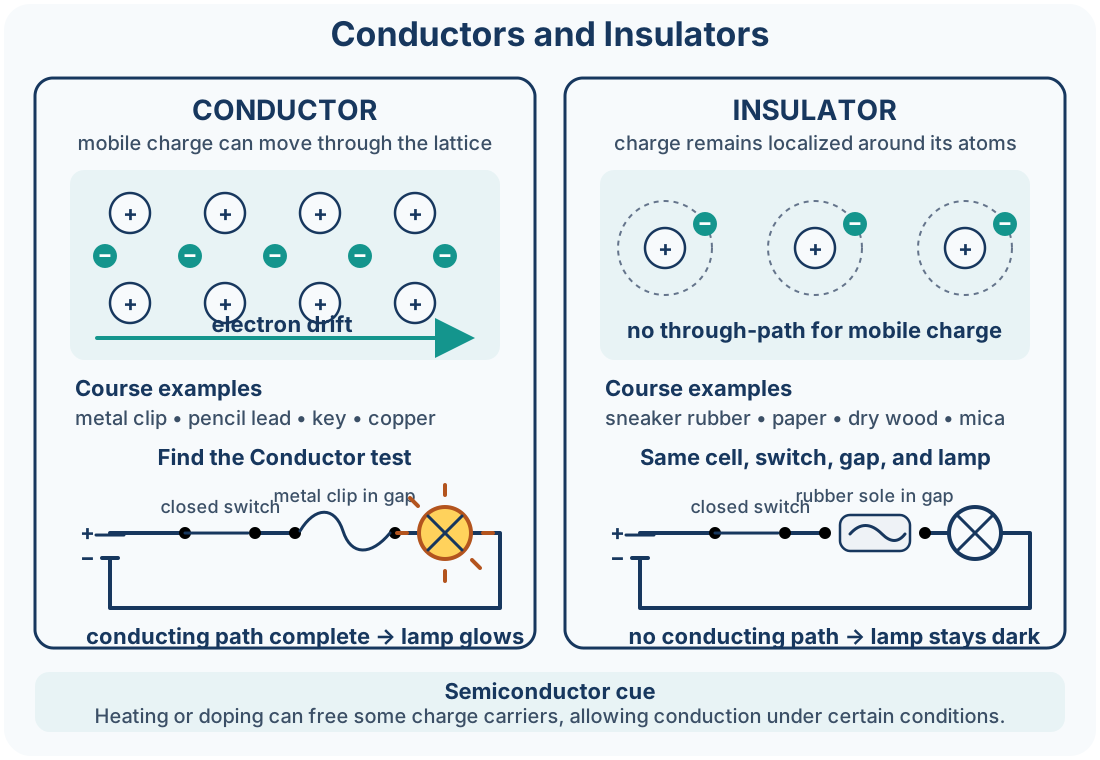
A conductor lets charged particles move through it. Metals and ionic solutions work this way because they have free electrons (or mobile ions). Copper wiring is a conductor. Silver, aluminum, and iron are conductors too. The human body also conducts, though it sits between excellent metals and strong insulators. An insulator resists that motion because its electrons stay tightly held. Rubber, paper, dry wood, and mica are insulators. They coat wires and make electrical gloves so charge stays on the intended path. Semiconductors conduct only under certain conditions, such as heating or doping. The course's Find the Conductor activity is the place to test household objects on a circuit board. If the bulbs light, the object completed a conducting path.
A metal clip provides a mobile-charge path, so the lamp glows. Rubber does not. Heating or doping can free some carriers in a semiconductor.
A circuit is a closed loop
The course defines a circuit as any unbroken loop of electrical components that forms a continuous conducting path. Charge follows that loop. If the path is broken, charge goes nowhere. Picture a race track with a washed-out section: the cars stop until the track is closed again. Building a working circuit means placing a source, a closed switch, conductors, and the device you want to run so they form one complete loop. In a single closed loop, the bulbs light together when the switch closes. They do not wait for charge to 'reach' the last bulb first.
How a bulb conducts
A bulb lights only if charge has a conducting path through the filament. The filament is a conductor. The glass and the black ring at the base are insulators. The tip and the threaded metal section are conductors. If a Canvas drawing is unlabeled, open that figure rather than guessing a contact rule this page does not have.
Like charges repel, opposite charges attract
Electric charge is a property of matter that makes a particle feel a force at a distance from other charged particles. Opposite charges move toward one another. Like charges move apart: two negatives repel, and two positives do the same. Field lines are a drawing of that push and pull. The course animation of positive and negative charges has no accessible text version, so if the motion is unclear, open the widget in Canvas rather than guessing what it showed.
Coulomb's law
Coulomb force
Fe=d2kq1q2
Force in newtons. Each charge in coulombs. Distance in meters. k = 8.99 × 10⁹ N·m²/C².
Not sure about this bit?
Product on top, distance squared on the bottom.
1
Larger charges
Double one charge, double the force. Double both, quadruple it.
2
Larger gap
Double the distance, the force falls to one fourth.
3
Sign
This course: positive q₁q₂ product means repulsion. Opposite signs attract.
Got it now? Scroll back up and re-read the section — it should land differently.
Rearrange before you substitute
1. Name the unknown
Write F, q, or d and its unit. Coulomb's law is for charged particles that are small compared with the distance between them. The force acts along the line joining them.
2. Convert units
Distance must be meters, not centimeters. Charge must be coulombs. A 1 C charge is a large amount: about 6.25 × 10¹⁸ electrons, on the order of the charge that passes through a 100-watt bulb in a little more than a second.
3. Substitute with grouping symbols
Keep k, both charges, and d² grouped. These calculations are messy powers of ten. Square the distance in the denominator.
4. Read the sign as direction, not extra algebra
This course reads a positive q₁q₂ product as repulsion. Like charges (both plus or both minus) give a positive force and push apart. Opposite charges give a negative product and attract. Do not turn that into vector unit-vector form.
Cereal-charge example
Two puffed-rice pieces from 04.01
Charge on each piece.q1=q2=1.85×10⁻¹⁸C
Separation.d=0.025m
Coulomb constant.k=8.99×10⁹N⋅m2/C2
Find the electrostatic force between them.
Write Coulomb's law.
Fe=d2kq1q2
Substitute the grouped values.
Fe=(0.025)2(8.99×10⁹)(1.85×10⁻¹⁸)(1.85×10⁻¹⁸)
Fₑ = 4.9 × 10⁻²³ N. Both charges have the same sign in the product, so the course reads this as repulsion.
Two coins from 04.01 practice
Force.F=2.0N
Separation.d=1.35m
Identical charges.q1=q2=q
Find the charge on each coin. Is the force attraction or repulsion?
Coulomb's law with equal charges.
F=d2kq2
Solve for q².
q2=kFd2=8.99×10⁹(2.0)(1.35)2
Take the square root.
q=2.0×10⁻⁵C
q = 2.0 × 10⁻⁵ C on each coin. F is positive, so this course classifies the force as repulsion. Both charges are plus, or both are minus.
Electric field is force per charge
Electric field
E=qF
E in N/C. Direction matches the force on a positive test charge. Rearrange to F = Eq when force is the unknown.
Not sure about this bit?
Field is how hard the location pushes, per coulomb of test charge.
1
Divide
E = F/q. Same force on a smaller charge means a stronger field.
2
Negative q
F = Eq. A negative charge gets a force opposite the field arrow.
Got it now? Scroll back up and re-read the section — it should land differently.
Lint in the dryer
Electric field from 04.01 practice
Force.F=3.0×10⁻⁹N
Charge.q=1.25×10⁻¹⁹C
Find the electric-field magnitude at that location.
Field is force per charge.
E=qF
Divide.
E=1.25×10−193.0×10⁻⁹
E = 2.4 × 10¹⁰ N/C. This source problem asks for magnitude only.
Negative test charge in a south field, from 04.01 practice
Electric field, due south.E=2.8×10⁴N/C
Charge.q=−4.0×10⁻⁶C
Find the electrostatic force on this charge.
Rearrange to F = Eq. Keep the sign of q.
F=Eq
Substitute.
F=(2.8×10⁴)(−4.0×10⁻⁶)
F = −0.11 N. The negative sign means the force is opposite the field, so north, not south.
Traps on this lesson
Human body is not an insulator
The course places the body between excellent metals and strong insulators. Do not call it a non-conductor.
Distance is meters, and it is squared
Leaving d in centimeters, or forgetting to square it, throws the force off by powers of ten.
Field direction follows a positive test charge
A negative charge feels force opposite the field direction. F = Eq keeps the sign of q.
Closed-path practice
Work the calculations on paper with units. For circuit items, ask whether the conducting path is actually closed.