Module 03 — Coordination and Control · quiz worth 36 pts · 2026-10-27
The big ideaEndocrine glands release hormones into blood to coordinate target tissues; neural, hormonal, and humoral control plus feedback keep hormone levels within useful ranges.
Trace every hormone claim through four links
A gland list becomes useful when it explains a regulated body change.
Not sure about the basics underneath this lesson?
1
Trigger
What neural signal, hormone, or blood variable starts secretion?
2
Gland and hormone
Which gland releases which chemical messenger?
3
Target
Which cells can respond because they have the receptor?
4
Effect and feedback
What changes, and how does the response limit or continue the signal?
Quick check — answer out loud before you peek
High blood glucose directly stimulates pancreatic insulin release. Which control mechanism?
Humoral control.
Got it now? Scroll back up and re-read the section — it should land differently.
Hormones act only where receptors can receive them
Endocrine glands release hormones into the bloodstream. Blood distributes a hormone widely, but only target cells with the appropriate receptors respond. Endocrine responses are often slower and longer-lasting than neural signals. The hypothalamus links the two systems by integrating neural information and regulating pituitary output.
Brain and neck glands regulate major rhythms
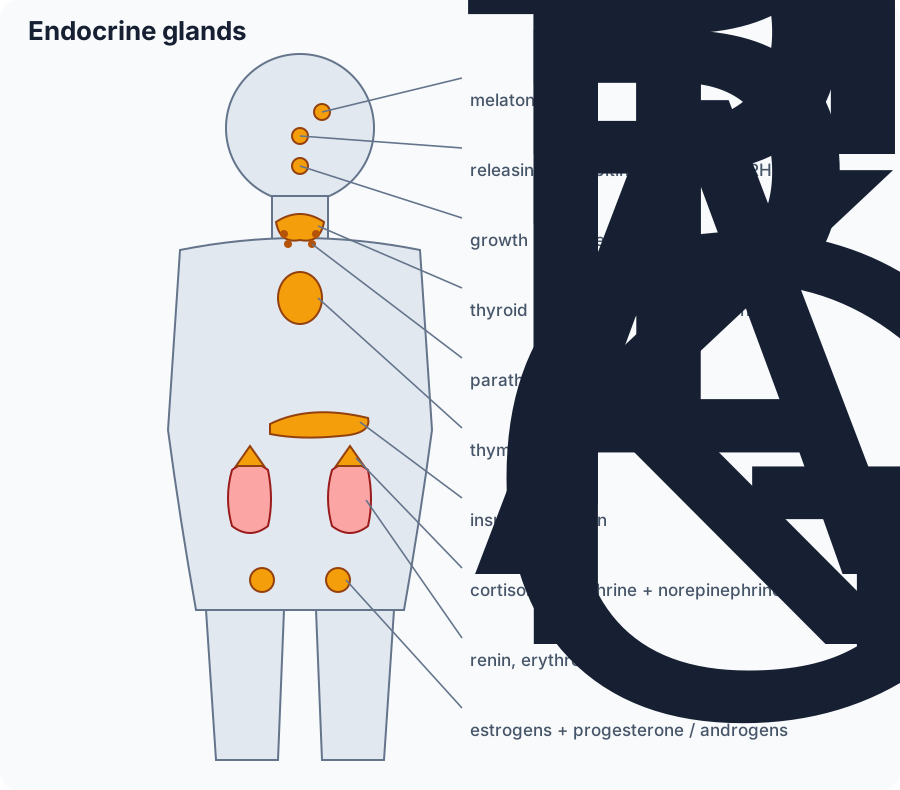
The hypothalamus uses releasing and inhibiting hormones to control the pituitary. The pituitary releases growth hormone (bone and muscle growth), endorphins (reduce pain perception), and hormones that control other glands, such as TSH. The pineal gland releases melatonin for rhythms like sleep. The thyroid releases thyroid hormone (T3 and T4) for development, growth, and metabolism, plus calcitonin, which lowers blood calcium; the parathyroids on the back of the thyroid release parathyroid hormone, which raises it.
The lesson's main glands with one or more representative hormones each.
Body glands regulate fuel, stress, blood, immunity, and reproduction
The pancreas releases insulin to lower blood glucose and glucagon to raise it. The adrenal cortex releases cortisol, which raises blood sugar in times of stress; the adrenal medulla releases epinephrine and norepinephrine for fight or flight. The kidneys produce renin, which helps regulate blood pressure, and erythropoietin, which stimulates red-blood-cell production. The thymus produces thymosin, which activates lymphocytes. The gonads produce sex hormones: ovaries make estrogens and progesterone; testes make androgens such as testosterone.
Three mechanisms can trigger endocrine output
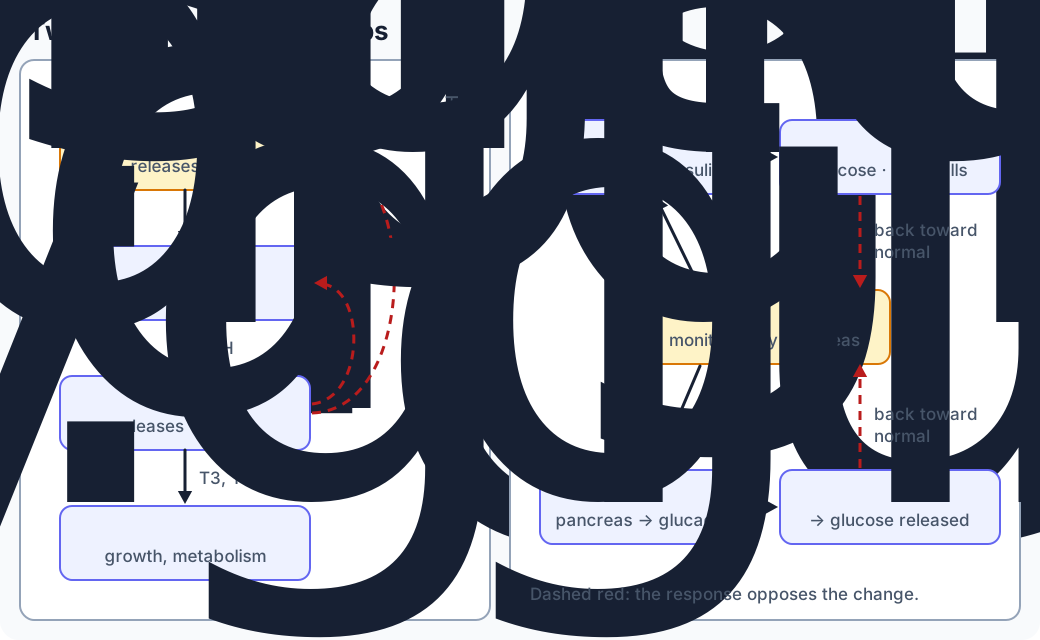
Neural control begins with a nerve signal, such as sympathetic stimulation of adrenal output. Hormonal control occurs when one hormone stimulates another gland, as in hypothalamus → pituitary → thyroid. Humoral control responds directly to a blood substance, such as pancreatic cells responding to blood glucose.
Negative feedback limits a response
In the thyroid axis, hypothalamic TRH stimulates pituitary TSH, and TSH stimulates thyroid T3 and T4 release. Rising thyroid-hormone levels reduce further TRH and TSH release. The response opposes the original drive, helping keep the regulated variable within a range rather than forcing one unchanging value.
Hormonal control (thyroid axis) and humoral control (blood glucose), each limited by negative feedback.
Disorders reveal the control chain
An endocrine disorder is a disruption that causes a hormone imbalance. In hyperthyroidism, too much T3 and T4 can make the heart beat too fast and cause high metabolism, anxiousness, and increased eye pressure; in hypothyroidism, too little can cause low metabolism, weight gain, hair loss, joint pain, depression, and a goiter. The lesson lists heredity, autoimmune responses, or pituitary problems as causes. Diabetes means the body does not make enough insulin or does not use it effectively, so blood glucose is poorly regulated; high glucose strains the kidneys and can cause nerve and vision problems, and too little glucose can cause lethargy, organ damage, coma, and death.
Build the assigned presentation
The worksheet's research (Part 1) asks you to choose an endocrine disorder (it does not have to be one from the lesson) and find its symptoms, the gland or glands involved, its impacts on the body and why they happen, and treatment or prevention. The presentation (Part 2) must include: the disorder with the glands and hormones involved; short-term and long-term impacts; causes; prevention or treatment; citations, with all research restated in your own words; and visuals of the processes (cited images or your own drawings).
Likely on the quizOutside research is expected for the disorder itself and must be cited. Make each claim trace gland → hormone → target → body effect.
Not sure about this bit?
Use the worksheet as a completeness check, not as the submitted artifact.
1
Research the chain
Disorder, gland, hormone, target, symptoms, impacts, causes, and care, cited and in your own words.
2
Show the process
Add visuals of the processes: cited images or your own drawings.
Got it now? Scroll back up and re-read the section — it should land differently.
Answer the four lesson connections from the lesson
The four lesson-connection questions are: why endocrine disorders are often hard to diagnose; one reason they are important to understand; how a disorder appearing at different ages would affect a person differently, with one example; and which gland you find most influential in homeostasis, and why. Answer them using what you learned in this lesson. The rubric puts an answer built from outside sources instead of lesson resources in its lowest band. The worksheet lets you add these answers at the end of your presentation or in the submission comment box.
Likely on the quizLesson facts to draw on: hormones travel more slowly, through the blood; all three control mechanisms need every step to work; the lesson lists heredity, autoimmune responses, and pituitary problems as causes of thyroid disorders; the hypothalamus links the nervous and endocrine systems.
Not sure about this bit?
This row is graded on lesson resources, not outside research.
1
Use lesson ideas
Mechanisms (neural, hormonal, humoral), feedback, the hypothalamus link, the glands and hormones.
2
Answer all four
Diagnosis difficulty, importance, an age-based example, and the most influential gland with a reason.
3
Place them
At the end of the presentation or in the submission comment box.
Got it now? Scroll back up and re-read the section — it should land differently.
Submit the presentation, not the worksheet
Make the presentation in any format: slides, video, cartoon strip, and so on. A video needs a typed script. Upload only the finished presentation in the course (36 points; the course allows two attempts), not the worksheet and not the portal practice.
Research (Part 1). 12 points (Skilled): Detailed, accurate research with thorough details and citations; Lowest band: 6–0: lacks citations; little information on the disorder
Present (Part 2). 12 points (Skilled): Well organized and supported; thorough explanations of the disorder; Lowest band: 6–0: minimally organized; missing explanations
Lesson Connections. 12 points (Skilled): Accurate answers using critical thinking, reasoning, and lesson resources; Lowest band: 3–0: most answers inaccurate, or outside sources used instead of lesson resources
Not sure about this bit?
The local directions make the deliverable explicit.
1
Choose a format
Slides, video, cartoon strip, or another clear format; a video requires a typed script.
2
Keep the worksheet
Use it for research and planning.
3
Upload one deliverable
Submit the finished presentation in the course: 36 points, two attempts.
Got it now? Scroll back up and re-read the section — it should land differently.
Practice the control system
Choose the gland, hormone effect, or control mechanism justified by the evidence. Some questions use a numbered gland map.