The big idea Use construction rules to evaluate three diagrams, then make and compare a construction of your own.
Pick a lane
This 20-point activity has two versions. Submit only one.
- Independent: answer the three evaluate questions, construct a segment or angle and bisect it, then compare that bisect with the other kind.
- Partner: answer the same three questions, trade a segment and angle, then both copy or both bisect them and compare the two constructions.
If you choose the partner version, follow Canvas's collaboration directions and submit its Collaboration Component form. Print or keep the Canvas directions open; this page is coaching, not the dropbox.
Question 1: which bisector is legal
A legal angle bisector has three clues:
- An arc from the vertex cuts both rays.
- Two equal-width inner arcs start at those two hits, not at the vertex again.
- A ray runs from the vertex through the inner crossing.
In the broken construction, the second arc came from the vertex again and the width changed. Name the first broken step in construction language; do not rely only on how the final ray looks.
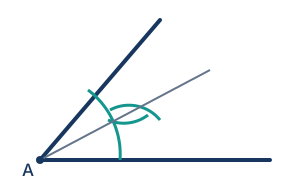
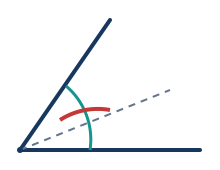
Question 2: which student has the order
Given line AB and point C off the line, construct a parallel through C by copying an angle.
- Draw transversal BC.
- From B, swing an arc through AB and BC; mark D and E.
- Keep that width and swing the matching arc from C; mark F.
- Open the compass to chord DE.
- From F, cut the new arc at G.
- Draw line CG.
To find the scrambled list, look for its first impossible reference. You cannot open to DE before D and E exist, or draw CG before G exists.
Question 3: name the inscribed polygon
A circle with two perpendicular diameters is a square in progress. One diameter is being used to construct the other as its perpendicular bisector. Connect the four circle hits to finish the square.
A hexagon or equilateral triangle would instead show six equal radius-width ticks around the rim. Connecting all six makes the hexagon; connecting every other tick makes the triangle.
Explain the diagram using its evidence: two perpendicular-looking diameters plus arcs from the endpoints of one diameter.
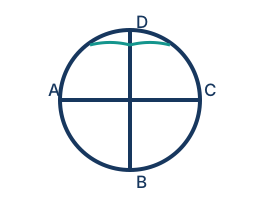
Your own construction
For the independent version, construct a segment or angle, bisect it, then compare it with the other kind. For the partner version, both people copy or both people bisect; do not mix the operations.
- Both use a compass and straightedge and depend on fixed widths.
- Copying a segment uses the segment's width and one arc on a new ray.
- Copying an angle uses a vertex-arc radius and then its chord.
- Bisecting a segment uses equal arcs from both endpoints and produces a perpendicular line.
- Bisecting an angle uses a vertex arc, equal inner arcs from its hits, and a ray through their crossing.
Paper compass work or a dynamic geometry program is allowed. A freehand paint program is not.
What to turn in
- Answers to all three evaluate questions, including the reason for each choice.
- Your construction image or export and the comparison paragraph. The partner version includes both constructions.
- The written portion in a document or the Canvas response box, as directed.
- For the partner version, the required collaboration form and assignment.
Open the matching rubric in Canvas before submitting. This portal does not score or submit the activity.